The Wuben X1 Pro was released a few weeks ago. It is available in black and white at an MSRP of $119.99.
Transparency note: I received the X1 Pro as a pre-production sample from Wuben free of charge for this review. The only requirement was to publish a review. The manufacturer did not influence the review in any way.
Packaging
My sample was delivered in a simple gray-blue cardboard box. The retail version comes in a white-blue cardboard box with the key features and specifications of the lamp printed on it.

A simple instruction manual was included.
Note: the series version differs from the version shown here in a few respects, including the battery compartment lock, the rubber plug for the USB port, and the reflectors, which, according to Wuben, are supposed to deliver better performance (higher brightness) in the series version.
Design

As with the Wuben X4, the design is rather “industrial-futuristic,” with many corners and edges. These do not feel sharp and do not interfere with handling. The white lamp body consists of two parts: one for the battery compartment and one for the lamp head, on which a black part for the LED heat sink is located. There is an attachment for the switch and USB port. The bezel and battery cover on the underside are black, which provides a good contrast.
The built-in fan can be replaced. To do this, four screws (TX6/Hex 1.5) must be loosened. The question of spare parts availability in a few years’ time arises, as this is not a standard fan.
The OP reflectors are protected by AR coated front glass.
The angular design provides roll-away protection and tail stand without any problems.

The X4 has several controls. There is a button on the lamp head and a selector switch for the light mode on the side. This can be used to switch from floodlight to high beam.
The side switch clicks into place cleanly. I can easily hold the lamp with the button facing up and operate the slide switch with my thumb.
Battery and charging

Two protected button-top 21700 batteries are included. These measure 74.7 x 21.5 mm. The 21700 batteries are rated at 4800 mAh each. In the discharge test (1 A in the Vapcell S4+ v2.0), 4989 and 5104 mAh could be extracted from the battery, respectively.
According to the imprint on the battery cover, the two 21700 batteries are connected in series (2S), resulting in 7.4 V.
Due to the length of the supplied 21700 batteries, unprotected 21700 batteries cannot be used as they will not make contact due to their reduced length. If spare batteries are carried, they must be the same length as the original batteries supplied, which is why the use of protected cells is recommended.

The cover at the rear is opened by pressing the lever on the side. The silver switch on the lever locks the flap so that it cannot be opened accidentally during normal handling.

The 21700 is charged with 1.36 A and 27.7 W (PD).
During charging, the LED in the side switch lights up red; when fully charged, it lights up blue. Although the red-blue color scheme is suitable for people with color blindness, it is not very intuitive, especially for new users.
During charging, the two lowest light levels can be used. The rubber flap protecting the USB port does not seem very stable and is difficult to close again.
The lamp offers a power bank function. This charges smartphones or other flashlights without any problems, which worked perfectly in the test. However, there is no fast charging here; it only charges at a maximum of 3 A at 5 V.
UI
Operation is kept simple.
The slide switch can be used to set the light mode: flood, both, throw. The following operation applies equally to all light modes.
- 1C from OFF: Mode memory, last used light level
- 1H from OFF: Lowest light level
- 1C from ON: OFF
- 1H from ON: Cycle through light levels (Eco, Low, Mid, High)
- 2C from ON: Turbo (can be turned off with 1C and exited with 1H or 2C)
- 3C from OFF: Strobe
- 4C from OFF: Lockout (can only be exited with 4C)
- 5C or more from OFF: Fan on/off (runs for max. 5 min)
The lowest light level is too bright in completely dark environments and causes self-glare. This should be corrected in future lamps; 0.5-1 lumens would be much better here.
LEDs and spectrum
The main LEDs are 1x Cree XHP50.3 HI (Throw) and 4x Cree XHP50.3 HD. According to Wuben, these have a forward voltage of 6V.
The LEDs should be relatively easy to replace, as the bezel can be easily removed after loosening the four screws (TX 6/Hex 1.5).


Both light modes offer low color rendering. Both LEDs are cool white, with the duv slightly above the BBL at over 0.002, although the tint is just fine for outdoor usage.
Measurements
There is PWM on the two lowest levels, but this may only be visible in the lowest light level under certain circumstances.
Battery: supplied 21700 (2x Wuben ABD4800), charged in Vapcell S4+ (1500 mA)
Throw LED
Eco = 6 lm @ 81 lx
Low = 161 lm @ 1600 lx
Mid = 381 lm @ 3850 lx
High = 939 lm @ 9350 lx
Turbo (100%) = 2331 lm @ 23800 lx
Flood LED
Eco = 9 lm @ 19 lx
Low = 180 lm @ 330 lx
Mid = 437 lm @ 790 lx
High = 1520 lm @ 2720 lx
Turbo (100%) = 7614 lm @ 15060 lx
Both LEDs (Mix)
Eco = 17 lm @ 100 lx
Low = 204 lm @ 1930 lx
Mid = 818 lm @ 4710 lx
High = 2452 lm @ 12250 lx
Turbo (100 %) = 9000 lm @ 38200 lx
The specified 13000 lm for flood and high beam combined is not achieved, even immediately after switching on.
The fan switches on after about 15 seconds (after cold start and turbo with both LEDs) and is temperature-controlled, producing a clearly audible noise. There is only one speed. The airflow is weak. Either the fan generates little pressure or the airflow needs to be optimized internally. An adjustable fan speed depending on the temperature would have been good, also to extend battery life and, above all, to keep noise pollution to a minimum.
Beamshots
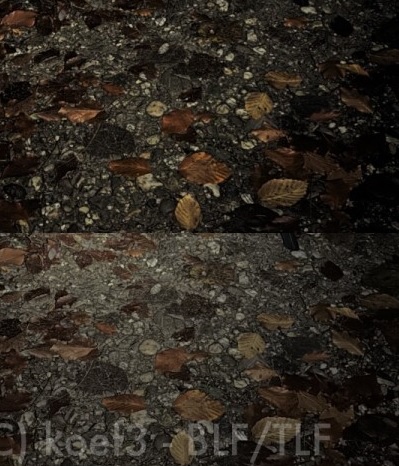
The beam is very balanced when all LEDs are used and is a good all-rounder.
The high beam mode offers more throw, but it is still far from being a pure thrower.
The floodlight mode is ideal for close range.

flood

mix

throw

flood

mix

throw
Conclusion
The Wuben X1 Pro is basically the larger version of the X4 already shown. It offers much more power, a significantly larger battery, and has a balanced beam.
The design is well proportioned and the switches are easy to operate despite the angular design. The UI is much more intuitive and simpler than was the case with the X4.
There is room for improvement in terms of the fan, the light levels/mode spacings, and the LED selection, although this is always a matter of taste.
Advantages:
- Good overall quality
- USB-C charging function with integrated power bank
- Battery included, 21700 replaceable without any tools
- Simple UI
- Good beam
Neutral:
- Barely visible PWM (low only)
- Slight green tint
Disadvantages
- Loud fan with only one operating level
- Only protected 21700 can be used
- No real moonlight, lowest level very bright
- 13000 lm max light flux not reached
- No selectable LED options, only cool white low CRI available
Thanks for reading!