For Christmas I received a small surprise package from Wurkkos containing several lights and some fan merchandise. Included was this Wurkkos HD02 with a personal engraving.
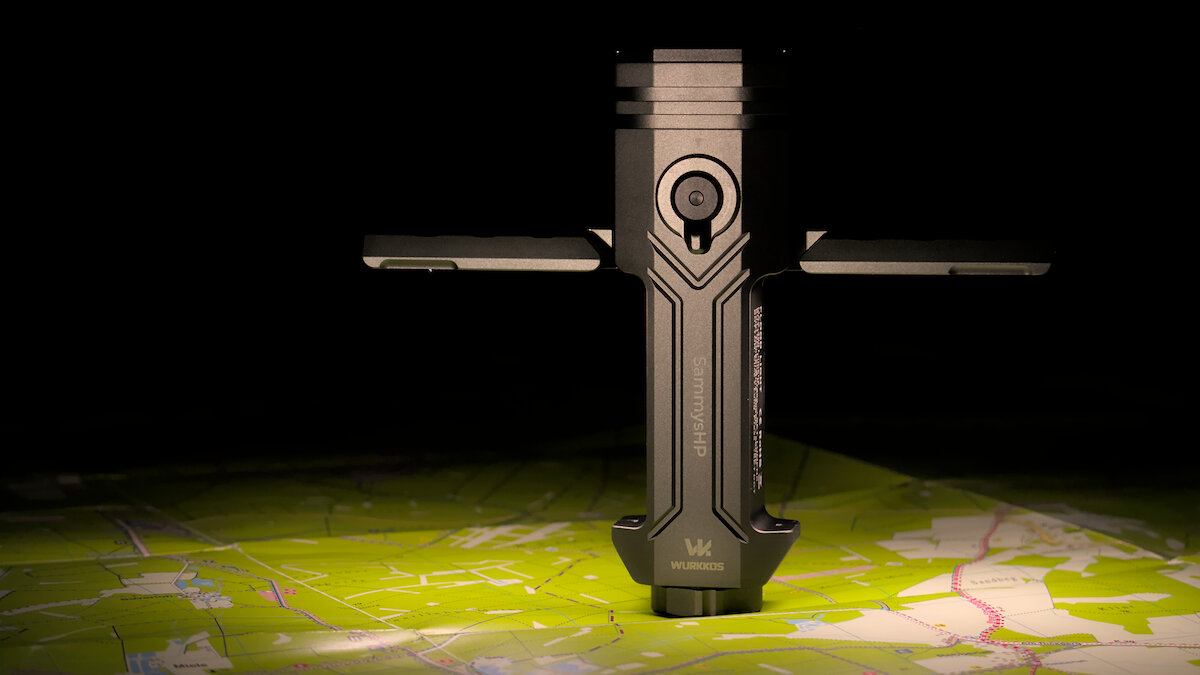
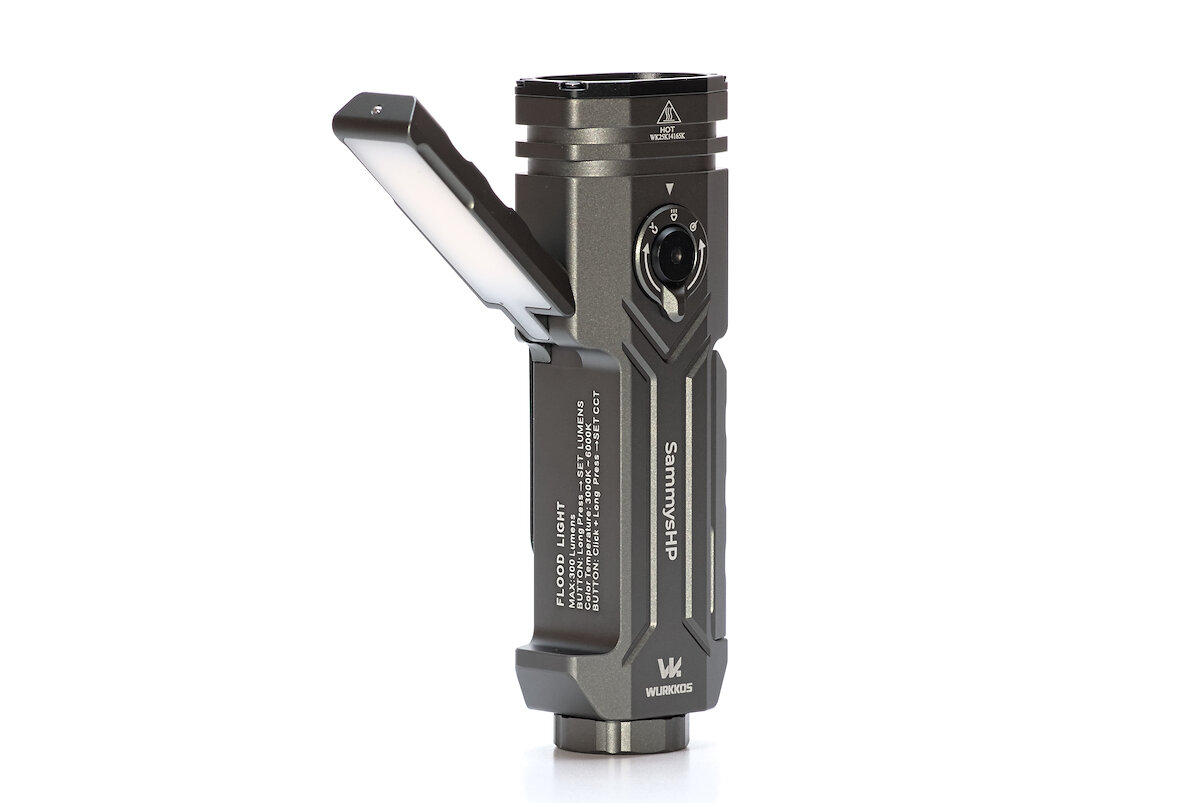
Highlight of this flashlight is its two wings that can fold out and provide a wide floodlight – even with adjustable color temperature! In addition, the flashlight features a powerful spotlight, a UV light and a green laser.
You can find the German version of this review on my website: SammysHP Blog › Wurkkos HD02
The flashlight was provided by the manufacturer for this review. Thank you very much!
Overview
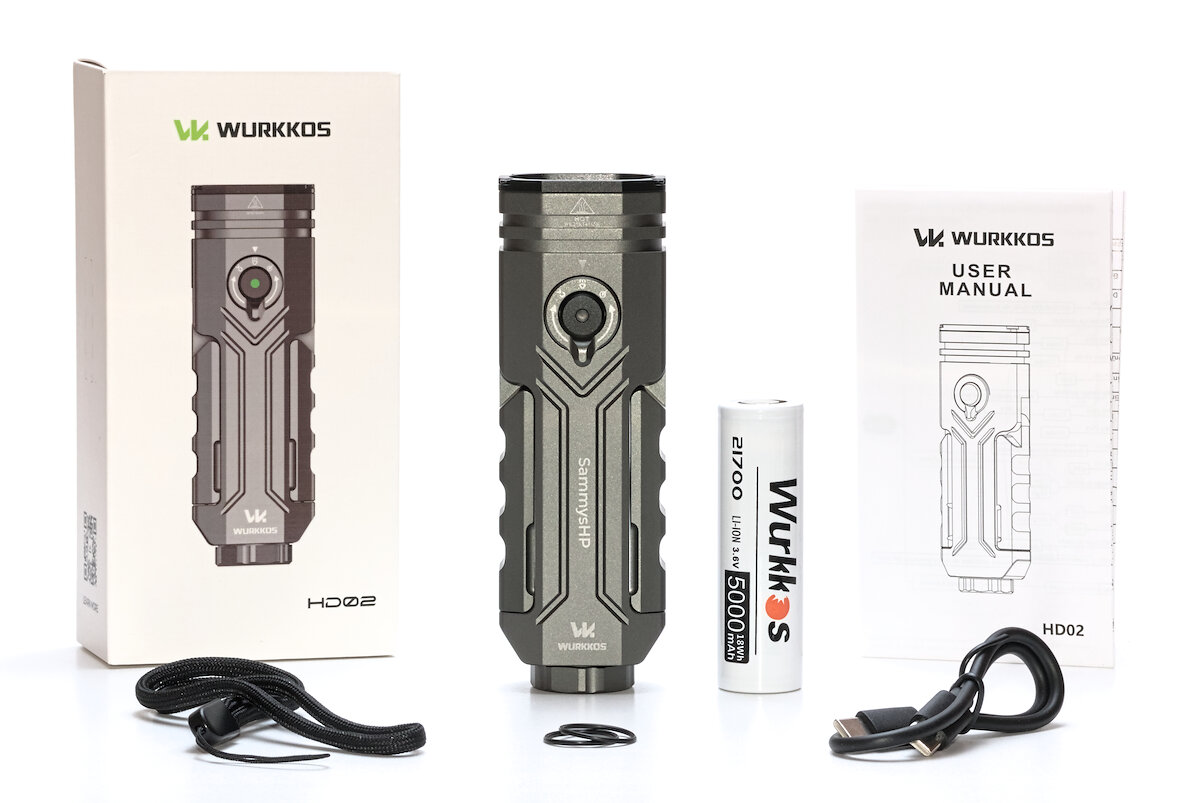
Within the last year Wurkkos changed the design of the packaging. Whereas the lights previously came in a box with a magnetic closure and a foam insert, they are now delivered in a typical retail packaging with a vacuum-formed insert.
- Wurkkos 21700 Li-ion battery (5000 mAh, 3.81 V at arrival)
- Lanyard
- USB-C charging cable
- 2x replacement o-ring
- Manual (EN, CN, FR, DE, IT, ES, JP, RU)
The manual includes a table with the specifications as well as a flowchart explaining how to operate the light. No further information is provided.
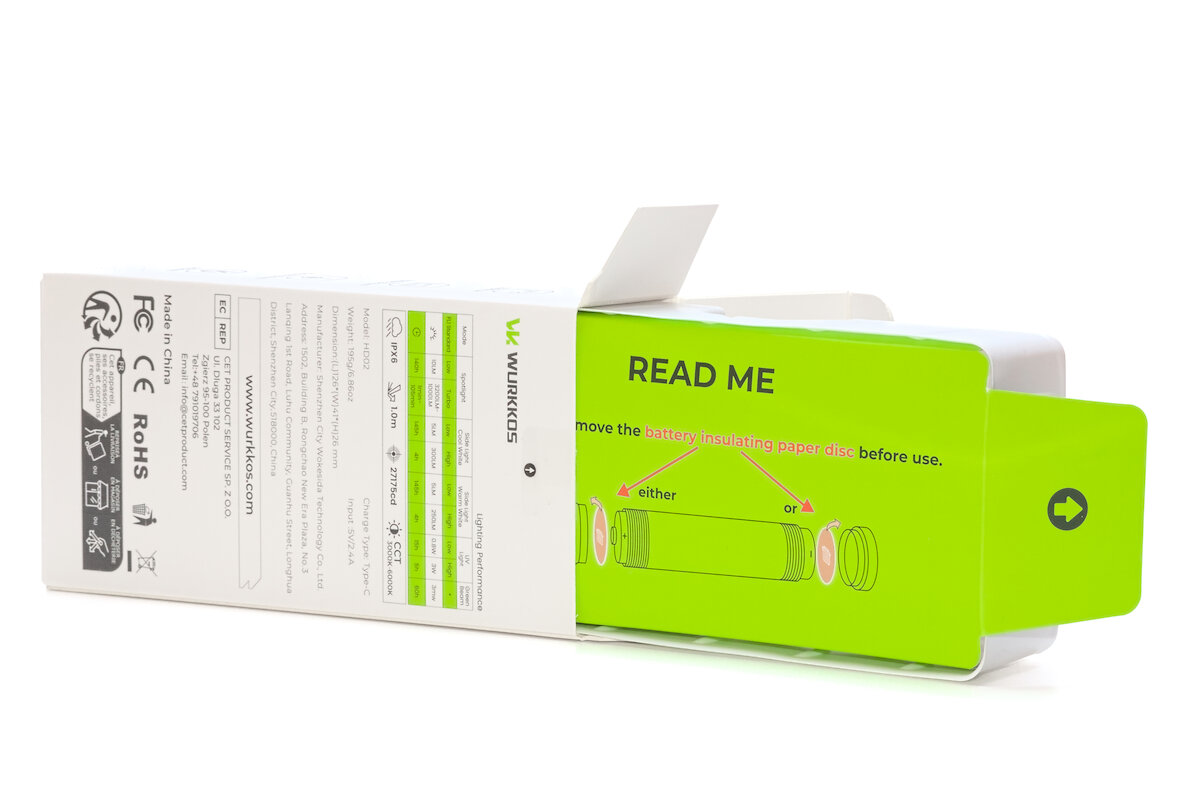
Before using it for the first time, a transport protection must be removed from the battery. In the past, there was a small tag attached to the light with a corresponding note. Apparently, there were frequent complaints about lights not working, because the notice is now much larger. At the same time, a pull tab makes it easier to remove the insert.
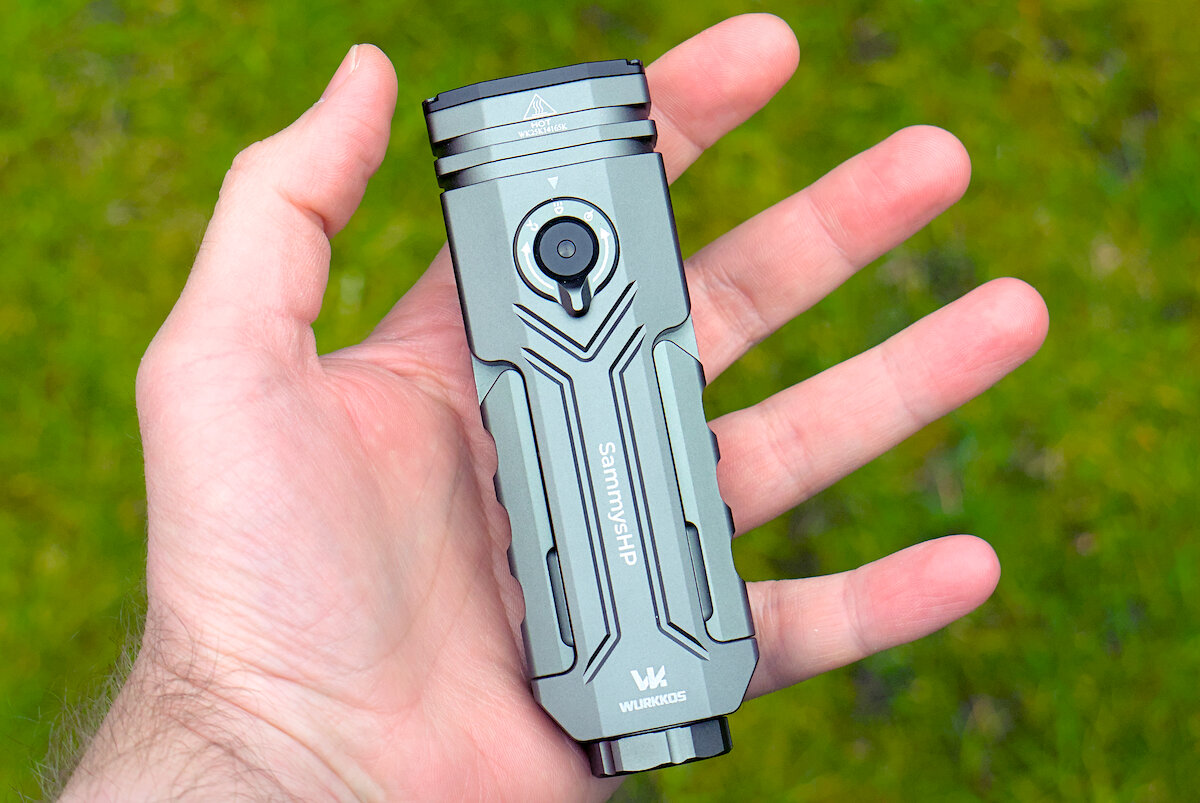
The appearance of the HD02 is unusual. At first glance, it gives the impression of being a “flat” light, like those that have become popular recently. However, the HD02 uses a standard round 21700 Li-ion battery and the tailcap is round as well.
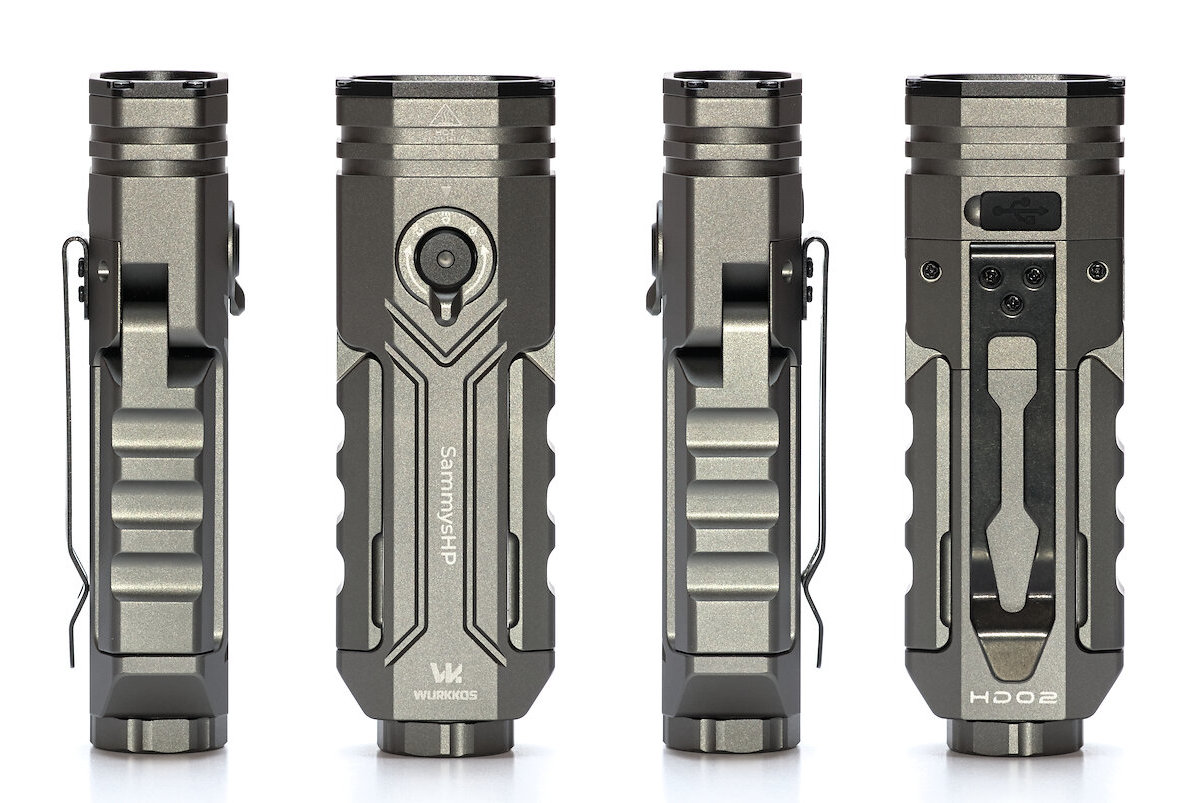
Its width of 41 mm is mainly due to the two LEDs positioned side by side and the fold-out wings. The serrated grooves and octagonal shape give the HD02 a futuristic, modern design.
Length: 126.0 mm
Width: 41.0 mm
Height: 26.0 mm
Height (with clip): 34.0 mm
Weight (without battery): 188 g
Weight (21700 battery): 65 g
Weight (total): 253 g
For a light with a single 21700 battery, the HD02 is relatively large and heavy. Given the features it offers, though, that’s likely an acceptable trade-off.
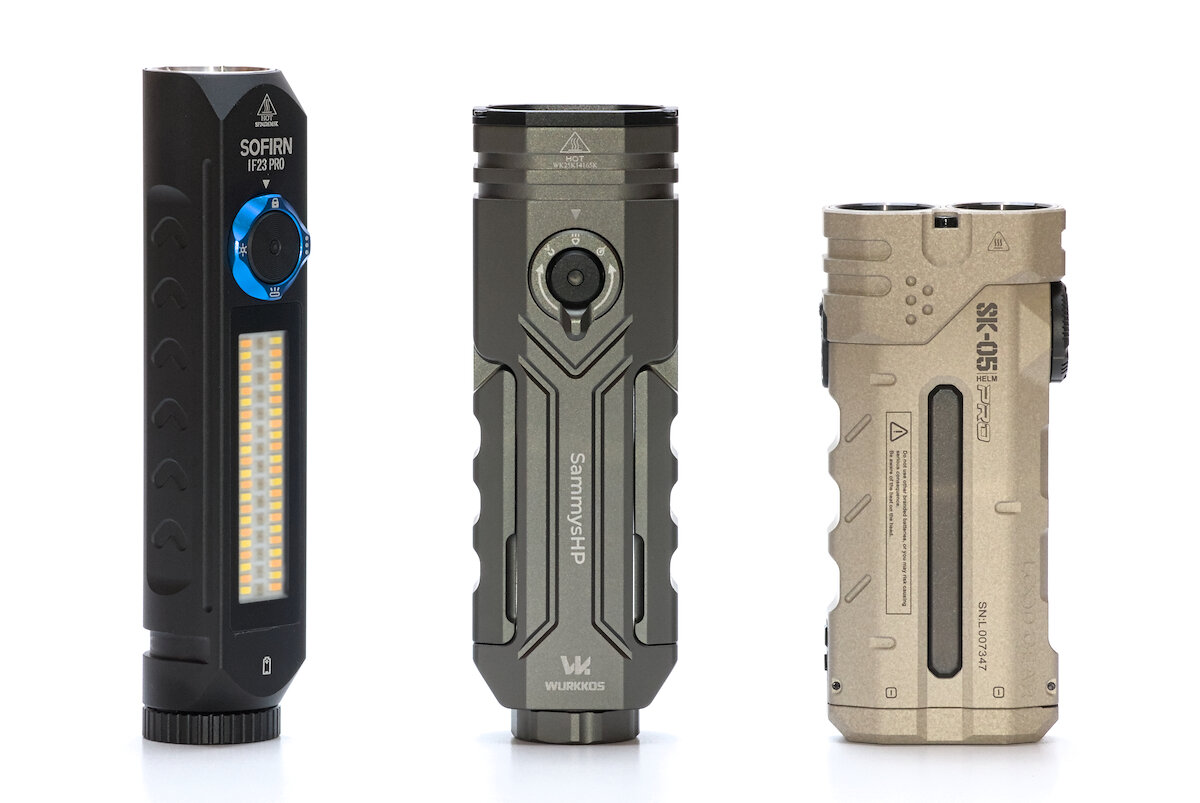
Sofirn IF23 Pro | Wurkkos HD02 | Loop Gear SK05 Pro
The body of the light is made of gray anodized aluminum. The black front bezel is secured with four screws.
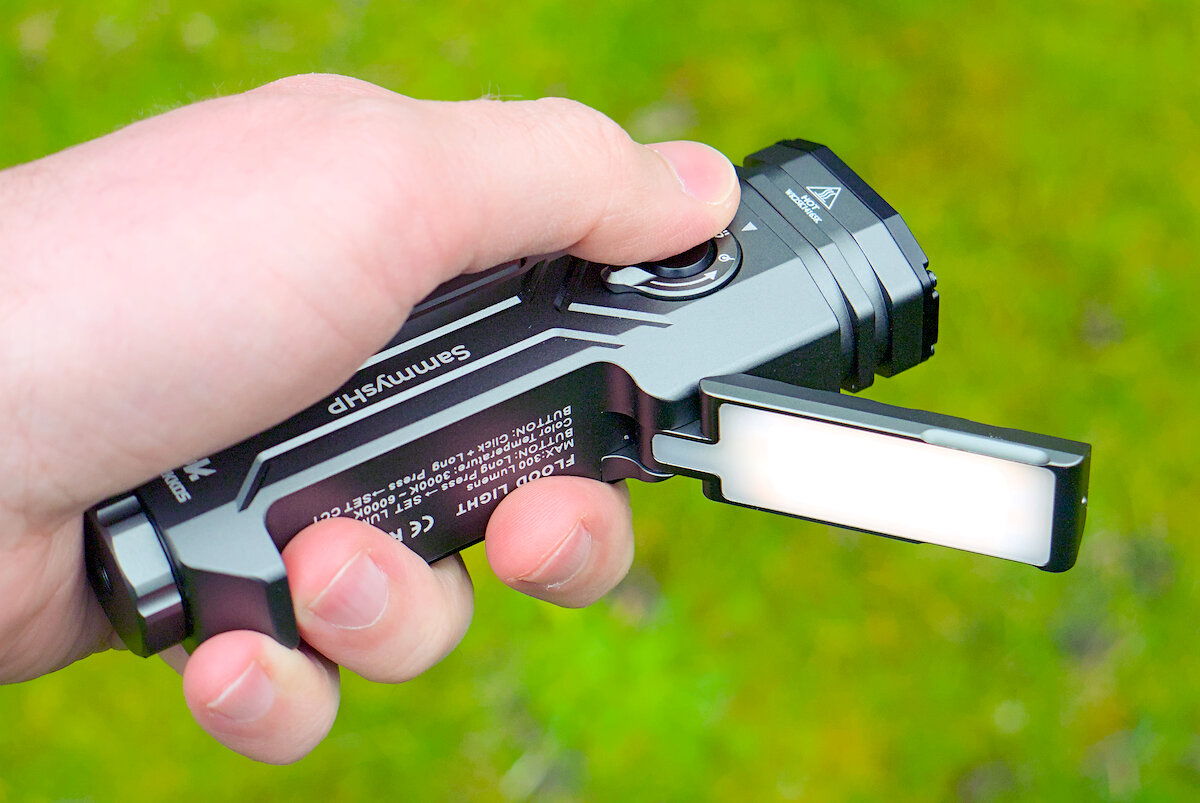
On both sides, a wing for the floodlight can be folded out to an angle of up to 135°. This allows the light to be adapted to many situations. Unfortunately, the wings cannot be rotated. The hinges move smoothly and likely use o-rings to seal against water and dampen the movement at the same time.
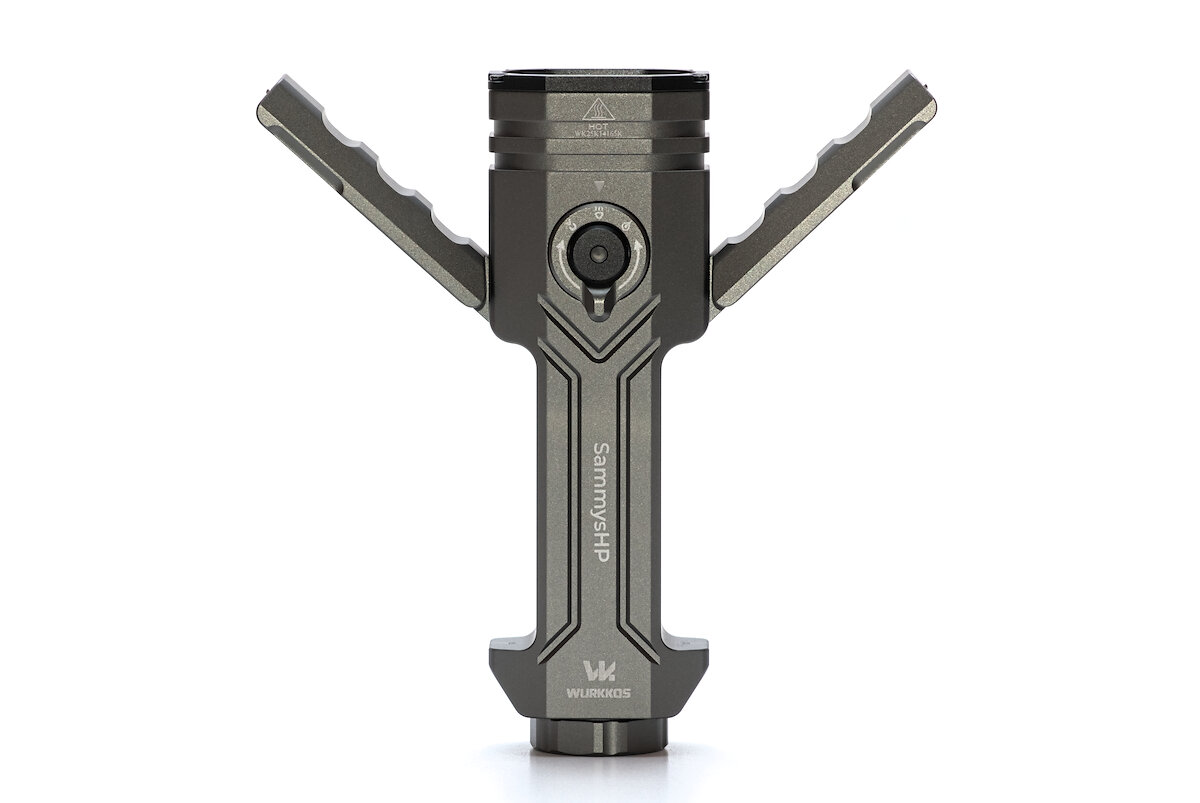
When closed, the wings are held in place by a small ball detent. Still, they can rattle slightly if the light is bumped. Behind the wings, there’s a quick-start guide for operating the floodlight – unusual, but practical.
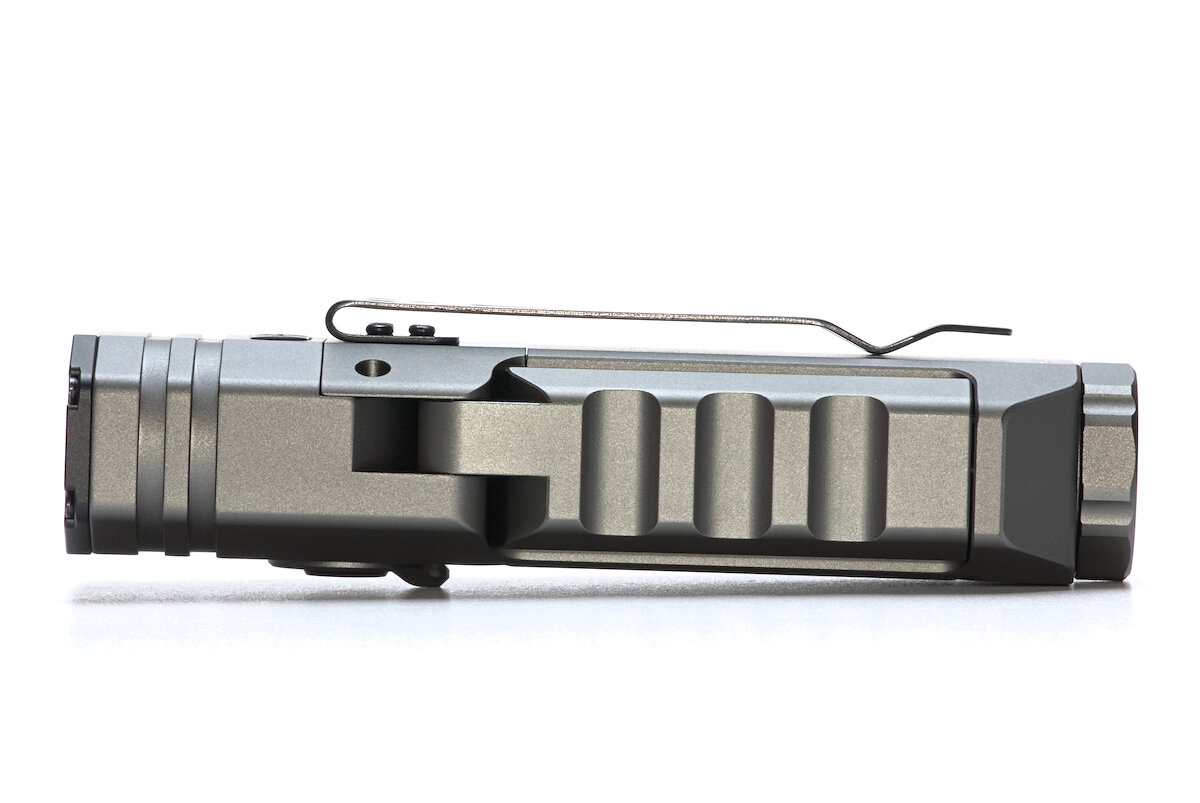
On the back, there is a wide clip, secured by three screws. This makes it easy to carry the light, for example on a belt. Only around the screws it might be a bit tight.
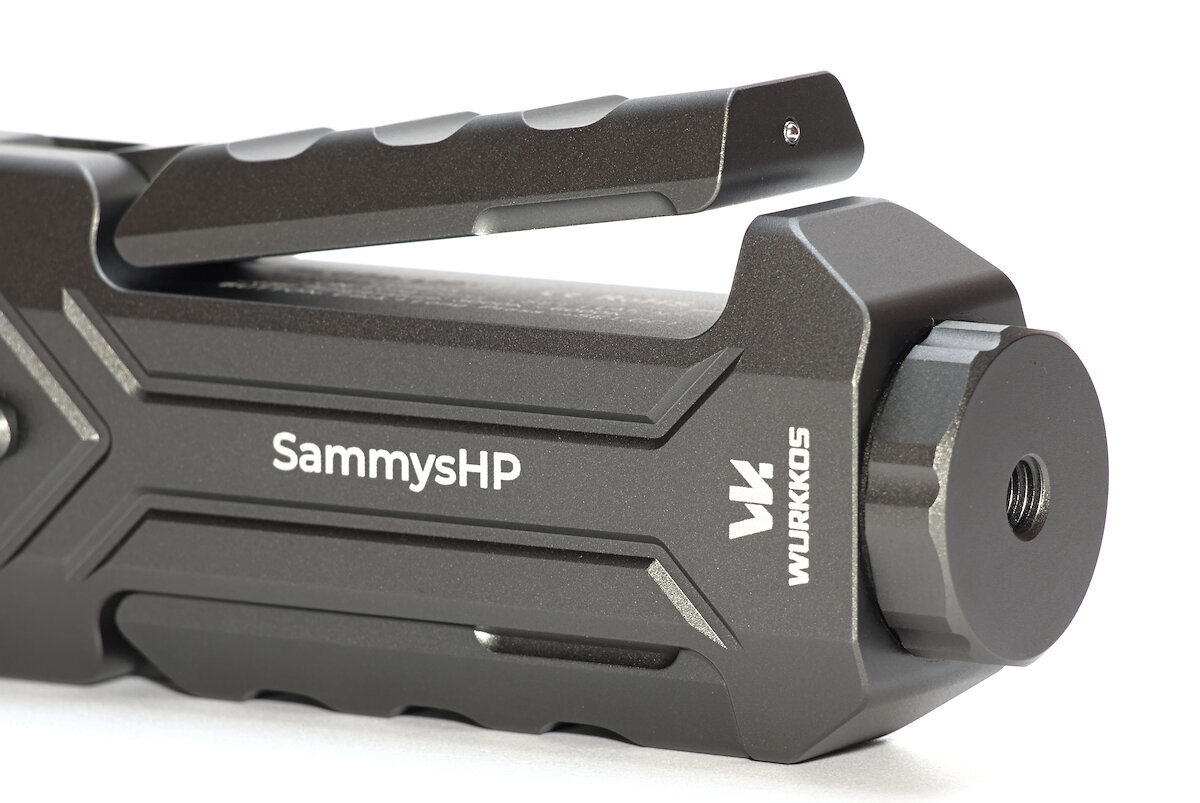
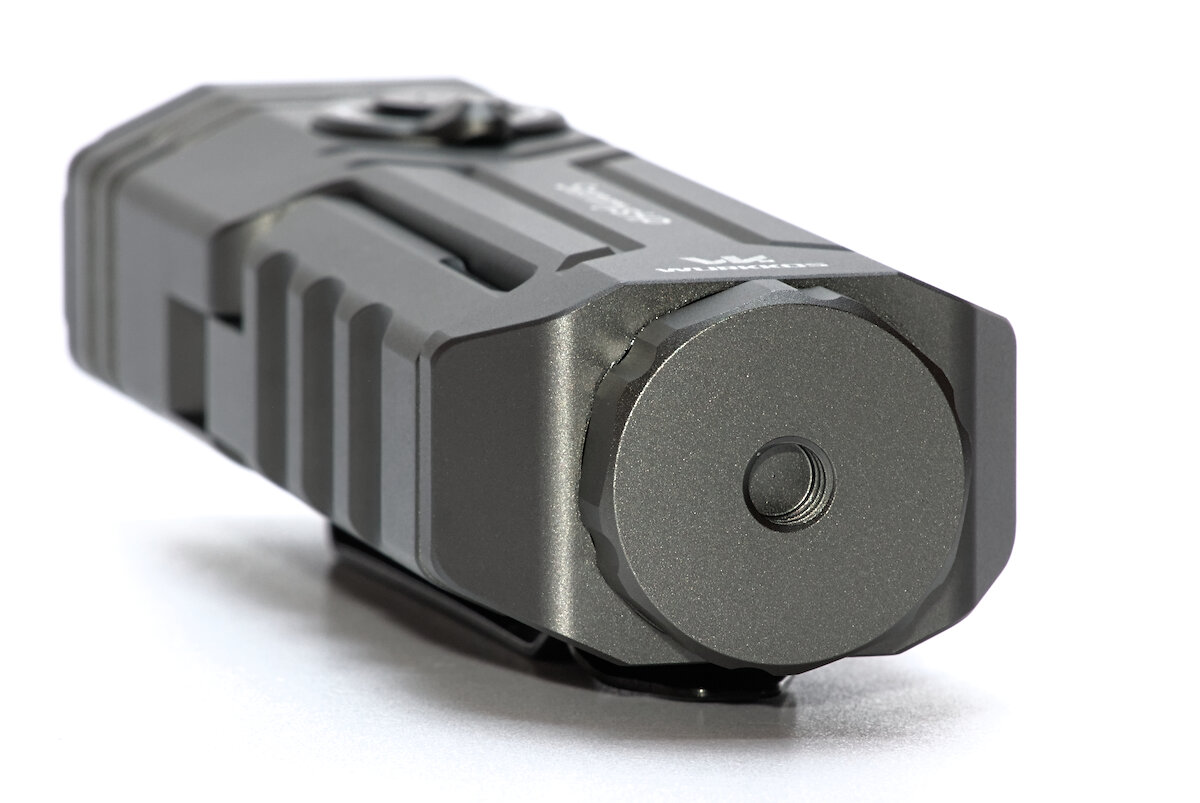
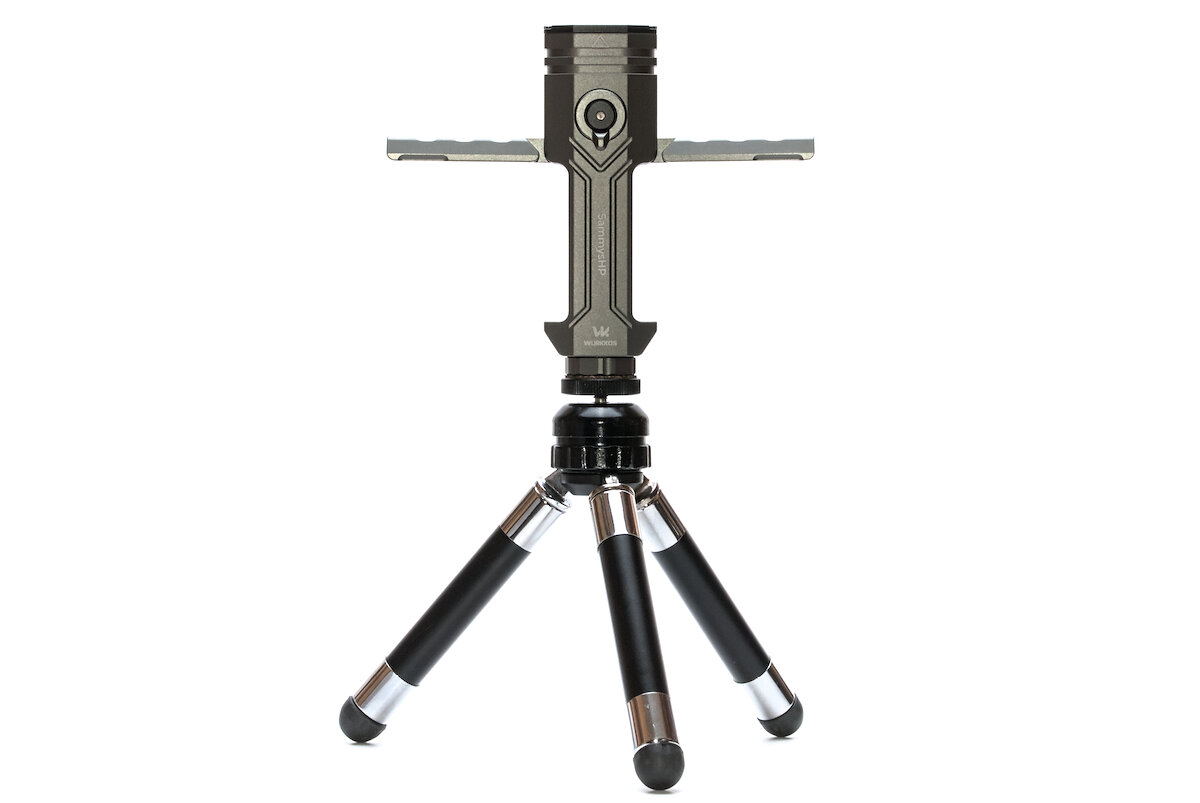
The tailcap features a 1/4" UNC tripod thread, allowing the HD02 to be mounted on a tripod for elevated placement – useful, for example, for better table illumination or as a work light on a construction site. A wrist strap can also be easily attached using a screw-in eyelet. Another option would be a hook, though in that case the floodlight would only shine upward, since the wings cannot rotate.
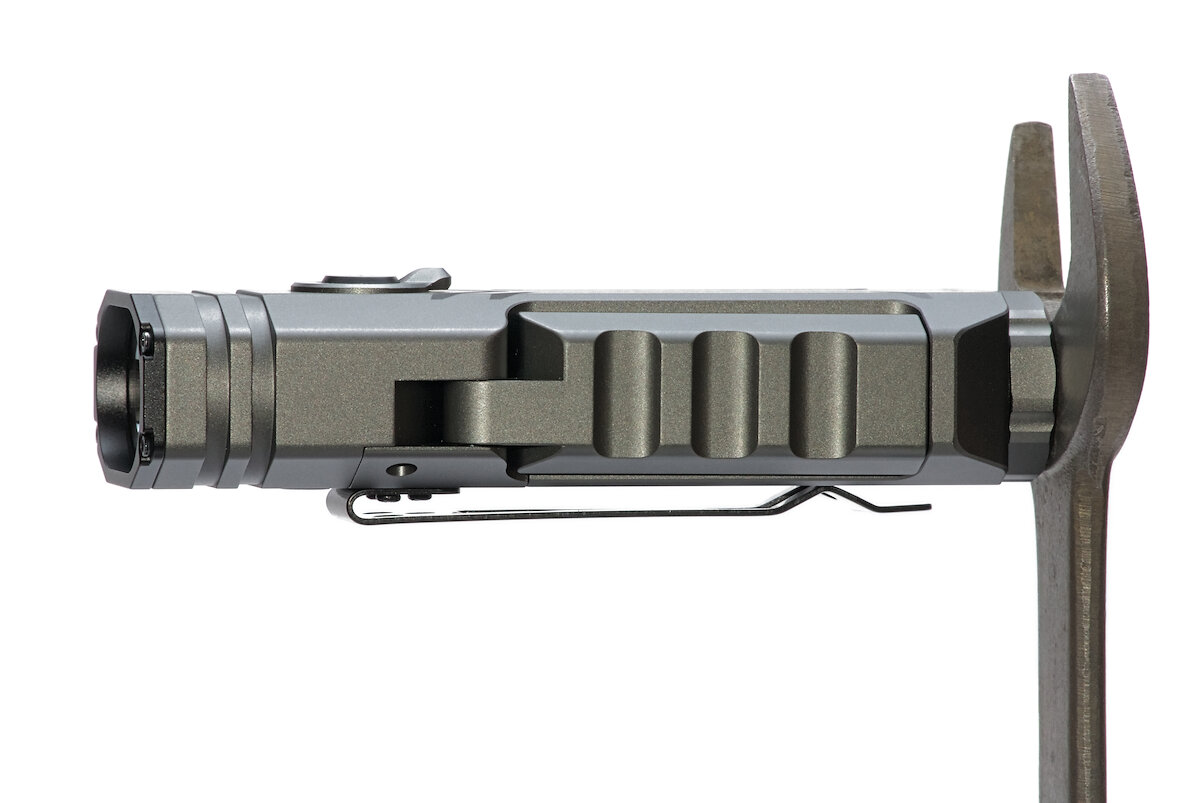
Additionally, the tailcap includes a strong magnet. This allows the light to attach to any magnetic surface in virtually any orientation.
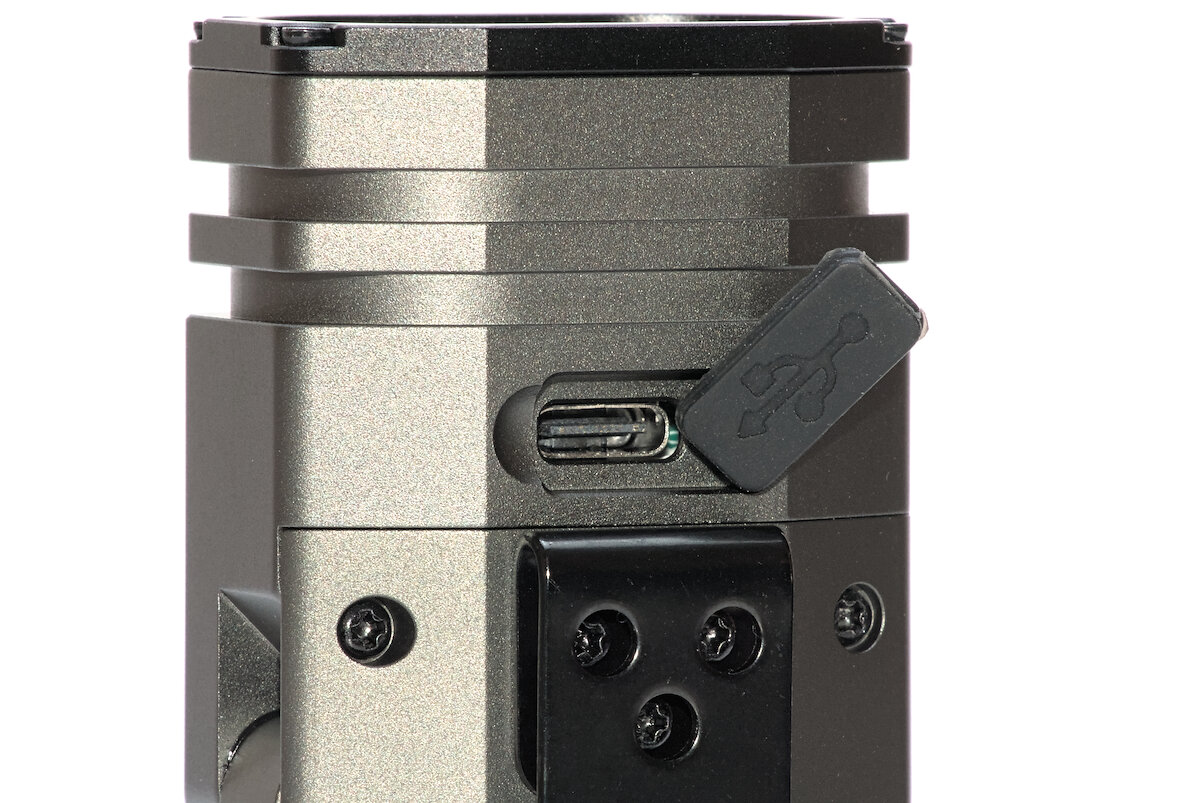
The battery can be charged directly in the light via a USB-C port on the back. A flat silicone cover protects it from water and dirt. Instead of a pull tab, there’s a small notch for your fingernail to make opening easier. I like this design, as it prevents the cover from being accidentally opened too easily.
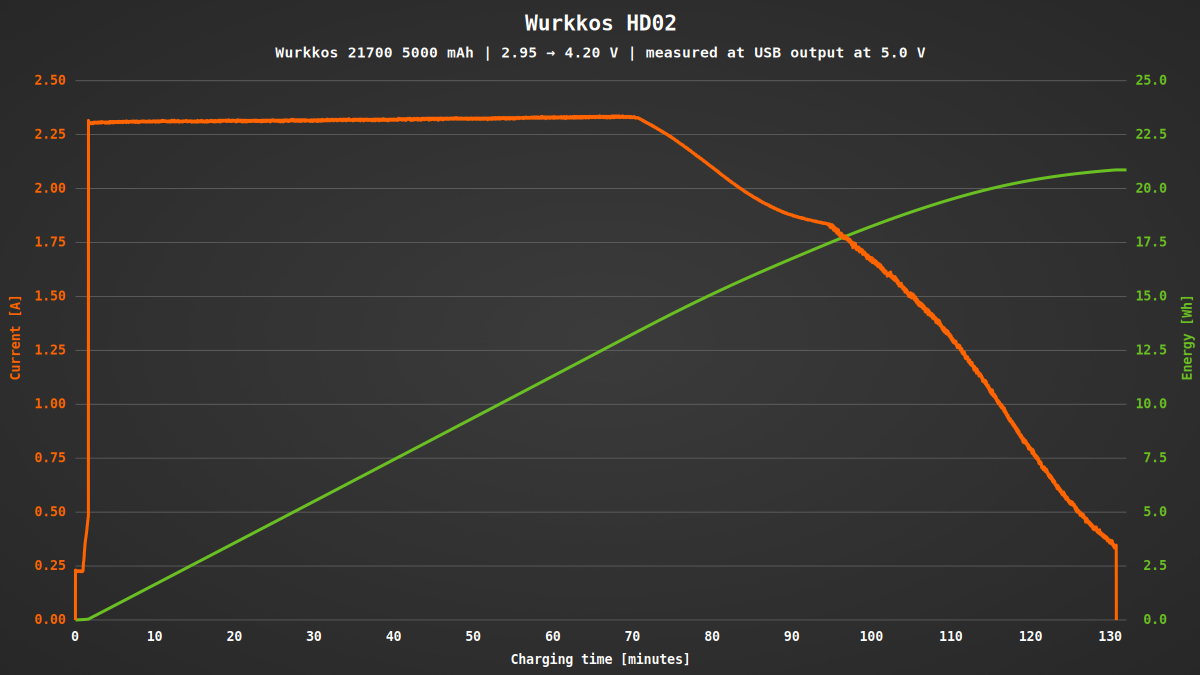
With a charging current of about 2.3 A, the battery is fully charged in roughly two hours. The progress is indicated by an LED in the switch, which changes from red to green when the battery is full. The light can be used normally while charging.
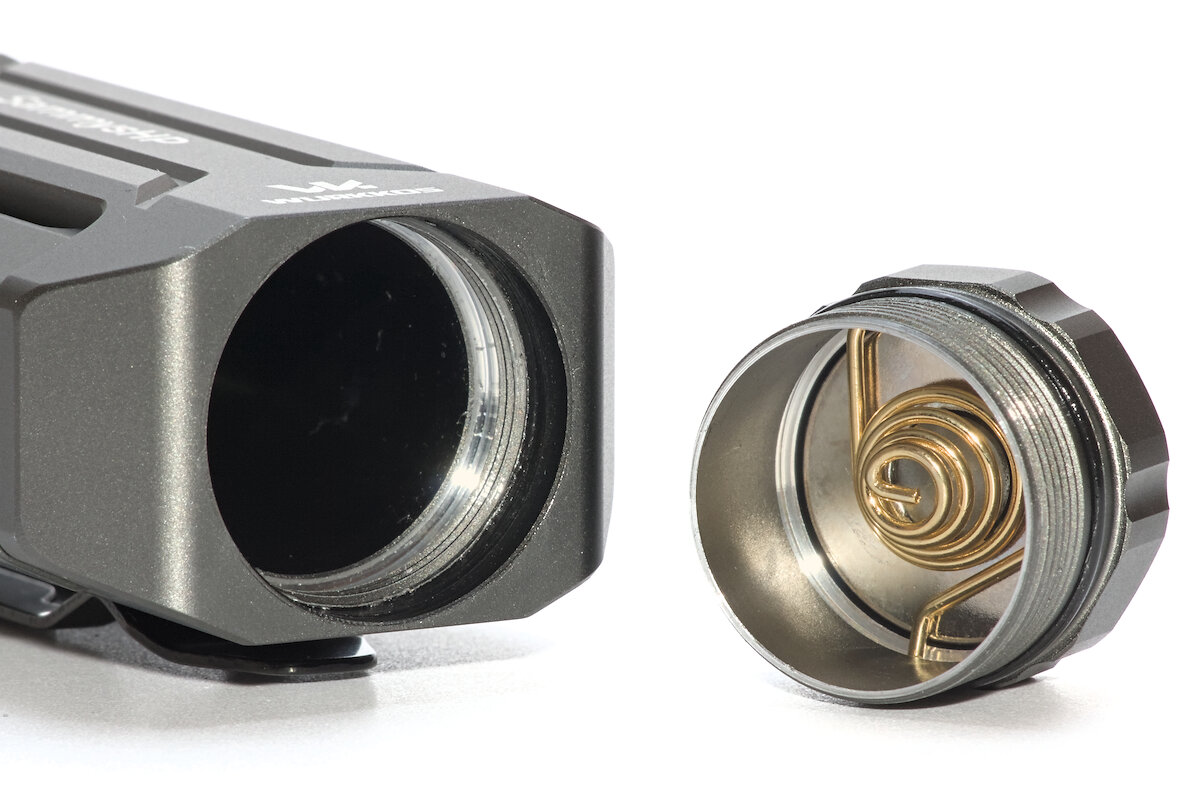
Strong springs on both sides make contact with the battery. The light is designed for unprotected 21700 batteries with a flat top. Button-top batteries fit just barely, but there isn’t enough room for longer (protected) cells.
According to the manufacturer, the HD02 is water-resistant to IPX6. This means it should handle a rain shower or a quick rinse under running water, but it’s best not to fully submerge it. The biggest weak point here is likely the hinge of the floodlight wings. The light is also rated to withstand drops from up to one meter.
The build quality is generally excellent and the edges are well deburred. On my unit, the adhesive on the floodlight diffusers has come loose slightly. You might need to re-glue them yourself if the issue persists.
User interface
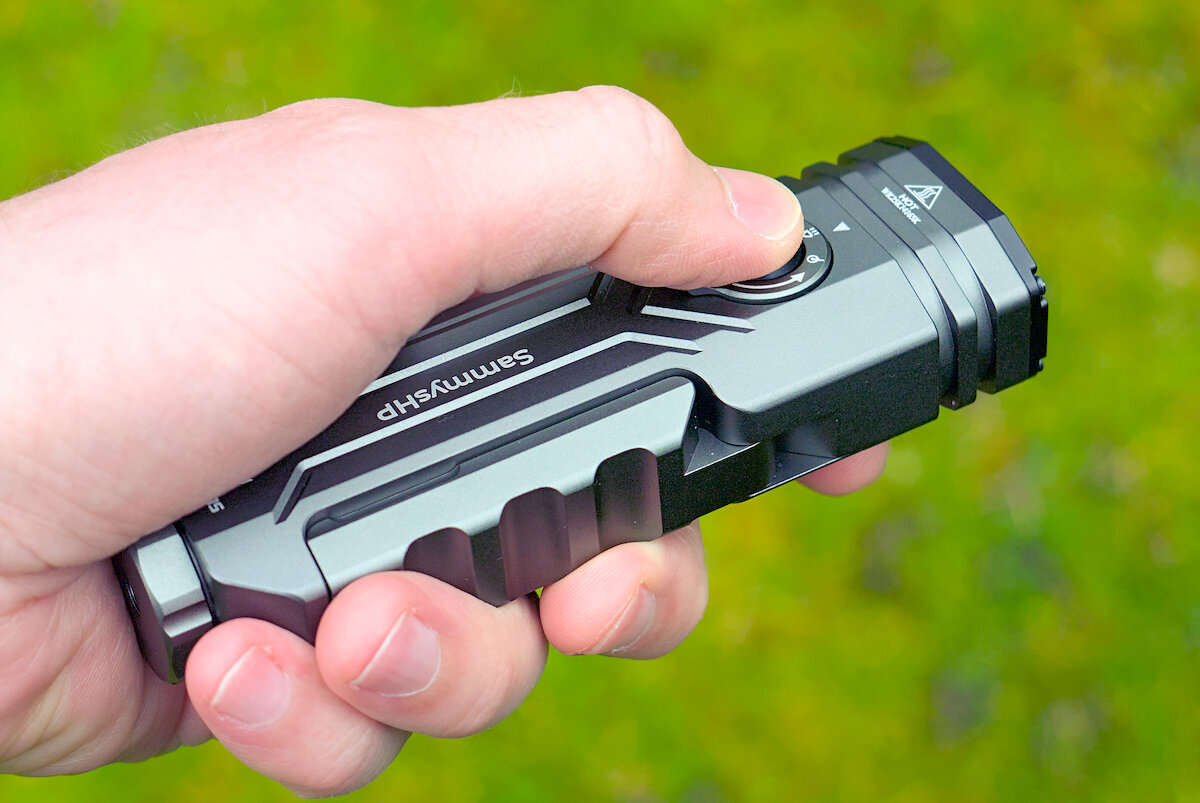
Operation of the HD02 is primarily controlled via a button located at the front of the flashlight. It is used to turn the flashlight on and off or to adjust the brightness. The switch travel is short. Actuation requires a force of about 800 cN and is confirmed by a subtle click.
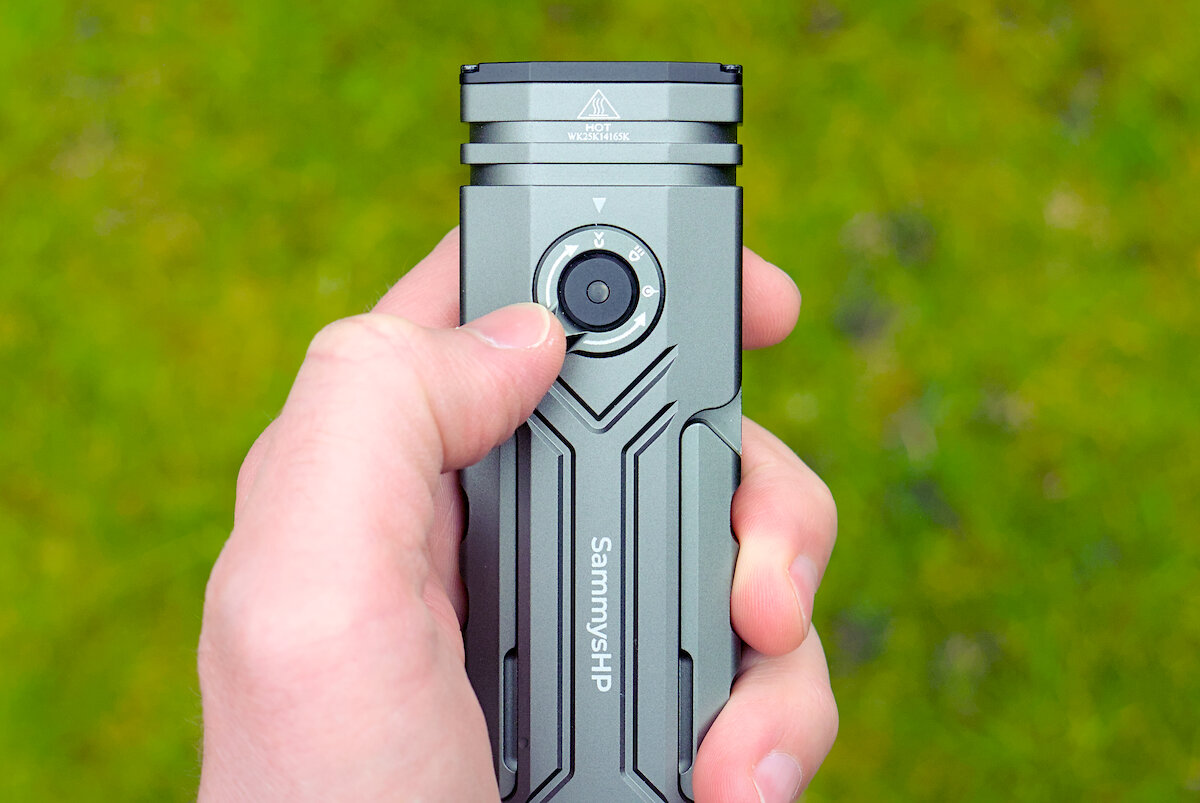
The operating mode is selected using a rotary switch. It has positions for UV, spotlight and laser. Thanks to the small lever, the position can be easily identified without looking. The switch is stiff enough to prevent accidental changes, yet still easy to operate. It uses Hall sensors, so strong magnets may interfere with its function.
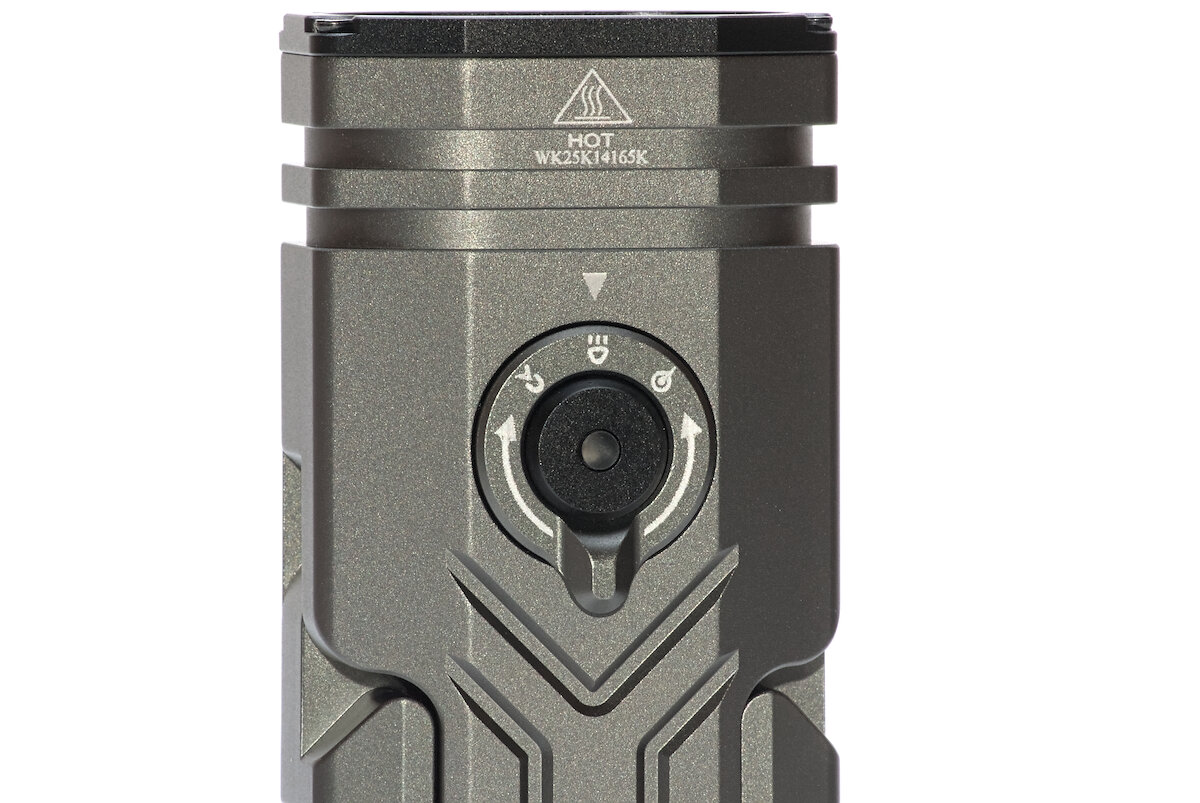
When the switch is in the spotlight position, the flashlight is operated normally using the push button.
On this model, the brightness can only be adjusted smoothly without steps. A full ramp takes four seconds and is difficult to control at low brightness levels. If the button is pressed and held again immediately after being released, the direction of the brightness adjustment is reversed.
The strobe operates at alternating frequencies of 6 and 15 Hz. Additional flashing modes such as SOS or beacon are not available.
| State | Action | Function |
|---|---|---|
| Off | 1 click | Turn on (previously used brightness) |
| Off | 2 clicks | Turbo |
| Off | 3 clicks | Strobe |
| Off | 4 clicks | Lockout |
| Off | Hold | Low |
| On | 1 click | Turn off |
| On | 2 clicks | Turbo |
| On | 3 clicks | Strobe |
| On | Hold | Smooth brightness adjustment |
| Turbo | 1 click | Previously used brightness or turn off |
| Turbo | 2 clicks | Low |
| Turbo | 3 clicks | Strobe |
| Strobe | 1 click | Previously used brightness or turn off |
| Lockout | 4 clicks | Unlock and turn on in previously used brightness |
| Lockout | Hold | Momentary Low (Spot) |
(Spotlight)
In UV light mode, there are only two brightness levels and – sensibly – no strobe. Otherwise, the operation is the same. An indicator showing that the UV light is active (e.g. a blue status LED in the button) would have been a nice addition.
| State | Action | Function |
|---|---|---|
| Off | 1 click | Turn on (previously used brightness) |
| Off | 2 clicks | High |
| Off | 4 clicks | Lockout |
| Off | Hold | Low |
| On | 1 click | Turn off |
| On | 2 clicks | High |
| On | Hold | Change brightness (Low / High) |
| Lockout | 4 clicks | Unlock and turn on in previously used brightness |
| Lockout | Hold | Momentary Low (Spot) |
(UV light)
The laser can be turned on and off. I would have liked a momentary mode when holding the button, since a laser is usually only used briefly to point at something.
| State | Action | Function |
|---|---|---|
| Off | 1 click | Turn on |
| Off | 4 clicks | Lockout |
| On | 1 click | Turn off |
| Lockout | 4 clicks | Unlock and turn on in previously used brightness |
| Lockout | Hold | Momentary Low (Spot) |
(Laser)
When the wings are unfolded, the floodlight turns on automatically. After that, brightness and color temperature can be controlled using the button. The floodlight can be turned off either by closing the wings or with a short press of the button. The two wings can also be used individually.
| State | Action | Function |
|---|---|---|
| Closed | Open | Turn on (previously used brightness) |
| Off (opened) |
1 click | Turn on (previously used brightness) |
| Off (opened) |
2 clicks | High |
| Off (opened) |
4 clicks | Lockout |
| Off (opened) |
Hold | Low |
| On | Close | Turn off |
| On | 1 click | Turn off |
| On | 2 clicks | Turbo |
| On | Hold | Smooth brightness adjustment |
| On | click + hold | Smooth color temperature adjustment |
| Lockout | 4 clicks | Unlock and turn on in previously used brightness |
| Lockout | Hold | Momentary Low (Spot) |
(Floodlight)
A lockout activated by a quick quadruple-click protects the flashlight from being turned on accidentally. Alternatively, the tailcap can be loosened slightly. A fourth position on the rotary switch would have made this even simpler.
After switching the flashlight on, a status LED in the button indicates the approximate battery charge level for five seconds. At a critical battery voltage, the LED flashes red continuously while the flashlight is on. Unfortunately, this information is not included in the manual, but can only be found on the manufacturer’s website.
| Color | Battery level |
|---|---|
| Green | 75% – 100% |
| Green blinking | 50% – 75% |
| Red | 25% – 50% |
| Red blinking | < 25% |
Although the flashlight feels quite bulky in the hand, it is still comfortable to hold. The wide grooves on the wings provide a secure grip even in wet conditions. The button is easy to locate in the dark and operating the rotary switch is effortless.
With the fold-out wings, the flashlight is also designed for stationary use. A small tripod or a mounting plate improves stability when the magnet cannot be used. For use as a work light, rotatable wings would be practical.
Illumination
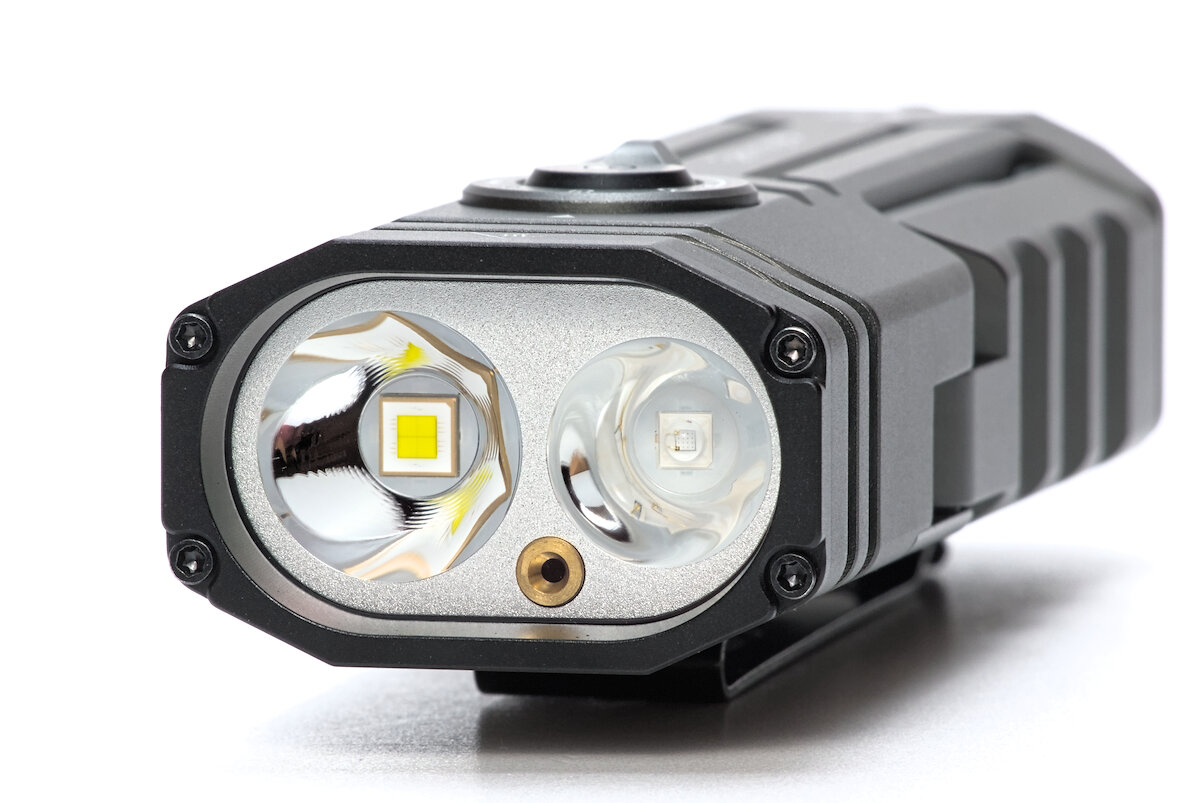
On the front, behind a glass lens with a magenta anti-reflective coating, there is a cool-white Luminus SFT-70 Gen 2 for the spotlight, a Luminus SST-08-UV at 365 nm and a green laser with a specified output of ≤ 5 mW.
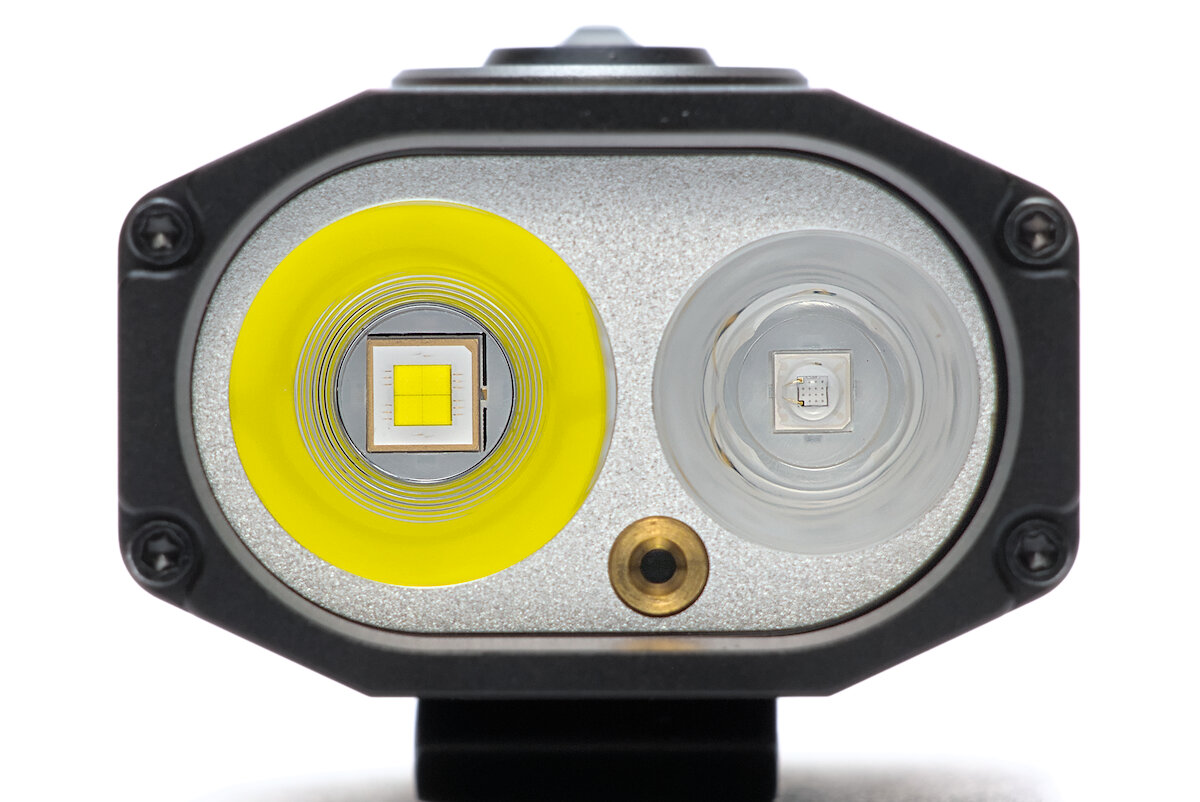
The cool-white spotlight has a neutral tint, but shows a slightly greenish tint at low brightness. The spot is a bit warmer than the spill.
The surface of the reflector is mostly smooth. Fine rings are visible in the center, possibly intended to reduce artifacts in the beam pattern. I’ve seen a similar structure in other lamps as well.
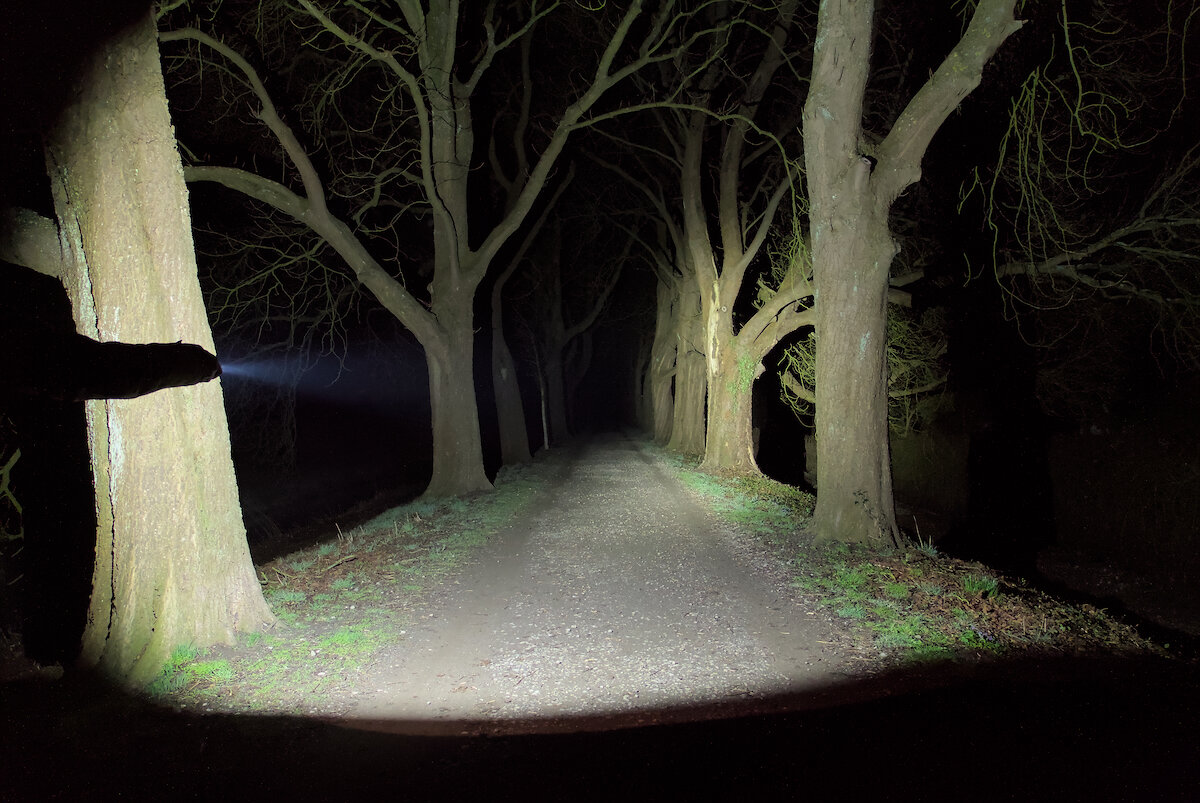
The spot is illuminated evenly. Upon close inspection, minimal “petals” appear in the corona, but they are not noticeable in typical use.
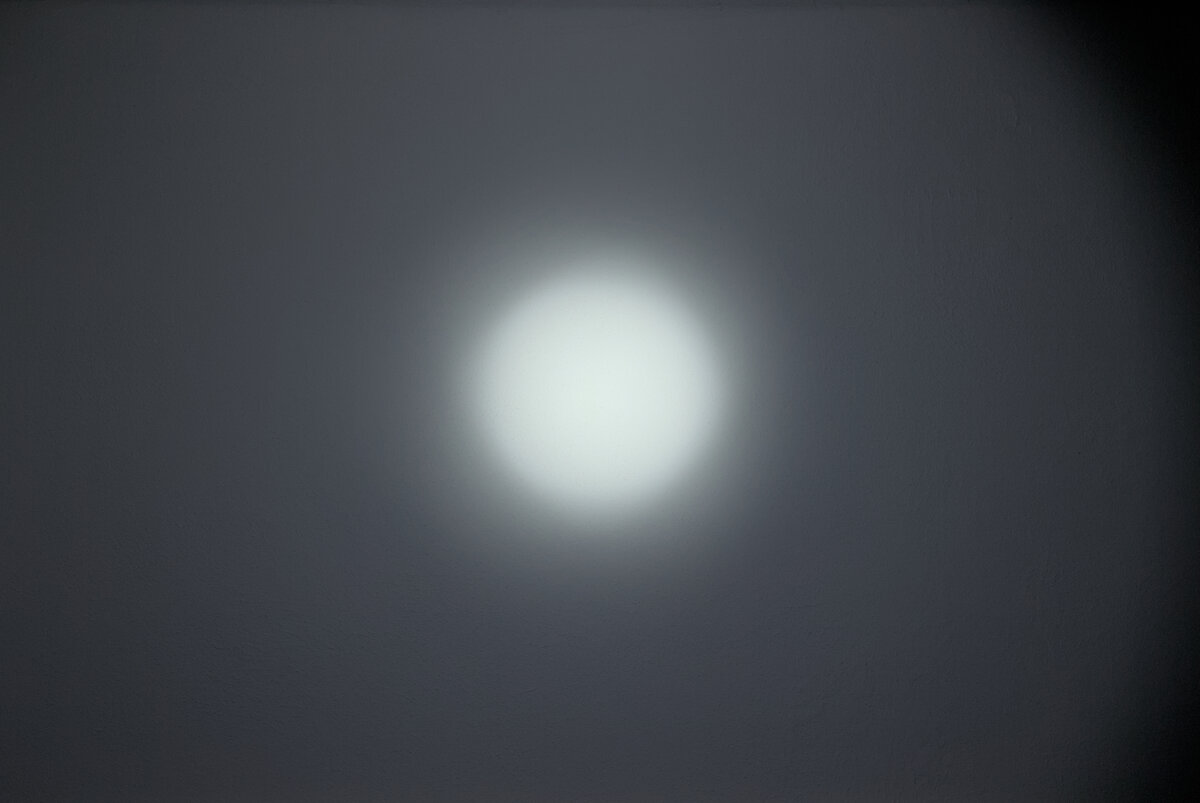
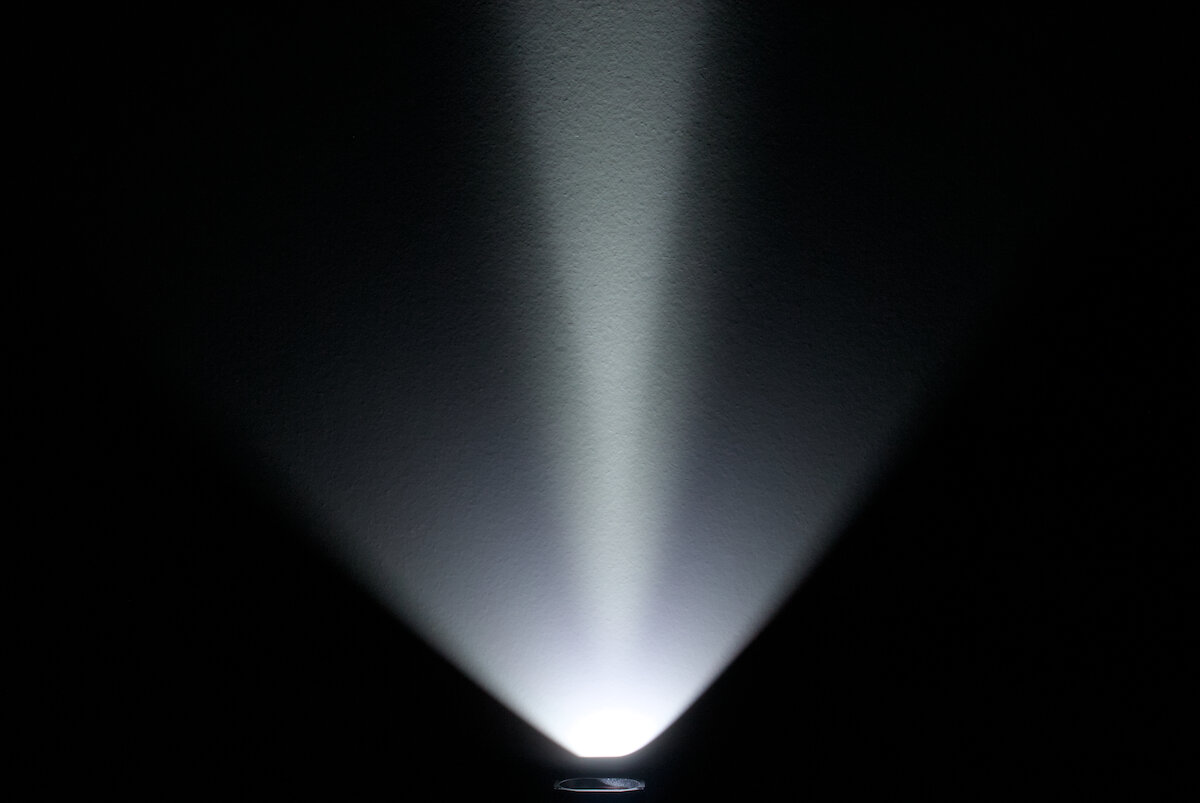
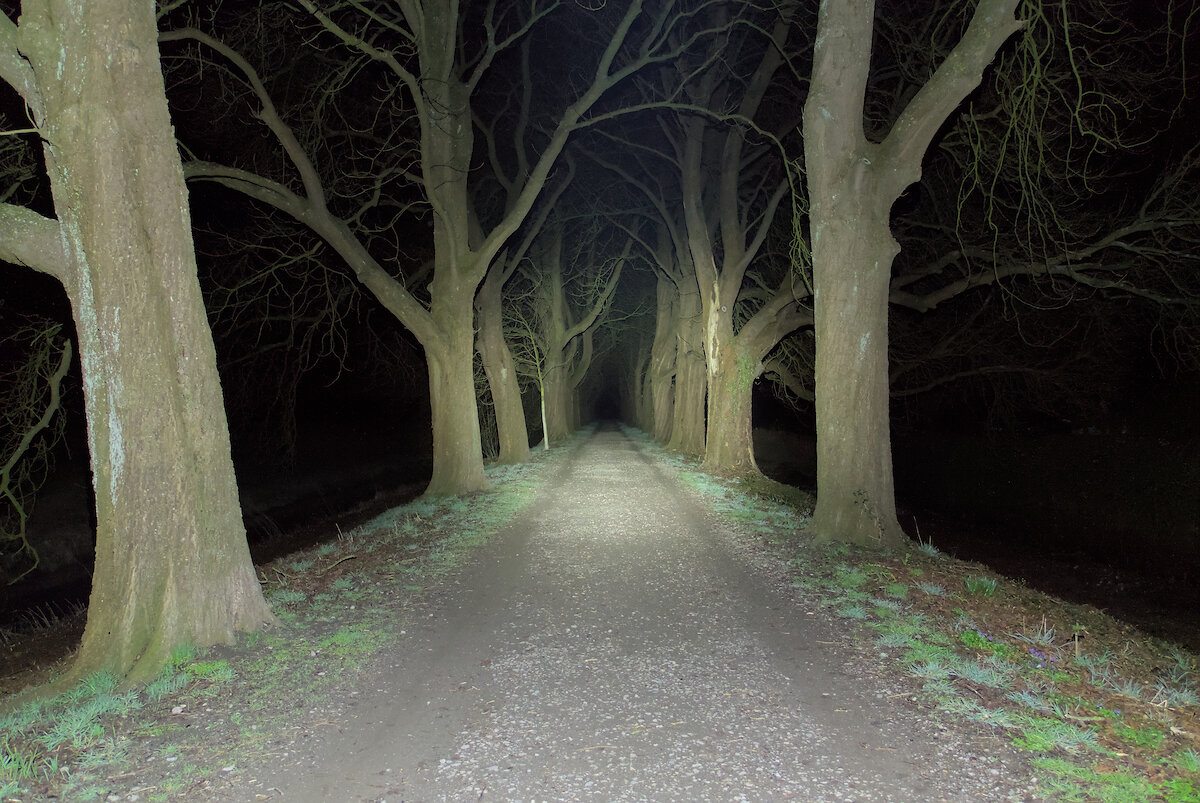
I really like the beam pattern. The spot is just the right size for versatile use: not too small, but also not so large that it wastes throw unnecessarily.
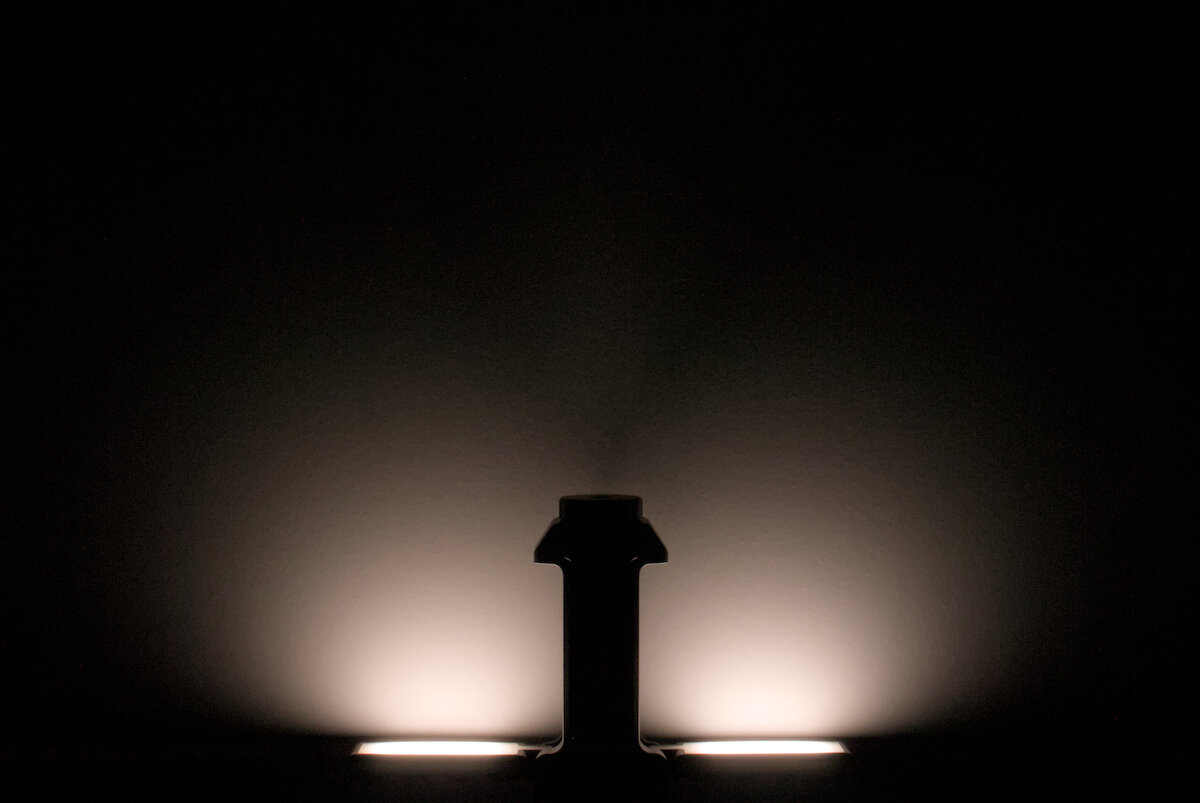
The floodlight consists of 32 warm-white (3000 K) and 32 cool-white (6000 K) LEDs per wing – 128 LEDs in total! This allows the light to spread evenly over a large area, reducing harsh shadows. With its wide beam, the floodlight is ideal for close-range use, for example when reading or working, where a larger area needs uniform illumination.
UV light is an exciting topic, as we cannot see it directly by eye, but only through the fluorescence of illuminated objects. It is divided into three categories, of which only UV-A is relevant for flashlights. Inexpensive UV flashlights in particular use LEDs with a fairly long wavelength (around 400 nm) and a high amount of visible light. As a result, the effect of fluorescence is partially hidden by the visible light.

Better UV flashlights use LEDs with a wavelength of 365 nm, such as the HD02. Many minerals, security features on money and ID cards or “organic residues” in the bathroom or on the carpet fluoresce in this range. These LEDs also have a small amount of visible light, which can be eliminated with a ZWB2 filter (which is not installed in the HD02).
In practice, I use the UV light to check the even application of certain lubricants with a UV indicator or to detect dirt (detergents, dust). In geocaching there are sometimes tasks that require UV light. In general, it often opens up a completely different perspective on the surroundings, as you can see in this example:
In the HD02, the UV light is focused primarily into a very narrow spot – narrower even than the spotlight. For example, an A4-sized area is fully illuminated only from a distance of about two meters. This makes the UV light more suitable for medium-range tasks, such as searching for UV clues in geocaching or inspecting pipes for leaks.
For shorter distances, the brightness can at least be reduced by one level. While the illuminated area remains small, it is easier on the eyes and causes less glare. The weak spill contributes even less in this case.
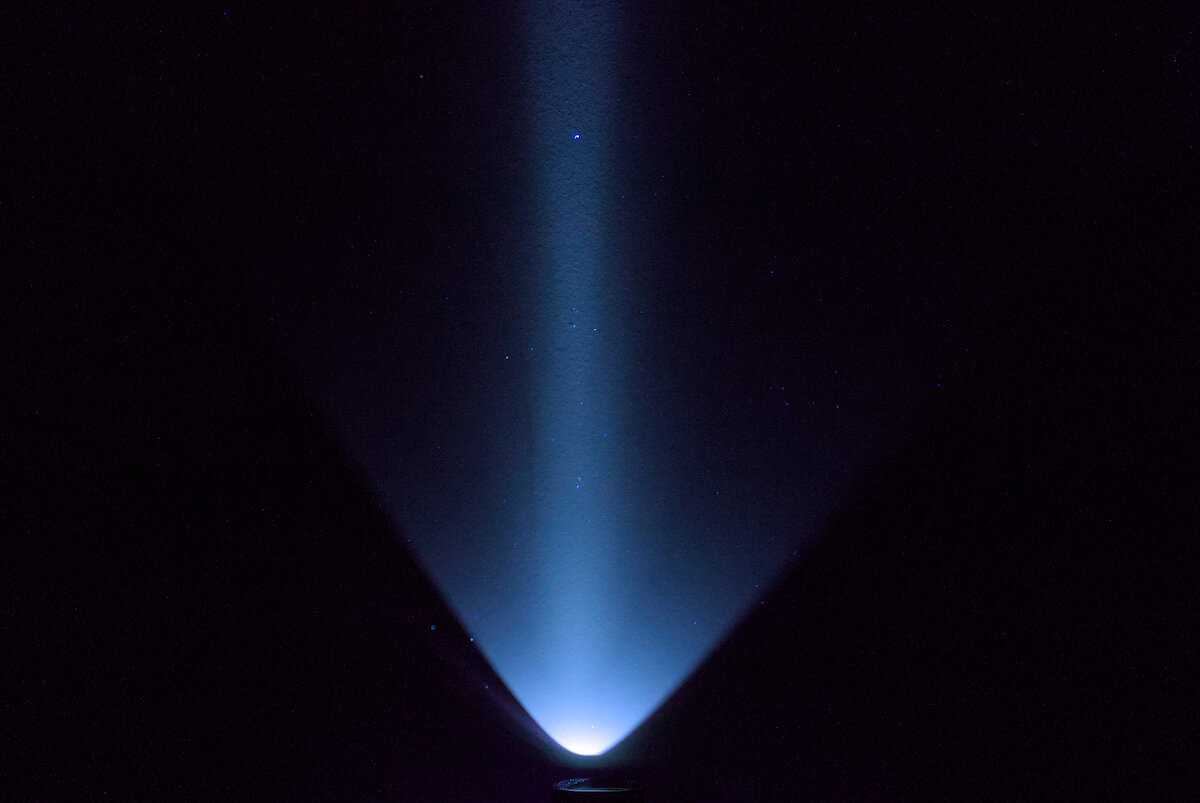
The green laser is a Class 3R device with an output of less than 5 mW and a specified wavelength of 520 nm. In most cases, I find the laser a bit too bright. Additionally, improper or careless use poses a risk of eye injury.
Driver and runtime
According to the manufacturer, the HD02 uses a boost driver that provides a mostly consistent output regardless of the battery’s charge level.
| Mode | Brightness¹ | Runtime¹ | Intensity¹ (Throw²) |
|---|---|---|---|
| Spot Turbo | 3200 / 1000 lm | 60 s + 1:45 h | 27 175 cd (330 m) |
| Spot Low | 10 lm | 140 h | 125 cd (22 m) |
| Flood Turbo³ | 300 lm 250 lm |
4 h | 130 cd (23 m) 105 cd (20 m) |
| Flood Low | 5 lm | 140 h | |
| UV High | 3 W | 5 h | |
| UV Low | 0.8 W | 15 h |
¹ According to manufacturer ² ANSI FL1 ³ 6000 K / 3000 K
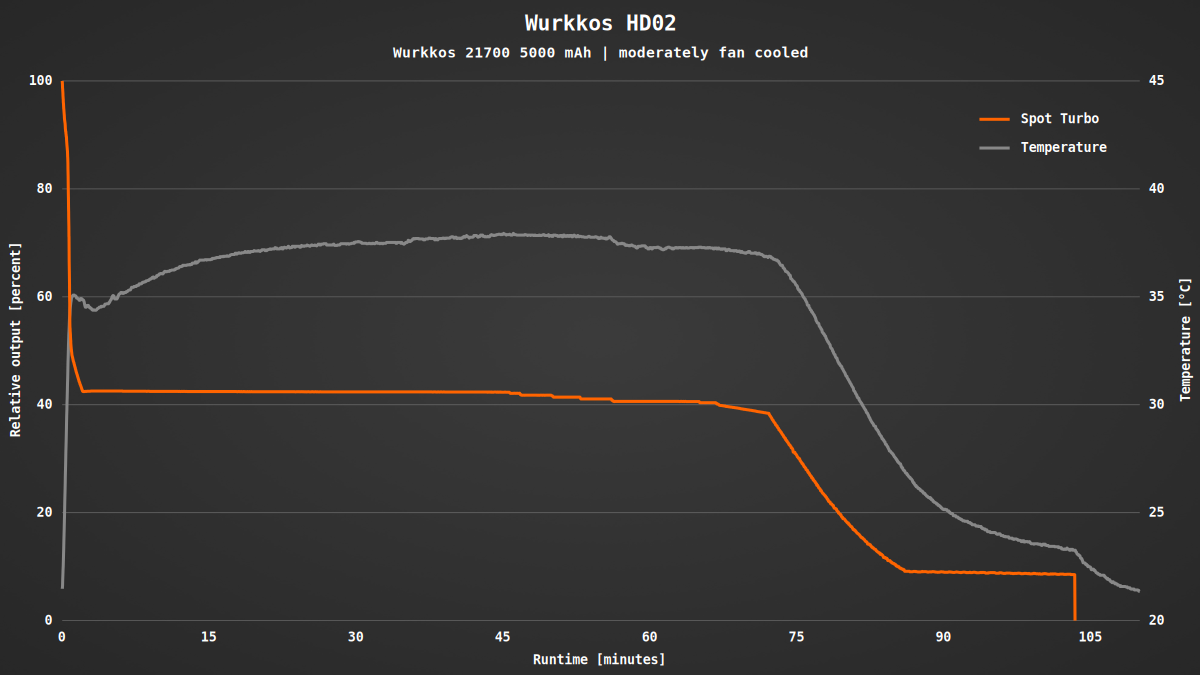
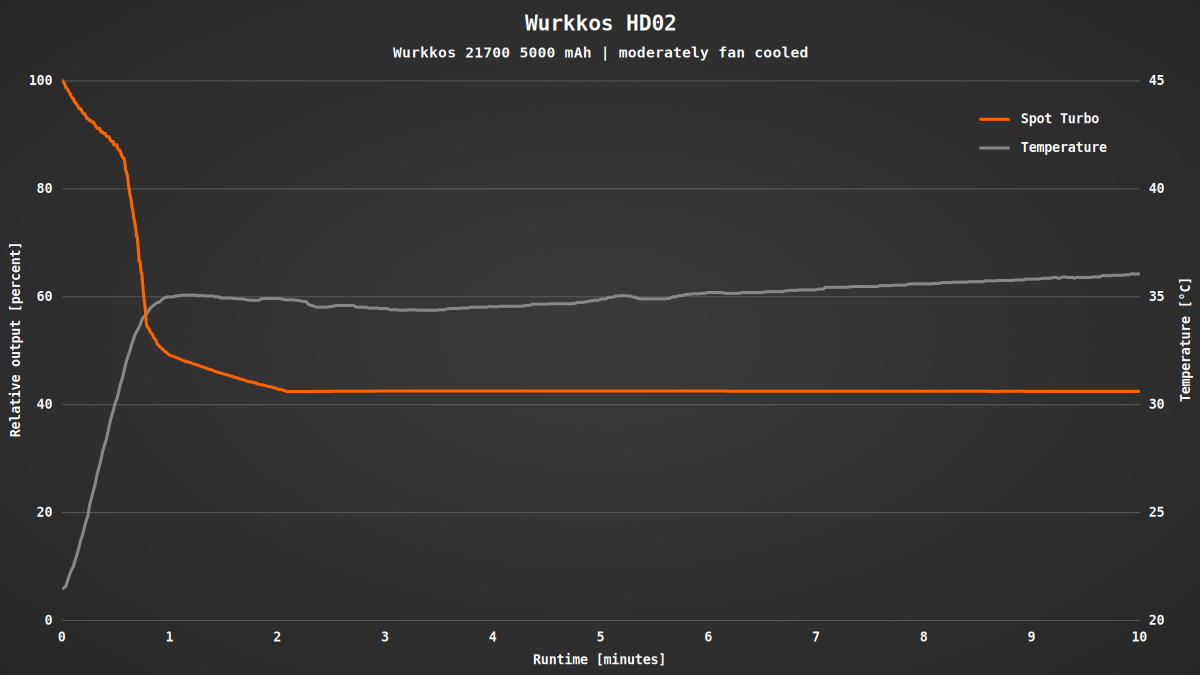
Since there are no fixed brightness levels, I measured the runtime only at maximum output. For the spotlight, the results match the manufacturer’s specifications almost perfectly. When the brightness is automatically reduced after just under a minute, the temperature reaches only 35 °C with light cooling and rises to a moderate 38 °C later on.
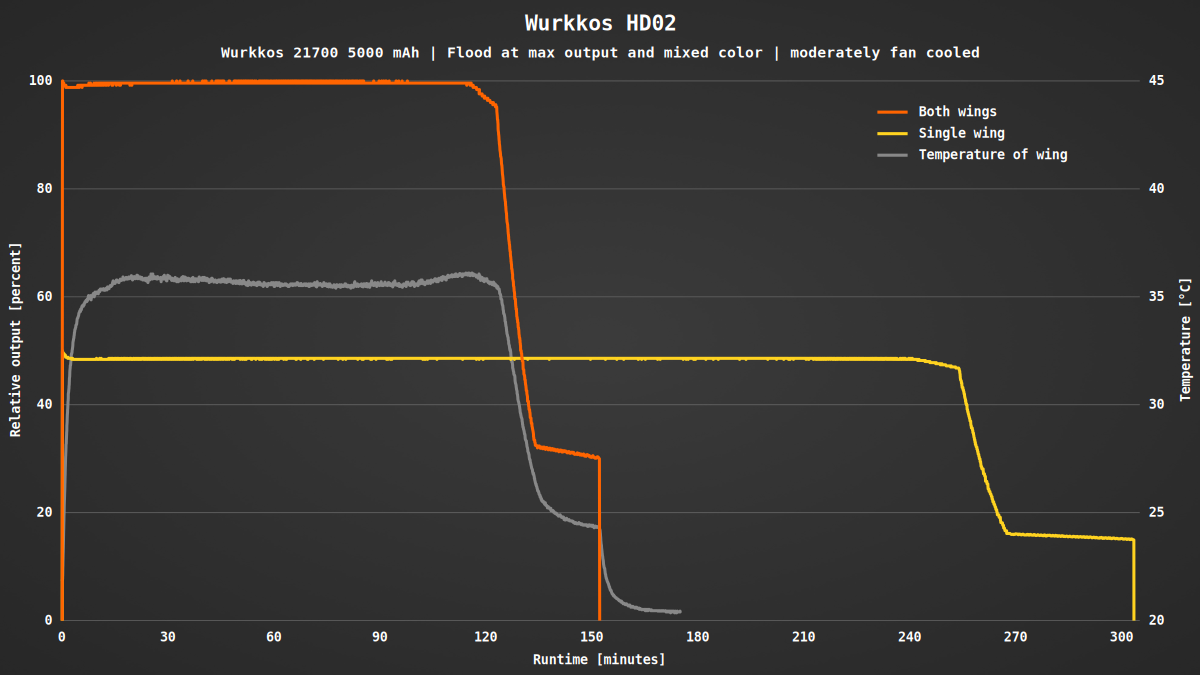
With the floodlight, maximum brightness is available for nearly the entire runtime. Using both wings doubles the brightness while halving the runtime. At full power, the wings reach a temperature of 35 °C, making the floodlight well-suited for continuous operation.
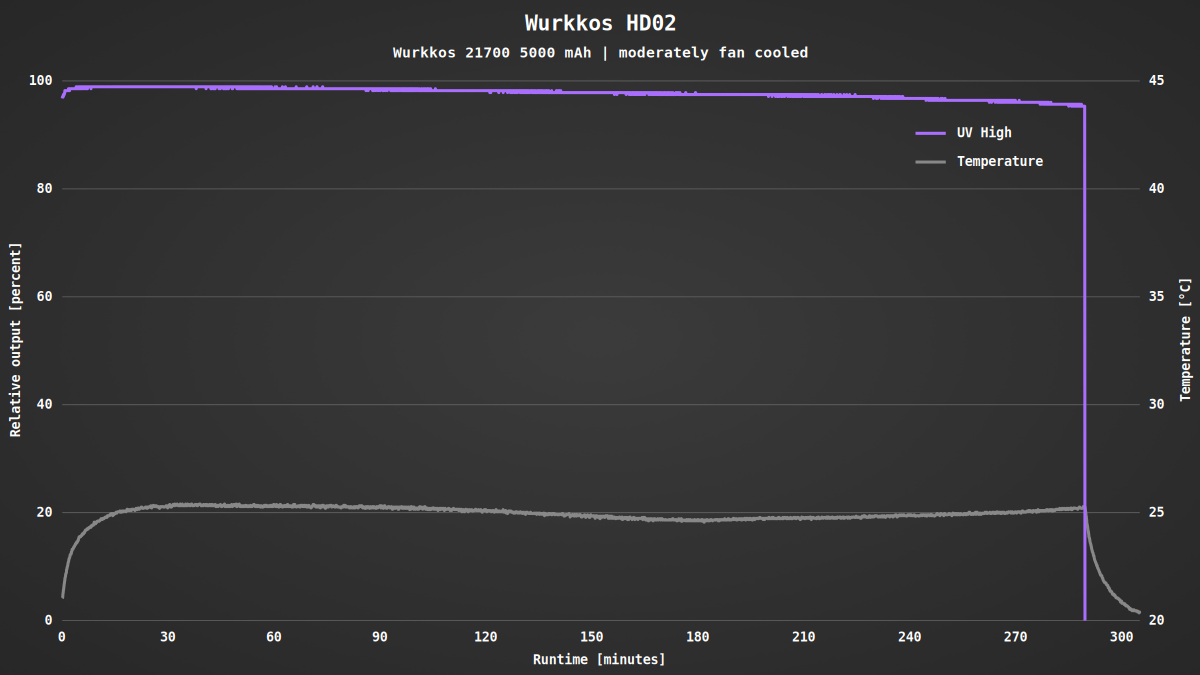
The UV light also demonstrates very constant regulation. Full brightness is maintained continuously for nearly five hours, roughly matching the manufacturer’s specifications. In this case, any heating is negligible.
Unfortunately, I have not yet been able to measure the current draw of this flashlight. As soon as the battery and the body are bridged with a wire, the floodlight LEDs in the wings turn on. It is likely that the tailcap magnet is taken into account in the firmware when detecting the magnetic field. Adding an extra magnet to the battery does prevent the floodlight from turning on, but it interferes with current measurement.
Even though I couldn’t determine the exact voltage, the runtime measurements indicate that the flashlight shuts off when the battery is empty, preventing deep discharge.
While the spotlight brightness is regulated without PWM, the UV light shows PWM at 23 kHz on an oscilloscope – though this is not perceptible to the eye. The floodlight does not use PWM, but the two channels for the different color temperatures are multiplexed, meaning they alternate at a high frequency (also 23 kHz).
Conclusion
With the HD02, Wurkkos has once again released a well-designed flashlight. It offers a powerful spotlight, UV light and a green laser. The real highlight, however, are the two fold-out wings, which provide even floodlight illumination with adjustable color temperature.
The user interface is straightforward: unfolding the wings automatically turns on the floodlight. A rotary switch allows easy selection between spotlight, UV light and laser. With the magnet and tripod thread, the flashlight can be mounted in many ways. In an emergency, it can even be used as a powerbank via the USB port.