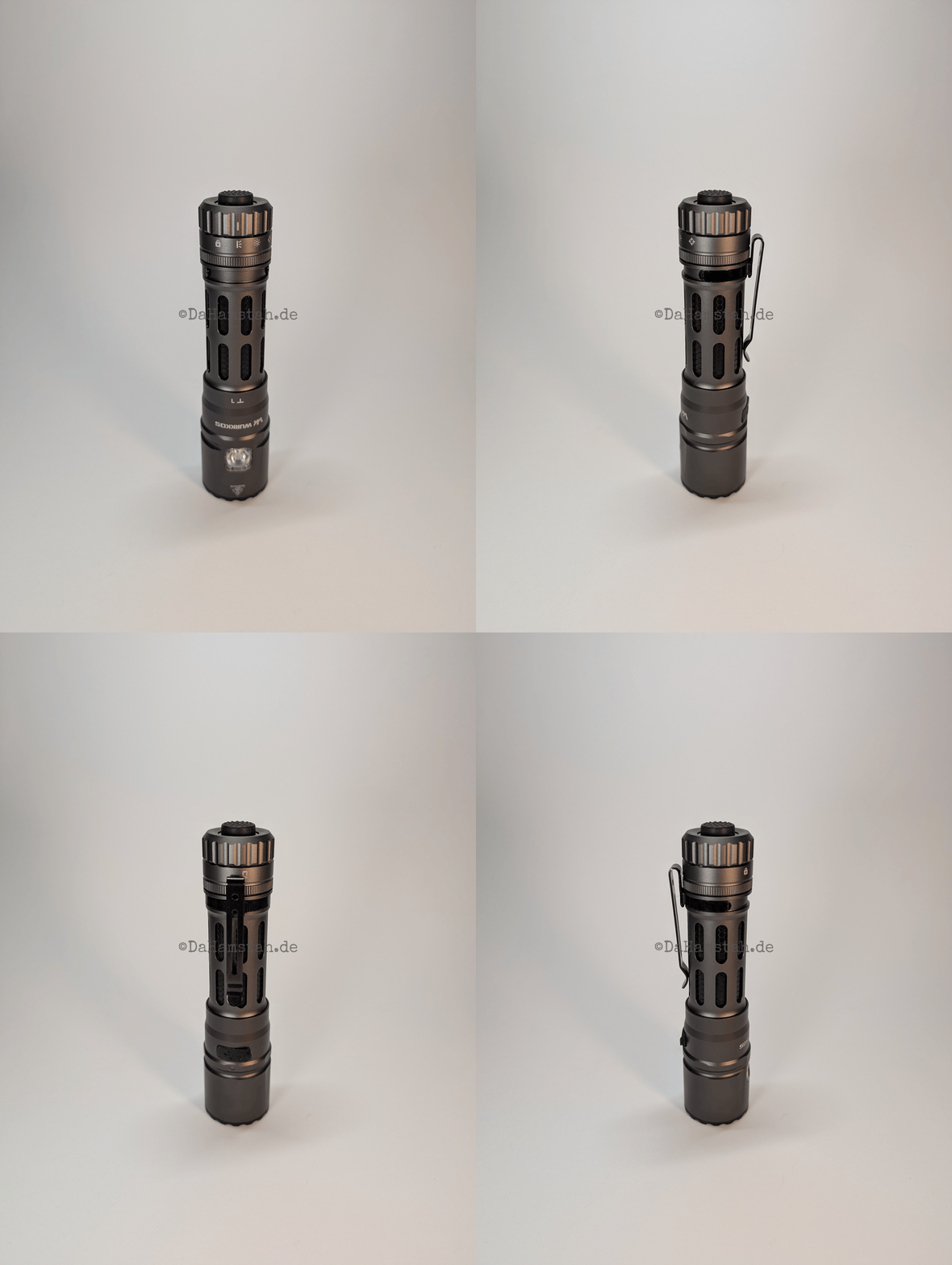
The Wurkkos T1 ticked a lot of my boxes right away. I am a fan of rotary control rings and unique body designs, and this light offers both. Throw in an auxiliary side light, a two-stage switch, and a high-power LED I hadn’t encountered before, and it sounded promising enough to warrant a review.
All my reviews can be found on my website.
Disclaimer: Wurkkos provided this light to me free of charge. This has had no influence on the review.


The light arrives in a white box printed with the key specs. Inside, the flashlight rests in a plastic tray with the battery pre-installed. Included underneath are a charging cable, lanyard, two spare O-rings, and a user manual.
Once unboxed, you can fully appreciate the design. To my eyes, it is a total winner, though certainly unconventional. The cutouts in the battery tube revealing the inner sleeve with its honeycomb pattern aren’t just for looks—they also provide excellent grip. Time will tell how much dirt and pocket lint will collect in those recesses.


At the tail of the light, which by the way is permanently connected to the battery tube, there is a rotary switch. It has enough resistance to prevent accidental activation, yet remains smooth enough for easy one-handed operation. It has minimal play in the axis of the battery tube – so that you do not notice it during operation, but can see it when wiggling it. Each of the 4 positions engages perceptibly and audibly. However rather subtle, you should not expect a loud click or a very distinct detent point.

In the center of the ring sits a switch. This is electronic and two stage, but feels more like a classic clicky. It sticks out far beyond the housing, so there is no tailstand. The switch is very sensitive – it happened to me several times that I changed the mode just by lightly resting my finger! Apart from that the switch feels good. Since you cannot simply disassemble the tailcap, you unfortunately cannot tweak it yourself to make the switch a bit less sensitive.

As already mentioned, you can only get to the battery by separating the head from the light. The thread is not anodized and extremely clean, as well as lightly greased. Looking inside, you can see that the battery is spring loaded on both sides.


On the head itself there is a USB C port, which is closed by a rubber cover. This sits deep and quite firmly in the lights head – I assume, however, that the port is not internally sealed again.


Opposite sits the special feature of the light: A side light! The lens is cleanly integrated and slightly set back. It is also flattened, so that it should be relatively well protected – especially since there is no glass over it that could break. The lighting can be set to red, green and blue and there is also a police strobe.

Looking into the front of the light, you can see the Cree XFLSNA nicely centered in a slightly textured reflector. This is optically very similar to the LMP LHP73B. Whether the bezel is aluminum or steel, I cannot say with certainty. The glass is visibly coated.
Ergonomics are solid. The body cutouts offer plenty of traction, the tail switch is effortless to locate with your thumb, and the control ring is easy to rotate. The portion of the head that heats up stays well clear of your grip, remaining comfortable even during extended runs at high output. Lengthwise, it is tall enough that the side light clears your hand during a standard full-fist hold.


Wurkkos TS28, Sofirn SK31, Wurkkos T1, Sofirn SR23

Sofirn SK31, Wurkkos T1, Convoy M21b
My scale reads 208g for the Wurkkos T1 including the battery.
The light measures 144.5mm in length. Head diameter is 34mm, the battery tube is 27mm, and the rotary control ring measures 30mm.
Lanyard: A standard lanyard is included - good quality, secures the light well, but nothing extraordinary.
Clip: I like the clip very much! One way, the light still sticks out a bit so that you can draw it well, and the shape and opening accommodate almost any thickness of fabric or pants hem. The cutouts in the battery tube do not interfere, but could, if the clip is rotated unfavorably, possibly result in increased wear on the fabric.


Magnet: There is no magnet.
(Jacket)pocket: The light is, for its size, surprisingly slim and in wider pants just about wearable for me. In the jacket pocket, on the backpack strap,… the light carries impeccably.

The UI of the light is simple. This is made possible mainly by the rotary ring at the end.
Lock: The light is completely locked out. Only holding half press activates moon mode as momentary light.
Side light: Fully pressing turns on the police strobe, half pressing through turns on the side light in the last used mode. There, half pressing the switch cycles through the brightness levels, holding half pressed changes the mode (white, red, green, blue). Fully pressing with the light turned on turns it off.
Outdoor: Holding the switch half pressed activates moon, half or fully pressing turns on the light in the last used mode. If the light is on, half press cycles through the levels, fully pressing through turns it off.
Tactical: Half pressing results in momentary turbo, full press momentary strobe.
All measurements were performed in my 30cm integrating sphere. Ambient temperature ranged between 24° and 30° C. In addition, an Opple Light Master III and a TASi TA636B lux meter were used. Please keep in mind that this is hobbyist equipment, so inaccuracies and variances are possible!

The light never gets really hot, the highest I could reach was just under 50°. That is noticeably warm, but (for me) still below the pain threshold.
The light offers a rather floody, clean beam pattern, which I liked well outdoors as well as indoors. The spot is nevertheless clearly visible and transistions smoothly to the spill. The spill is wide and free of artifacts.
The side light is floody, without a visible spot. If you have clipped the light to the backpack strap, it offers you a wonderful, even cone of light in front of your feet.

I would describe the performance of the light as very good. At first I was amazed at the somewhat low sustained output – although that would have been complaining at a high level. After a conversation with another reviewer, I did a cooled runtime test. Wurkkos built in a clean thermal regulation here and my uncooled tests in midsummer were not optimal there. With a light airflow, which in my experience corresponds roughly to real world use (holding in hand and walking), the picture looks significantly different and the sustained output of the light is praiseworthy!

I also want to “zoom in” on the time until the stepdown again:

I also tested the side light. The lumen specs for red are completely without guarantee, my sphere is only calibrated for white light. The white side light runs unregulated, I assume that this also applies to the colors. As an example I show you red.

| mode | Max. in 1. Minute | Lumens at 30s | runtime |
|---|---|---|---|
| Wurkkos T1 Turbo | 6040 lm | 2198 lm | 3h 18min |
| Wurkkos T1 high | 2152 lm | 2136 lm | 3h 22min |
| Wurkkos T1 mid | 711 lm | 711 lm | 4h 9min |
| Wurkkos T1 low | 287 lm | 287 lm | 8h 43min |
| Wurkkos T1 moon | 3-4lm | 3-4lm | n/a |
| Wurkkos T1 side high | 113 lm | 97 lm | 11h 28min |
I measured a maximum throw distance of 390 meters.
CCT, CRI, DUV, PWM
| moon | turbo | side light low | side light high | |
|---|---|---|---|---|
| CCT | 6100 | 7100 | 5500 | 6500 |
| CRI | 67 | 72 | 67 | 75 |
| DUV | 0,007 | 0,000 | 0,009 | 0,005 |
Flicker index is safely in the green, and no visible PWM was detected visually or through a camera.
More details regarding the measurements can be found here.


All beamshots were taken back-to-back with locked, identical camera settings. The batteries were fully charged. The reflective barrier in the center of the path is roughly 260 m away.


Capturing the side light’s beam profile in standard beamshot settings is difficult. To show its distribution, here is a shot against a white wall at a distance of about 1 meter.


The onboard USB-C charging circuit recharges the included 21700 cell safely, terminating cleanly at a low trickle current of ~13mA. Such a low termination cutoff is worth mentioning!
Whether the current ramp-up and the slight dip before the CV phase are intentional, or whether, for example, the charging chip is pushed to its limits and thermal-throttling, I cannot tell - it certainly won’t do any harm. In the worst case, charging takes about 15 minutes longer than it would with a standard CC-CV profile; in the best case, it was designed this way on purpose. The latter is entirely possible, as some charging ICs adjust the current to the rising cell voltage during the charge cycle. Many current Sofirn and Wurkkos models show a similar curve, so I would bet on it being a quirk of the chip.
The flashlight remains functional while charging, though maximum output on the main emitter is restricted. The side light can be operated without restrictions.
Built-in low voltage protection (LVP) and reverse polarity protection are present.
My Vapcell S4+ analyzed the included 21700 cell capacity at 5166mAh, matching its 5000mAh rating.
There is no powerbank functionality built into this model.

The Wurkkos T1 is an intriguing flashlight on many fronts—a new, unfamiliar LED, a physical rotary dial, and a two-stage e-switch that is a bit on the touchy side. It pairs all of this with a distinctive design that looks great, even if the body grooves might trap debris over time. Thermal regulation and output performance are solid, offering impressive peak output and great sustained performance when cooled by movement.
There is very little to criticize. The UI is well thought out, though I occasionally missed having a direct shortcut to Turbo in Outdoor mode - a gap easily bridged by switching over to Tactical mode. The auxiliary side light is more than a gimmick, it provides real utility. Lighting up the trail ahead while clipped to a chest strap or pocket is usually reserved for right-angle headlamps. The T1 shows that it’s possible with a classic flashlight, too!
As with most multi-functional flashlights, its value depends on whether its feature set fits your specific carry needs - and the T1 certainly brings plenty of features to the table!
Interested? Check out the T1 directly on the Wurkkos website!