INTRO
@Barry0892 from Sofirn kindly offered to send me one of their their new SR23 lights in exchange for an honest review, and after 2 weeks of using it pretty intensively, here it is.
To begin with, I would like to make it clear that (besides getting the light at no cost) this review is not getting any kind of compensation, and that Sofirn has not previewed it, nor has interfered/participated (or tried to) with my reviewing it in any way. All opinions here are my own, and I will point any failures or shortcomings as I see them.
In second place, in order to keep the signal-to-noise ratio as high as possible, I would like to point to the great reviews already published here in BLF, in chronological order: by (1) @Radu19 , (2) @Chris100575, (3) @Rusty_Joe and (4) @Kraids; they are all excellent and give different viewpoints and anyone interested in this light should make sure to read (or watch, in case of @Rusty_Joe’s) all of them. To avoid repeating what has already been said, I will try and restrict myself here to new information I can add, or to the points where I might disagree with them.
Also, I should note this is my 3rd Sofirn light (after the SC28 I have previously reviewed, and the Q8 Plus I purchased on my own late last year. This is also my 2nd UV Light (after the Lumintop ToolAA 2.0 UV I got a couple of years ago), and my 2nd single-battery 21700 light and the only flooder so far (the other being the Firefly T9R, which is a thrower).
In terms of single-battery 21700 flood lights, I don’t have any other light to compare it to, so I’m not gonna try – but, to my surprise, despite the different battery sizes and the absence of a ZWB2 filter on the SR23, in its UV mode I found it pretty much comparable to the Lumintop ToolAA2.0 UV, see below for more details.
UNBOXING AND FIRST IMPRESSIONS
Here’s a full unboxing video: https://www.youtube.com/watch?v=7xxYhwZY_p8
My initial, right-out-of-the-box impressions:
- like their SC28 and Q8 Plus, the SR23 comes in quality packaging (Sofirn’s standard magnetic lid box with foam inserts for the light itself and its accessories);
- the light itself is very well built:
– the anodizing is solid and looks like will stand to a lot of use and abuse;
– the tail magnet is strong enough to hold the light perpendicular to all the vertical metallic surfaces I tested it on (including my truck sides and my camper internal metallic surfaces, and even a knife’s blade);
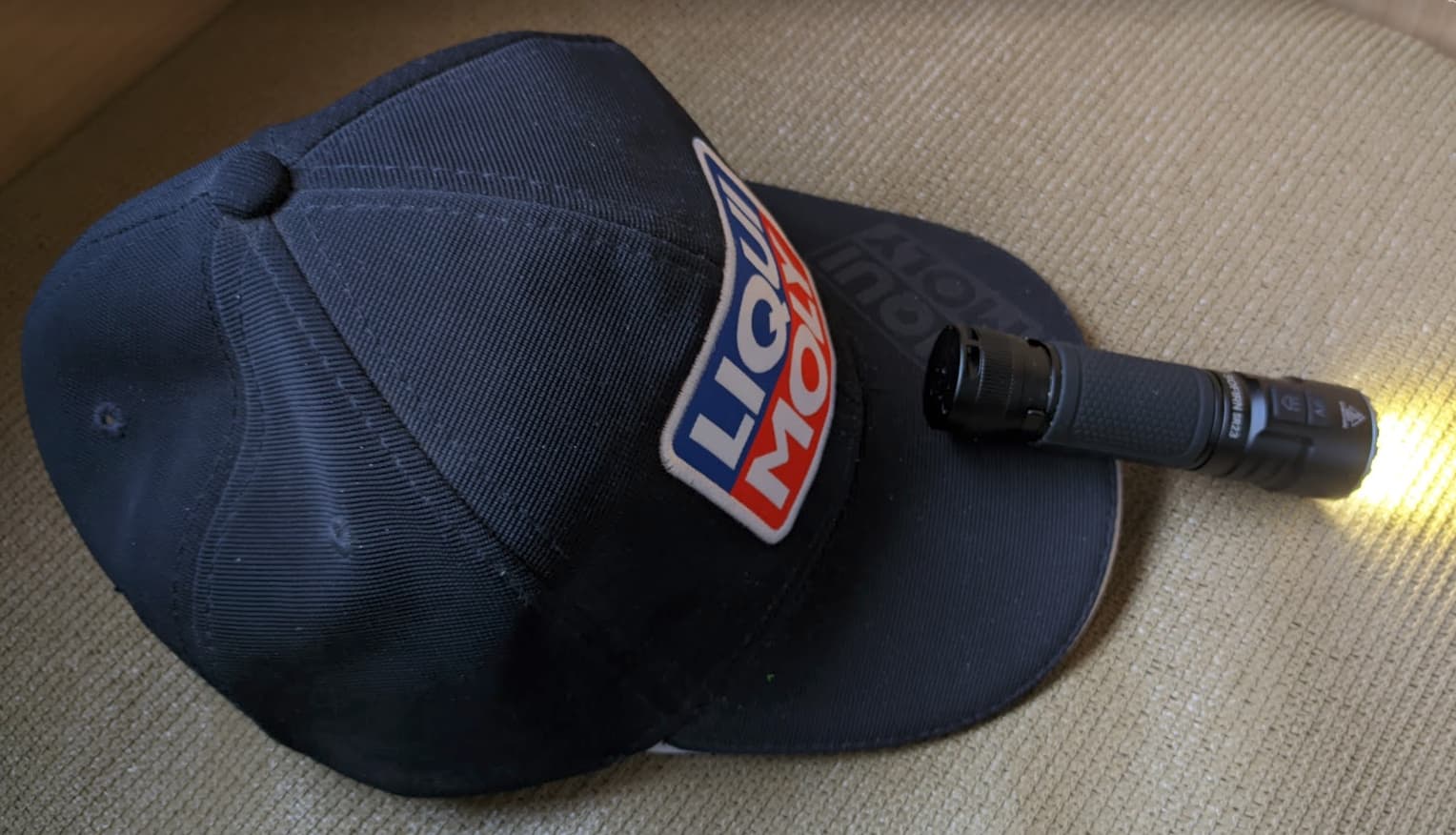
– the clip is robust and dual-direction and can actually be attached to a baseball hat’s visor (see below);
– the USB port rubber boot is in line with my other Sofirn lights and robust enough to protect the light from water ingress (didn’t try submerging it but had no problem in the rain or when I tested it under an open faucet)
– The light itself is surprisingly compact and light, quite comparable to my Wurkkos FC13 which is a 18650 light. - It came with a Sofirn-branded 5000mAh 21700 battery; I have quite a few of these batteries (3 came with my Q8 Plus and I bought a couple more to use as spares) and they’re actually quite good for up to 10A CDR use, and offer good capacity to boot. The battery arrived at 3.85V which is a bit over 50% charge and a good voltage to store/ship batteries at, and so far (despite having put it through quite a few hours of use) I haven’t needed to recharge it: the switch light battery indicator keeps reporting 50-75% charge. It’s amazing how much more endurance a 21700 battery gives when compared to the 14500 and even 18650 lights I have more experience with.
- The bezel crenellations are not too aggressive, and when leaving the light head-standing on a flat surface, leaked just enough light to let one know when it was turned on;
- I liked it came with a USB C-to-C cable; all my USB-ported lights so far came with USB A-to-C cables and had me replacing them with C-to-C which is actually what I use most.
WHITE LIGHT (NORMAL) USE
See the other reviews I pointed to above for more details, including beamshots and CRI/CCT/DUV measurements/estimates; I will add that, for my eyes and uses, the beam is well-formed and I didn’t notice any significant artifacts, despite the somewhat asymmetrical positioning of the white LEDs (due to there being 3 of them placed in a 4-point cross arrangement in the head, each one with its own TIR, with the 4th spot being taken by a separate embedded small smooth reflector containing the UV LED).
Despite Sofirn quoting a CCT of 6500K-7000K for the SR23, I agree with the other reviewers that it seems much lower; I would estimate around 6000K max (which is great since 7000K would probably be really aggressive to the eyes). The DUV, on the other hand, is not great: the light has a very distinct green tint to it, for use outside it didn’t bother me too much, but it’s quite apparent and disagreeable for normal indoor use (I wouldn’t even think about white-wall hunting as it would be sure to disappoint).
The flood is quite wide, and it’s safe to say almost everything in front of the user will be well illuminated; and despite it being no thrower, when placing it in turbo mode I was able to see quite well up to about 50m or so, which is more than I would expect from any flooder, specially one feeding on a single battery and with such small optics.
The thermal mass/management is also quite good; I didn’t notice any abnormal heating, and turbo lasted more than enough for my uses (albeit I tend to use it sparingly).
I also liked the boost driver: it’s well regulated and swapping the half-charged battery for a fully charged one didn’t produce any noticeable difference in brightness.
USE IN THE RAIN, ATTACHED TO A BASEBALL HAT
I tested the SR23 one night when it was raining and I had to do some urgent chores outside; anyone who knows me, knows that my preferred way to use a light in the rain is to stick it to the visor of a baseball hat so I can keep my hands free and have the light pointing to whatever I’m looking at, and at the same time keeping the rain out of my glasses (which is the reason a normal headlamp doesn’t work well for me in the rain).
That was doable thanks to its double-direction clip, and I’m glad to say that despite it being 21700-sized, the SR23 was light and compact enough to work well on my freebie/promo (so, not great quality) Liqui Moly hat: wouldn’t try to run or jump around with it, but for walking about and doing stuff it was totally stable:
USER INTERFACE
Anyone who knows me, also knows that I’m very partial to @Toykeeper’s gift to humankind, Anduril. This light does not have it, which I initially thought would make me dislike it (I actually gave my SC28 away a short time after reviewing it, because I couldn’t stand its UI).
Well, I’m happy to report I was wrong: the SR23 has quite a nice, electronic-switch-based UI, and given it’s mostly click-compatible with Anduril, the muscle-memory I acquired from all the years I’ve been using Anduril almost exclusively, works quite well with the SR23. That was a relief! Thank you @Sofirn very much, that was a great design decision and is much appreciated! 
The other reviews I pointed to above cover the UI very well, suffice it to say the only thing I miss from Anduril during normal use is the 3C-from-off command to blink out the battery voltage (in the SR23, 3C from either on or off turns on Strobe mode, which I detest – but we can’t have everything, now can we?  ). Also, the 3C-from-off is almost made redundant by the switch-light battery level indication, it’s just that I tend to 3C-from-off almost without thinking every time I want to check the battery in any of my lights, and then I get that extremelly irritating strobe – oh well
ANDURIL PORTING AND GENERAL HACKING POSSIBILITIES
Also, it’s not completely out of the question to have Anduril (or even a more click-compatible UI) ported to this light: I was very glad to learn Sofirn made the right call and included actual, honest-to-Dog flashing pads in the visible part of the driver’s PCB, accessible by just unscrewing the head from the flashlight’s body. I’ve been in contact with @Barry0892 and, while I promised to keep most of the details to myself, I can say its MCU is architecturally PIC-like, albeit not directly compatible (different instruction-set encoding, etc). I was able to determine it comes with 10KB of flash program memory, which albeit probably not enough to run full-blown Anduril 2.0 (unless its instruction encoding, or its compiler, are incredibly more efficient), should be enough for a very large subset of its functionality. Had I the time and the tools (AFAIWATD, it needs a proprietary flash programmer and SDK for development) I would probably be doing the port myself.
UV LIGHT USE
**WARNING** Do not go anywhere near an UV light without wearing certified UV-blocking glasses/goggles! UV light you shine on objects can and will reflect back to you, and will invisibly damage your eyes! Also be sure to expose as little skin as possible, eg use long sleeves and pants, and *never* shine any UV light on anyone’s face or skin. (UV-A like these lights emit is less damaging than UV-B or UV-C, but take all precautions anyway – remember, better be safe than sorry.)
The 4th LED in this flashlight emits 365nm (ie, UV-A, long-ish wavelength when compared to UV-B or UV-C) light. It comes with its own small reflector embedded in the light’s optics. Also, it comes with no ZWB2 filter, so I was expecting a lot of visible light mixed along with the UV, which would make it more difficult to see more faintly fluorescent targets when compared to my ZWB2-equipped Lumintop ToolAA UV 2.0. Also, Sofirn choose the SST08 as the UV LED for the SR23, which is supposedly less powerful (can take less current) than the SST10 that comes in the Lumintop, so (coupled with its significantly larger reflector) I was expecting the SR23 to get its UV butt badly kicked by the Lumintop.
I’m happy to report that doesn’t seem to be the case: I don’t own any photometers (much less an UV-capable one) or similar instruments, so I thought out and arranged a test setting using a scrap of strongly fluorescent white plastic (which does not glow in the dark, ie it stops emitting visible light as soon as UV light stops hitting it) and the UV “diffuser” that came with my Lumintop (which keeps glowing in the dark for a few minutes after the UV light stops):
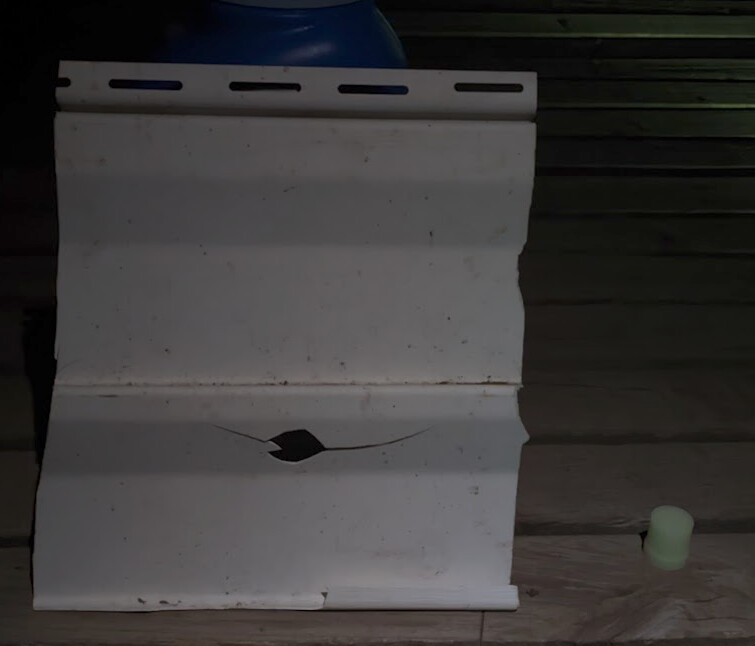
The Lumintop UV diffuser is the small, cylindrical piece of plastic to the right, and I think you can figure which one the plastic scrap is
 They were both positioned in a large outdoors area on top of a hip-level dark wood deck.
I then positioned myself at increasing distances, initially 3m (9.84ft for you Imperial-unit using barbarians ) tested both lights in both their high and low UV light modes, then moved to 5m and did the same, then to 10m, 15m, and 20m. I took care to observe both the intensity of the light being emitted back by the plastic scrap while each UV light was on, and the intensity and time until fade-off of the light being emitted by the GITD UV diffuser after the UV was turned off.
In all cases, with the lights in their high-intensity mode, both test objects seemed to glow back with the same intensity while the UV was on (and in the case of the UV diffuser, for about the same time after the UV was turned off). Also, in both cases, the limit of visibility for my old and very abused Mark-1 eyeballs was at about the 20m mark. At their low-intensity mode, the Lumintop seemed a bit less intense than the SR 23 also at low intensity, but not by much.
So, much to my surprise, the UV intensity of both the SR23 and the Lumintop ToolAA UV 2.0 seems to be about the same.
The other thing that surprised me when comparing both lights is that the SR23 in both UV modes had about the same visible light spill as the Lumintop, despite not having a ZWB2 filter like the Lumintop does. The only explanation I have for this is the fact the Lumintop has a ring of GITD plastic at the front, right after the ZWB2 filter, which glows strongly when the UV is on (I guess as a safety feature so people can always be aware the light is on) and the visible light being emitted by that ring may be, at least partially, defeating the purpose of its ZWB2 filter and causing the apparently equivalent visible light spill I observed.
CONCLUSION
As an UV light, the SR23 is a keeper for me: I like its UI, and it’s going to replace my Lumintop Tool2.0 UV as my main UV light with quite a few advantages:
- Dual white/UV light capability (the Lumintop is UV-only, which forces me to take a 2nd light when going outside with it);
- Much more convenient USB charging;
- Much, much more time between battery swapping/recharging given its 21700 battery vs the 14500 on the Lumintop;
I even thought about also replacing my Wurkkos FC13 with the SR23; unfortunately for my use cases it fell short in a few aspects, in order of importance:
- No powerbank capability (this is really important to me when I’m out and about; the FC13 has reasonably competent powerbank capability, and given my other Sofirn light (the Q8 Plus) also has it, I was kinda expecting the SR23 to have it too – alas, that is not the case);
- I already carry a small 14500 light (either my TS10 or my D3AA) as a flooder, so it would rather carry the FC13 as a thrower than another flooder like the SR23;
- Not really Anduril, albeit it comes close (if it was possible to prevent the strobe mode from being activated, like having some click-combo to permanently disable it, or something, it would come even closer).
ADDENDUM: OBLIGATORY SCORPION UV PHOTOS
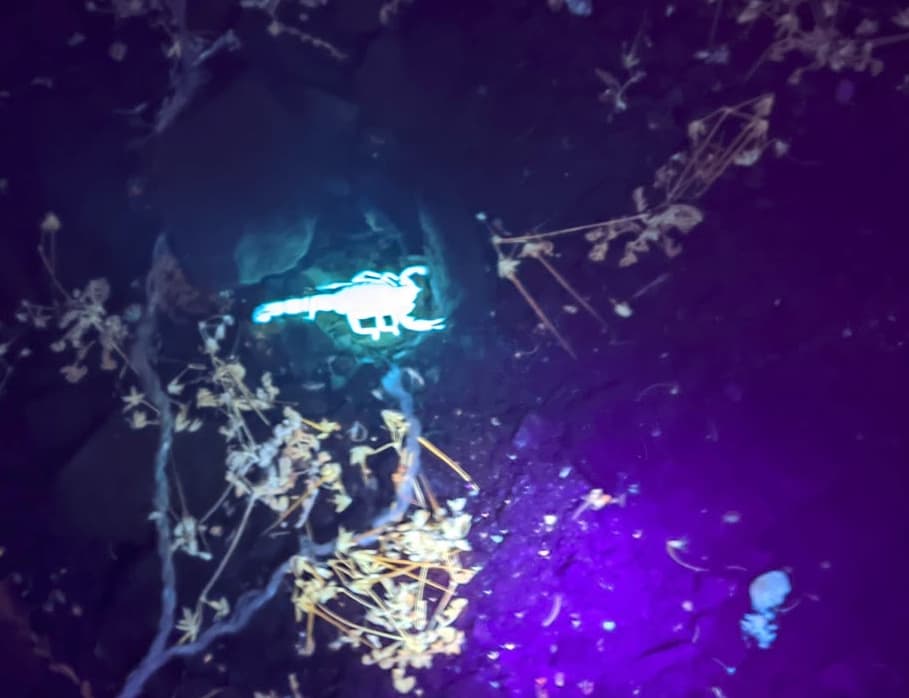
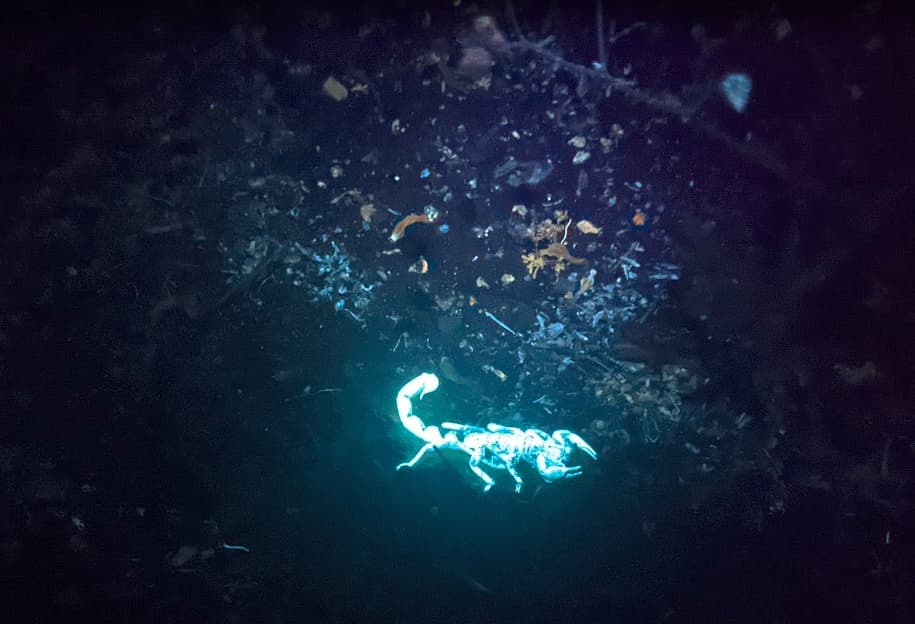
No escorpions (nor any fluorescent fauna/flora) around where I am right now, so all these pictures were taken when I was in a suitable area (Atacama Desert) a couple of years ago when all I had was the Lumintop; but given the very similar UV performance of the SR23 on my tests above, I would bet I could take very similar photos with it:




EoF