This review is of the upcoming Sofirn ST2, kindly provided by @Sofirn. Aside from the light itself, I receive no compensation for the review.
This is a white/red/UV 3-channel swivel head light powered by 2x18650 batteries. Click on the sections below to read more!
Basic observations
The light comes in a nice box as usual. Aside from the light, also included are a charging cable, lanyard, and a very thorough, large-print user manual, which I found to be clear and helpful for navigating the features of this light.
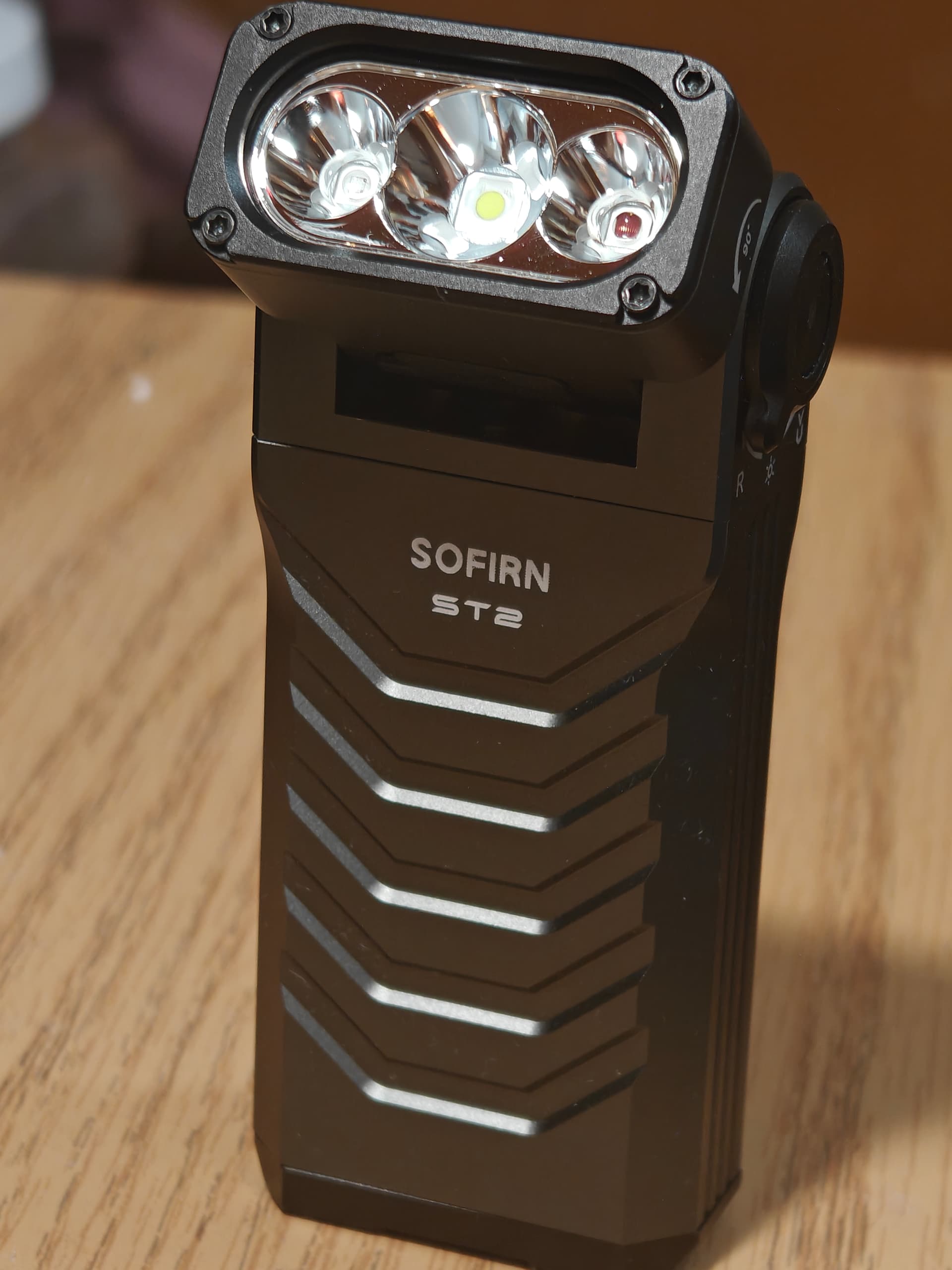
The light is well-built, with solid anodizing and no sharp edges. The swivel head action is smooth and stable at all angles within a 90-degree range.
Off to the side there is an e-switch at the center of a mode selection dial. On the front there is a type-C charging port protected by a silicone cover, and on the back there is a removable clip held by screws. The combination of the clip and swivel head allows the light to be clipped to a front pocket and point to the front of the user.
At the bottom there are two strong magnets that enable attaching the light to ferromagnetic surfaces.
Emitters, beam, and performance
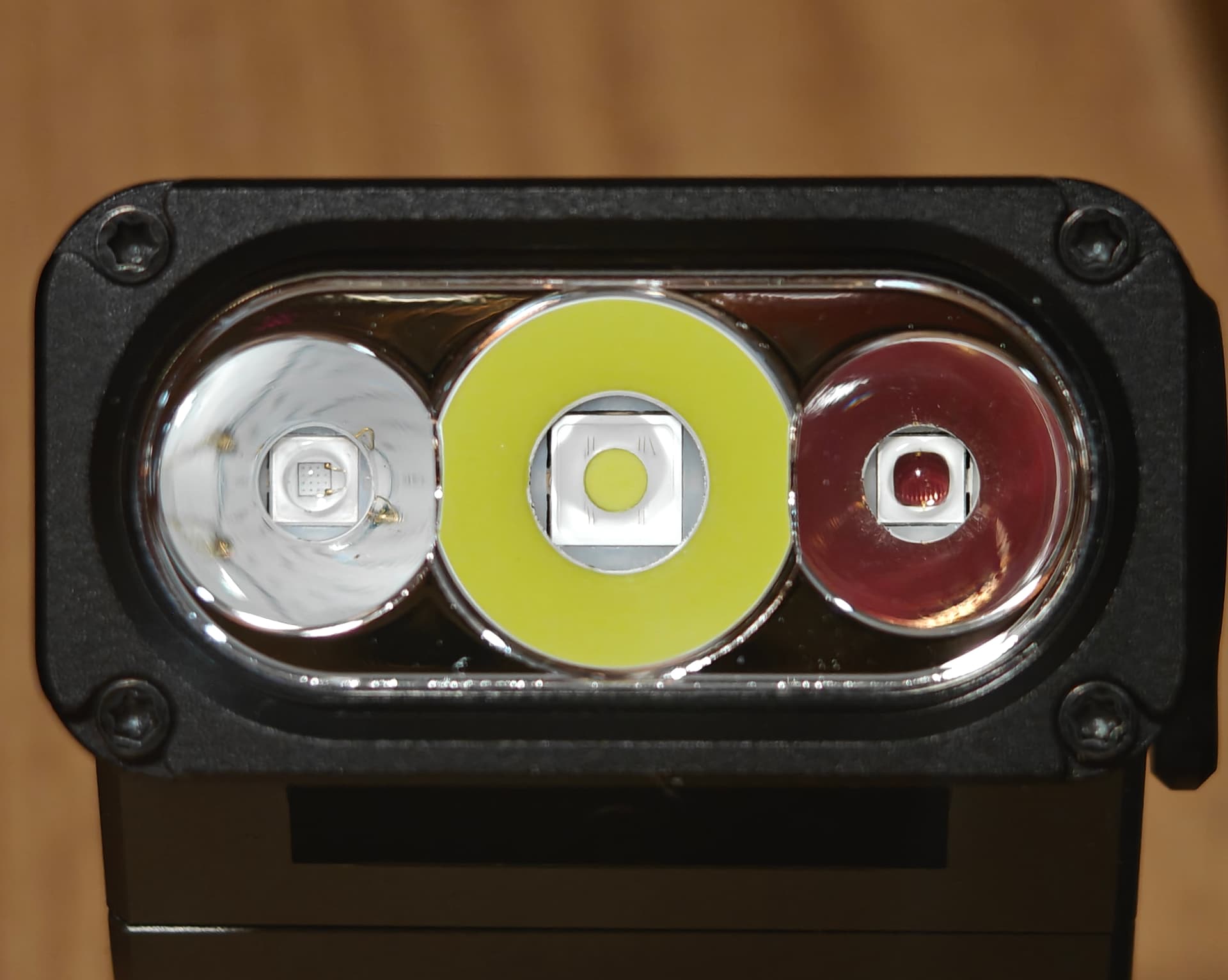
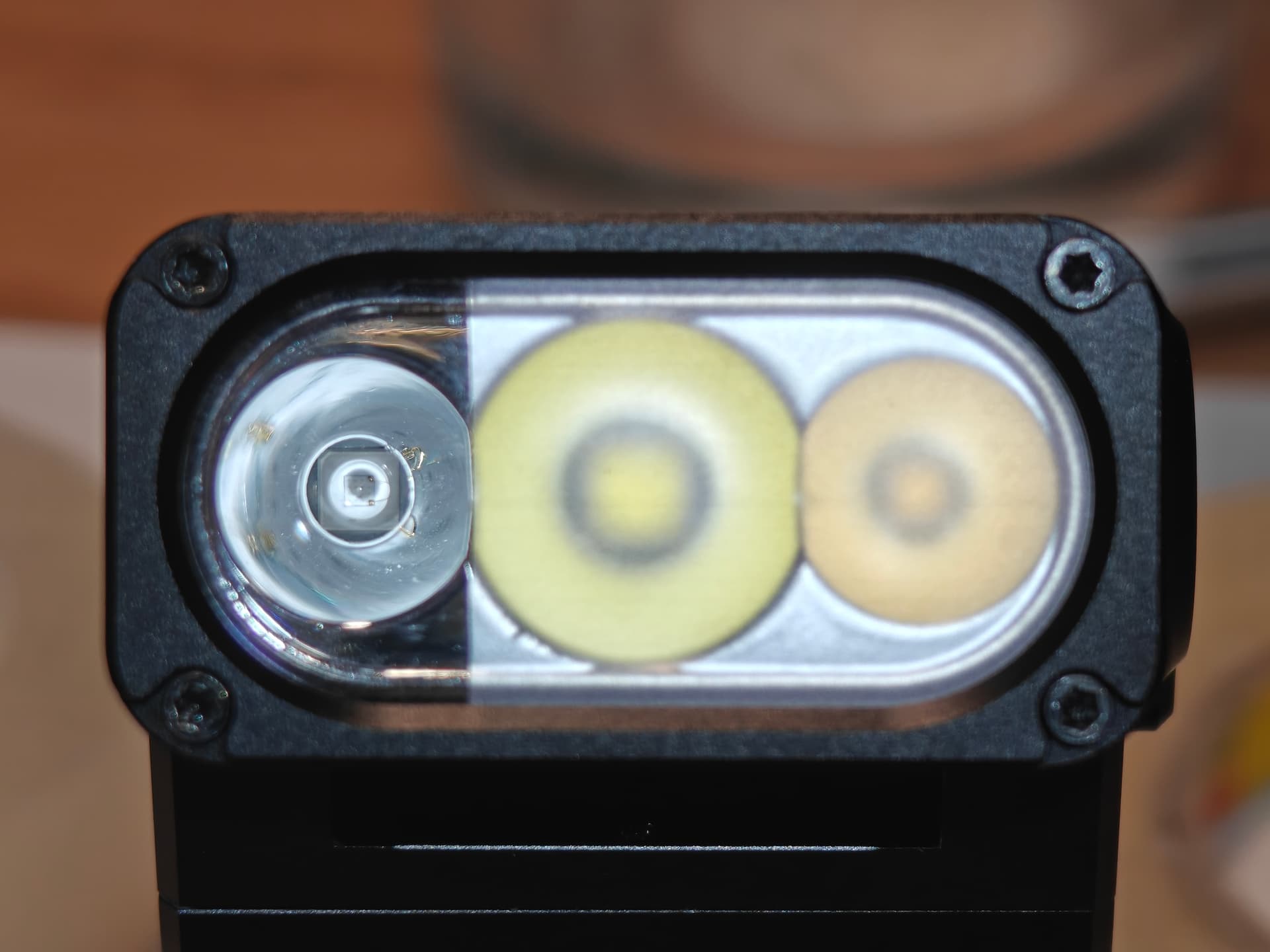
This light has 3 emitters in smooth reflectors behind an AR-coated glass: SFT42R (6500K) for the main light, plus SST20-DR (660nm) and what appears to be SST08-UV-H (365nm). I think this is a fantastic combination: the SFT42R provides simultaneously good throw and flood, the SST20-DR provides very powerful red, while the SST08 UV emitter throws quite well behind the smooth reflector, and with output very impressive for the small LES.

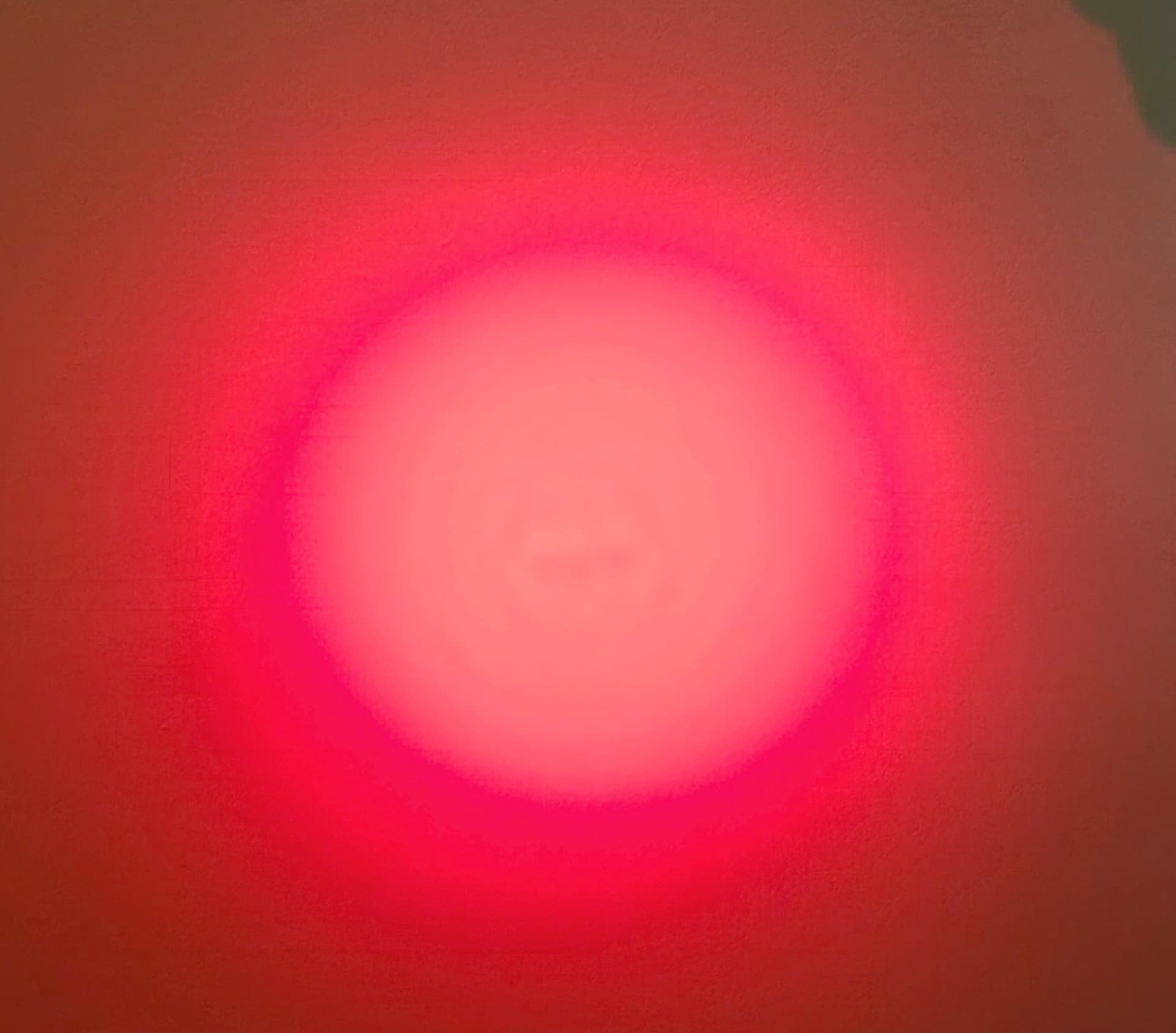
The hotspot appears slightly lopsided due to imperfect centering, but is not a problem in real use. The red hotspot exhibits some swirl patterns due to the striped construction of the SST20-DR’s die; for this, I would suggest changing the reflector from smooth to OP.
The UV emitter is quite interesting–judging by paper fluorescence, it matches the output of a Convoy S2+ with Seoul CUN66A1G, but in a much smaller and throwier package; furthermore, the forward voltage does not appear excessively high, and the brightness does not drop as much as other UV emitters as the battery depletes.
There is no ZWB2 filter, but this LED emits very little visible waste light. Given the recent discovery of how inefficiently ZWB2 filters transmit 365nm UV, I find this perfectly acceptable.
I don’t have a reliable way to measure lumens, but the claimed 3000lm seems credible, based on emitter tests and ceiling bounce comparisons with my other lights. I measured throw at around 300m, which exceeds the claimed 270m.
I cannot reliably measure the red output, but visually it seems to match an S2+ with 2.5A red buck driver.
User interface
The light has a rotary dial for emitter selection, plus an e-switch for brightness selection. The large-print manual is photographed below:
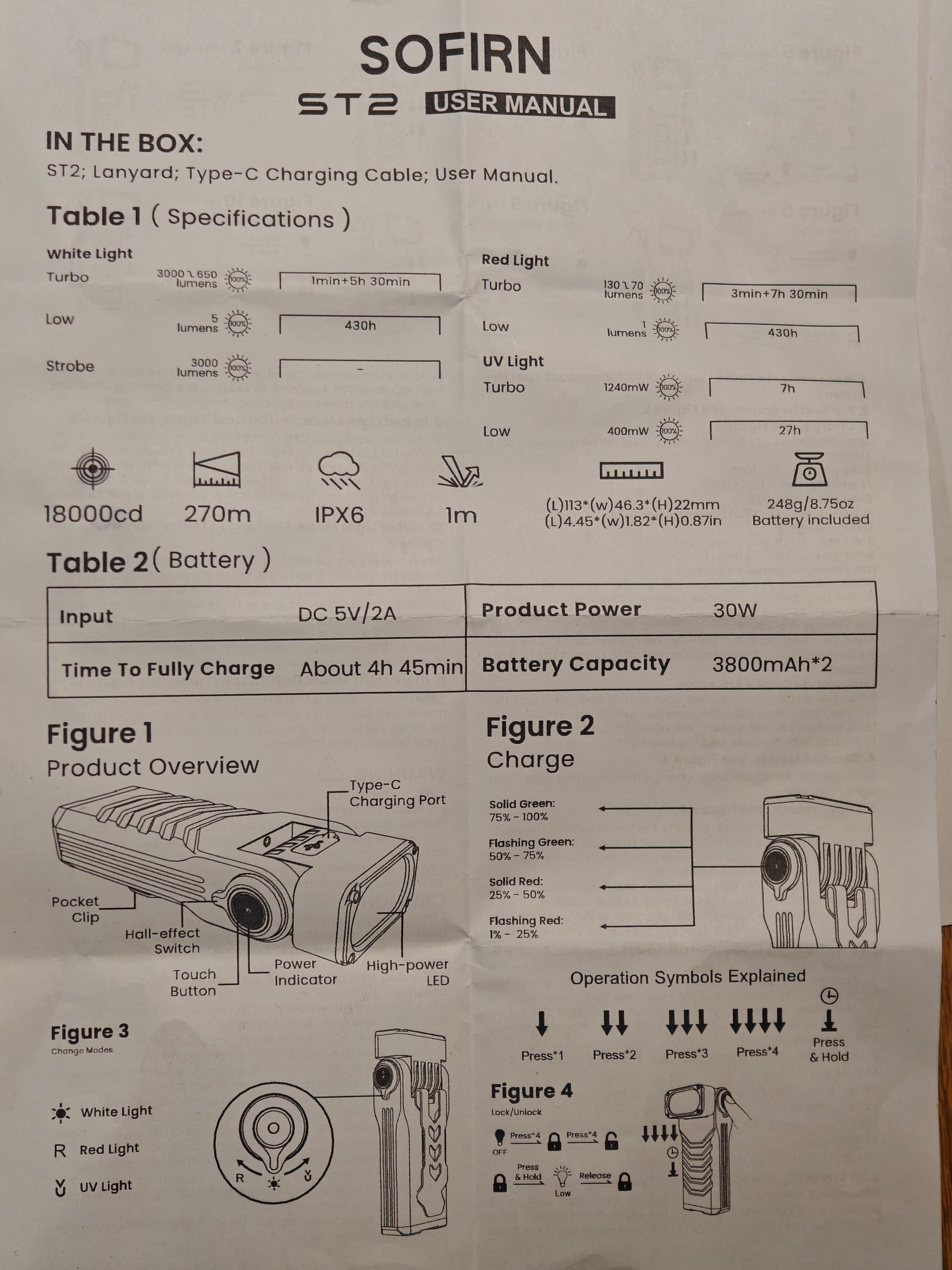

For both the white and red emitters, the basic UI is similar to Anduril simple mode: click for previously memorized mode (except for moon/turbo), hold for ramp, hold from off/double click for moon/turbo. I find this a good implementation, particularly the decision to not memorize moon and turbo. The ramp is smooth and “visually linear”.
Special blinky modes are available, but well-hidden behind the main menu.
The UV comes in 2 modes spaced around 4x apart (memorized and toggled by holding), which is an excellent design decision. Too many UV lights come in 100% only, which is inconvenient for low-power or sustained usage such as ID checking.
Interestingly, it is possible to have the light on and directly toggle the rotary dial to access the previously memorized mode in the corresponding channel.
Battery and charging
The light runs on two replaceable 3800mAh 18650 batteries, and has a type-C charging port protected by a rubber cover. The charging rate is around 2.2-2.3A, so 1.1A per cell. Some might find this slow, but the slower rate is good for longevity.
The e-switch has an indicator light that tells you the battery level during normal use, and also indicates progress during the charge.

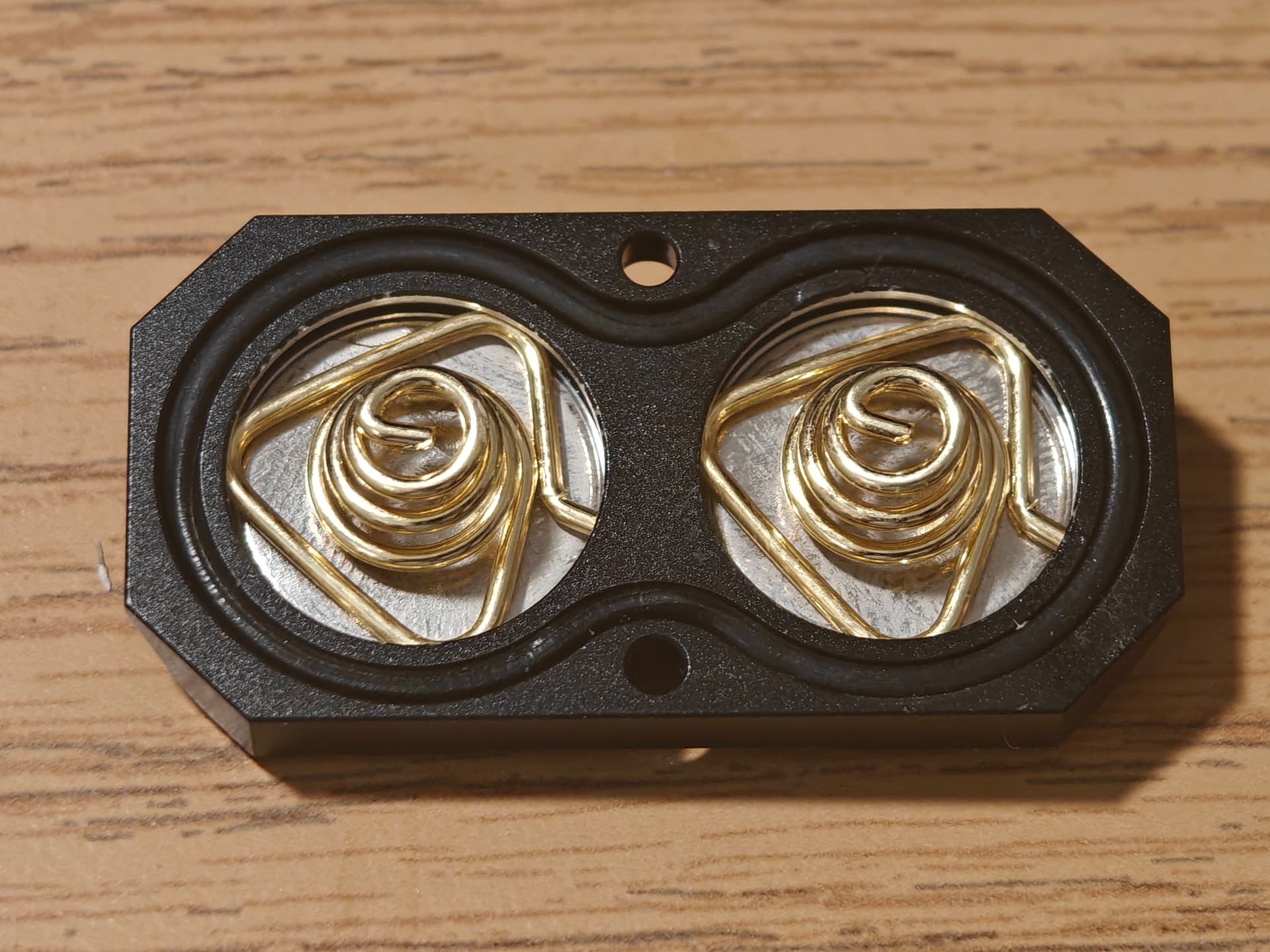

To open the battery compartment requires a torx screwdriver. Once opened, the battery compartment reveals two very thick and stiff springs, which is good for high current. Unfortunately, the springs may be too stiff and slightly dented the minus contact of the batteries. I would still trust the batteries, but if this light were dropped/impacted, the springs might be capable of doing more damage.
Since the current is already distributed across 2 cells, I would recommend using softer/thinner springs. If a battery replacement is needed, make sure the batteries used are flat top and as short as possible.
Teardown and mod!
One thing I love about Sofirn lights is that they are generally modder-friendly, and this one is no exception. The head can be opened by a torx screwdriver, revealing the bezel, an AR glass, an o-ring, the triple reflector, and gaskets & LEDs.
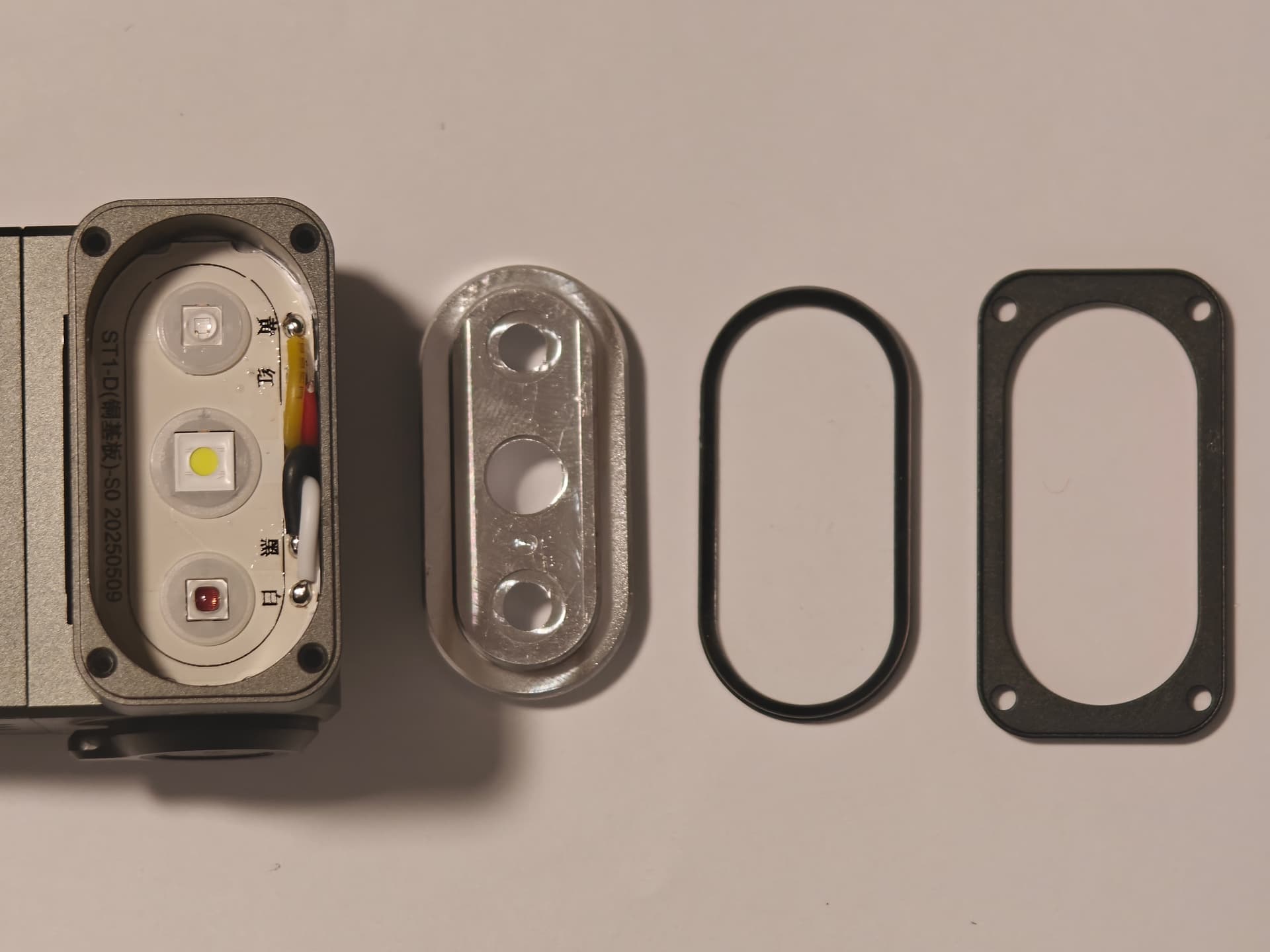

There are 4 wires, with Chinese characters on the MCPCB indicating which color goes where. If I recall correctly, the red pad was a common +, while the yellow, black, and white correspond to the - contact of their closest emitters. In any case, this can be easily checked with a multimeter. The MCPCB is copper and decently thick.

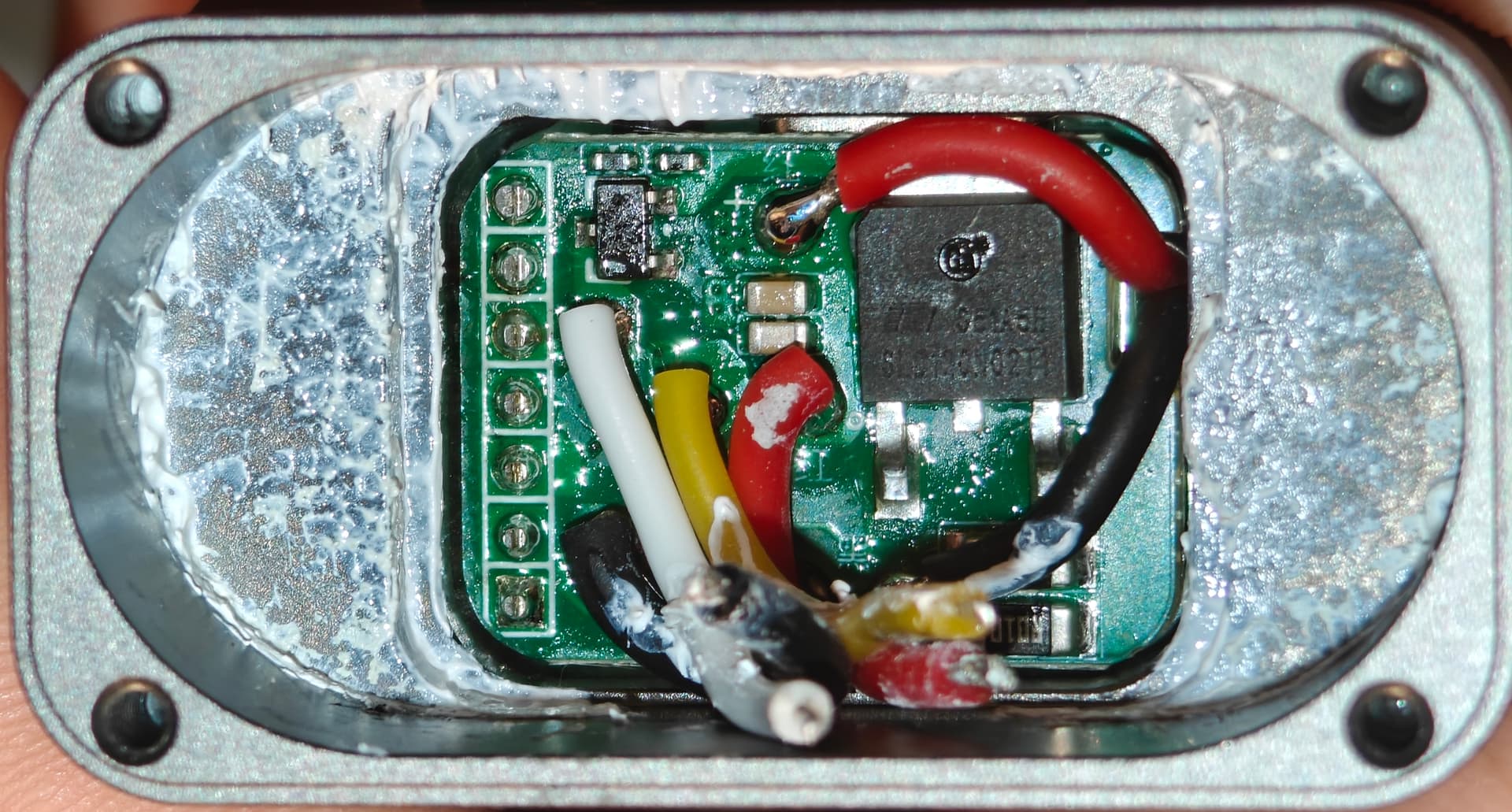
After desoldering the wires and removing the MCPCB, we arrive at the heatsink. It is not a single contiguous shelf: there is a brass (?) block in the middle that is thermally coupled to the remaining shelf by a generous amount of thermal paste. Not optimal, but adequate and convenient.
Lifting the block reveals the driver, which has a large square component thermally coupled to the block by a heatsinking pad. I’m guessing that’s a MOSFET, but someone should correct me if wrong.
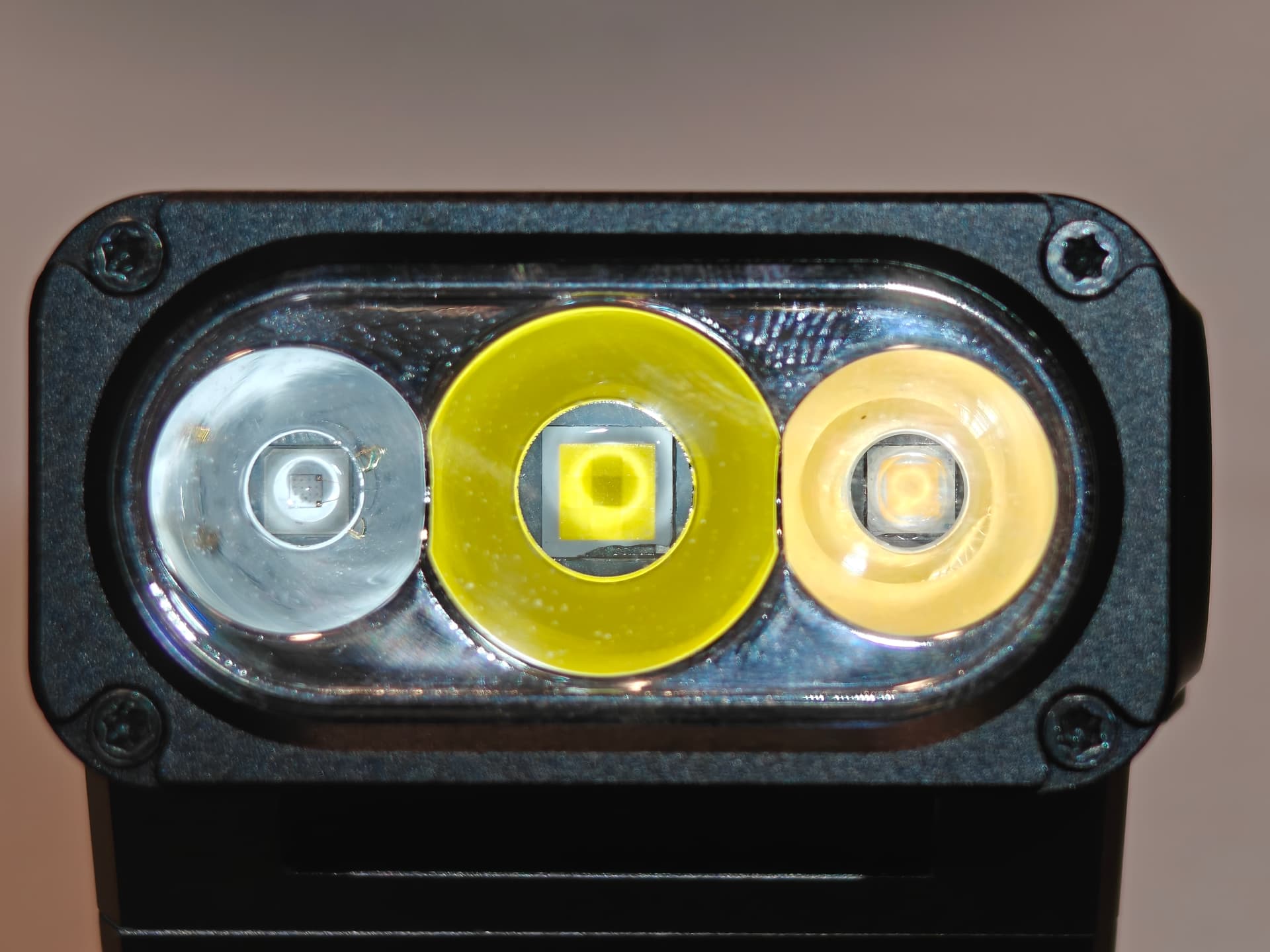
Just for fun, I’ve swapped the stock SFT42R for a LHP531 5000K, and the SST20-DR for a partially-sliced 519A 5000K–the 3030 pad accepts a 3535 emitter without issue. I also added frosted tape to smooth out any artifacts. The lights still works fine, though the ramp has become a bit fast on the low end and slow on the high end. I bet the swap of the SST20-DR to the higher-voltage 519A was responsible for this. I think I will keep the light in this configuration until 5000K SFT42R becomes available.
Concluding remarks
I think the ST2 is a unique and fantastic light. Although many lights on the market also have red/UV capabilities, they tend to be low-power and treated as a secondary feature. On the other hand, the ST2 offers high-power emitters and the full UI experience on all channels, which makes the channels as powerful/usable as dedicated red and UV lights, rather than an appendage or afterthought.
What I like:
- Great build quality and swivel feature
- Great selection of emitters, and high output+throw on UV/red channels
- Flexible and intuitive UI
- Replaceable batteries
- Easy to emitter-swap and convert to arbitrary 3-channel light
What I think can improve:
- Use softer tail springs to avoid denting cells
- Use OP reflector for white and red channels to smooth out the beam. Given how large the emitters are relative to the reflector, going from smooth to OP would not visibly lose any throw.
- Add a battery bank (reverse charging) feature
Thank you for reading!
 ?
?