Hi BLF,
We recently had the SPERAS PZ21 independently tested by 1Lumen, and we thought the results were detailed enough that they deserved a technical discussion here rather than just a link to the review.
We’re not posting this as “look how great our flashlight is.” The useful part of an independent review is that it measures the product under a defined test method and also points out things that could be improved.
So below we’ve summarized the main measurements, beam behavior, runtime, charging performance, UI, dimensions, and the reviewer’s criticisms.
Full independent review:
https://1lumen.com/review/speras-pz21/
What is the PZ21?
The PZ21 is a 21700-powered zoomable flashlight built around a Luminus SFT42R LED.
Its main design concept is simple: instead of choosing between a flood-oriented flashlight and a dedicated thrower, the head can be adjusted continuously between a broad flood beam and a concentrated spot.
The published configuration includes:
- Luminus SFT42R LED
- 1 × 21700 Li-ion battery
- Included 4,800 mAh 21700 battery
- Onboard USB-C charging
- Electronic side switch
- Adjustable flood-to-spot beam
- 2,700-lumen rated maximum output
- 900-meter rated maximum beam distance
- 202,500 cd rated peak intensity
- 151 mm length at the flood position
- 173 mm length at the focused position
- 48 mm head diameter
- 254 g with battery
These are the published product specifications. The numbers below are the measurements reported by 1Lumen on its review sample.

SPERAS PZ21 zoomable flashlight with adjustable flood-to-spot beam.
1. The most interesting part of the test: throw performance
The PZ21’s published specification is 900 meters of throw and 202,500 candela.
1Lumen measured the beam outdoors in darkness at a 10-meter measurement distance using a Dr. Meter LX1330B illuminance meter. Measurements were taken at the 30-second point, consistent with the reviewer’s stated approach for ANSI-style output and beam measurements. The reported ambient temperature for the throw test was 28°C.
Here are the reported results:
| Mode | Specified intensity | Specified throw | Measured intensity | Measured throw |
|---|---|---|---|---|
| Low | 7,500 cd | 173 m | 11,100 cd | 211 m |
| Medium | 31,750 cd | 356 m | 38,500 cd | 392 m |
| High | 79,000 cd | 562 m | 82,800 cd | 575 m |
| Turbo | 202,500 cd | 900 m | 266,000 cd | 1,032 m |
The most notable result is Turbo.
The measured peak intensity was 266,000 cd, compared with the published 202,500 cd specification. The calculated beam distance was 1,032 meters, compared with the published 900-meter figure.
1Lumen calculated the Turbo intensity as approximately 31% above the specified figure and the measured throw as nearly 15% above the published distance. It also reported that every tested output level exceeded the stated beam-intensity/throw figures.

One thing we find especially interesting here is that the PZ21 isn’t relying simply on high lumen output to achieve the long throw. The optical system is producing a very concentrated beam at the focused end of the zoom range.
2. Flood versus spot: the real purpose of the zoom system
The PZ21 uses a large convex lens and an adjustable zoom mechanism rather than a conventional reflector or TIR optic.
At the flood end, the light produces a broad wall of illumination. At the focused end, the beam contracts into a small and much more concentrated spot.
1Lumen described the flood beam as broad and relatively even, with only a slight outer halo. At full focus, the beam becomes a small concentrated circle designed for distance. The reviewer also noted a faint square artifact associated with the SFT42R emitter, while considering it relatively unobtrusive during normal outdoor use.
This is an important part of how the PZ21 should be understood. The point of the design is that the user can choose how concentrated the beam should be depending on the task.
For example:
Flood
Useful when you need to illuminate a relatively broad nearby area.

Intermediate focus
Useful when you want some foreground coverage but still need more reach.
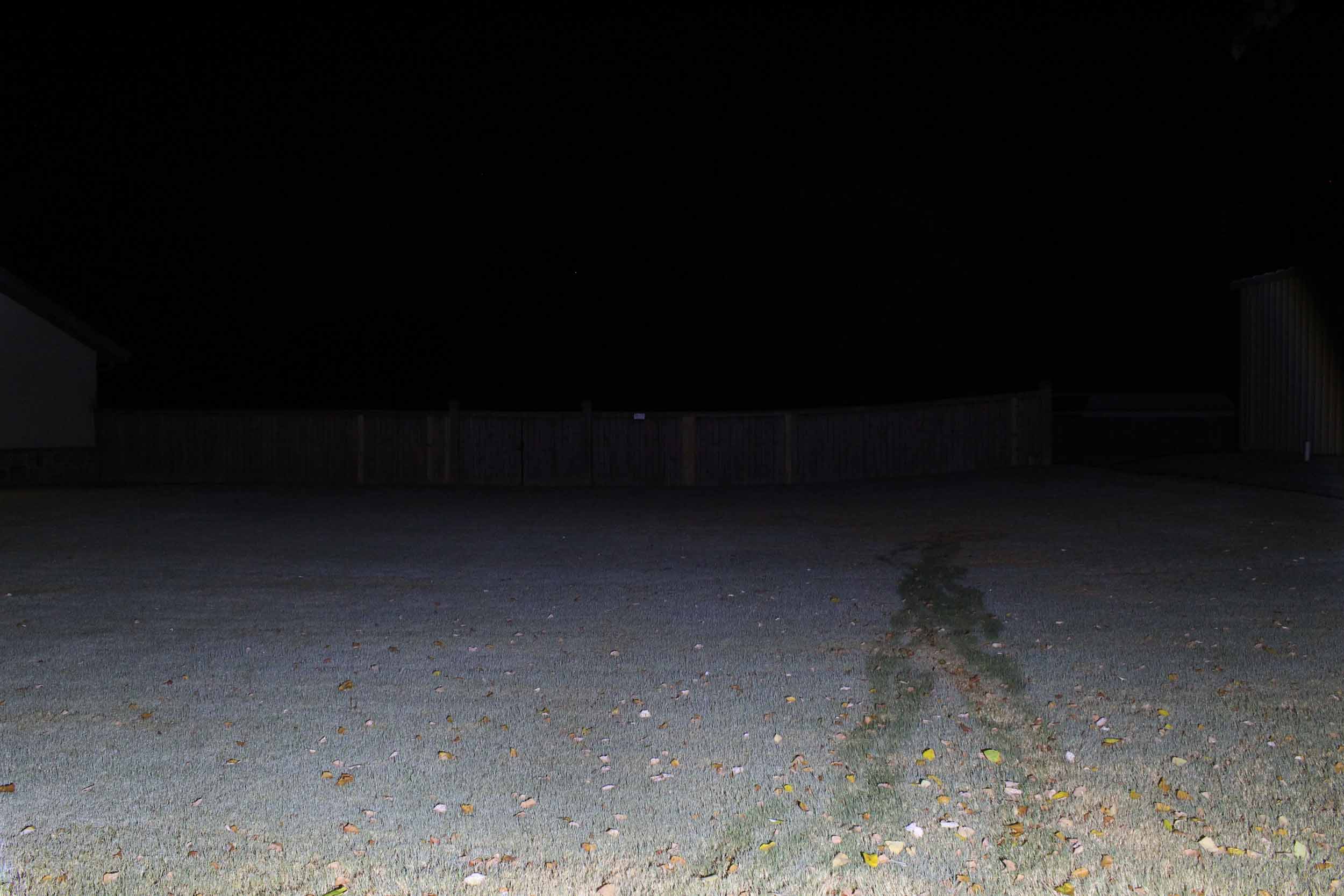
Spot
Useful when the target is far away and concentrated intensity matters more than peripheral coverage.
[IMAGE 3 – flood / intermediate / spot beam comparison]

The PZ21’s adjustable beam changes from broad-area illumination to a concentrated long-range spot.
3. Output measurement: 2,700 lumens claimed versus 2,543 lumens at 30 seconds
The PZ21 is specified at 2,700 lumens.
1Lumen uses an integrating-sphere setup and focuses on the 30-second measurement for its primary lumen comparison. The reported measurements were taken with a fully charged included SPERAS 21700 4,800 mAh battery. The review reports a 20.5°C ambient temperature during the lumen test.
| Mode | Specified | Turn-on | 30 sec | 10 min |
|---|---|---|---|---|
| Eco | 5 lm | 7 lm | 7 lm | 7 lm |
| Low | 100 lm | 110 lm | 110 lm | 109 lm |
| Medium | 400 lm | 367 lm | 365 lm | 365 lm |
| High | 1,000 lm | 905 lm | 891 lm | 385 lm |
| Turbo | 2,700 lm | 2,792 lm | 2,543 lm | 416 lm |
The Turbo measurement is interesting because the initial reading actually exceeded the 2,700-lumen specification at turn-on, reaching 2,792 lumens.

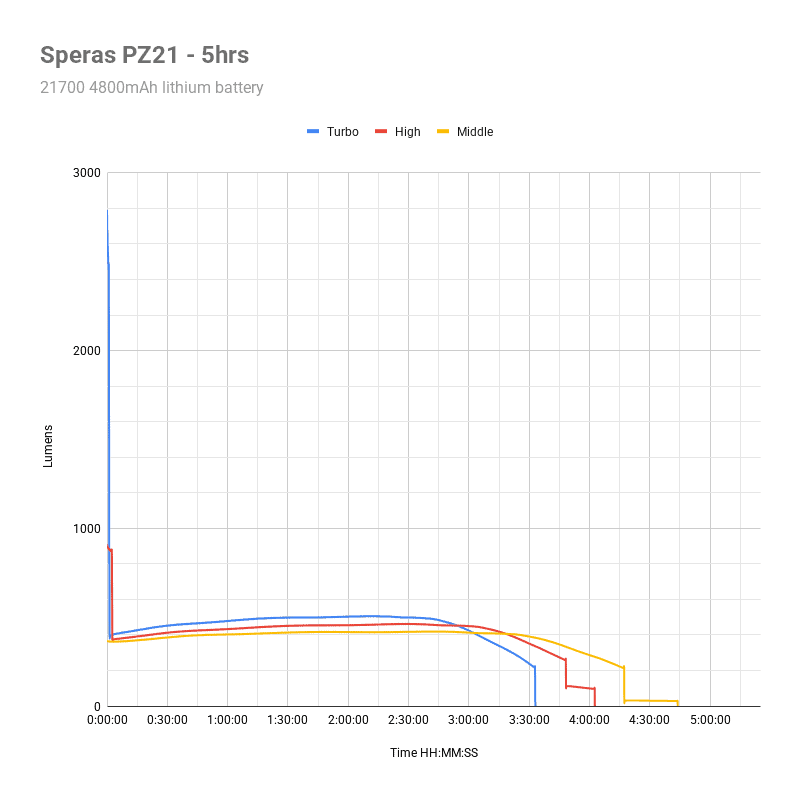
At 30 seconds, the measured output was 2,543 lumens, which is about 94% of the published specification.
This is also a good example of why it is useful to distinguish between:
- initial turn-on output
- standardized 30-second output
- longer-term runtime behavior
4. Runtime: the test results were also above specification
1Lumen measured runtime using the same included 4,800 mAh 21700 battery.
The report provides both ANSI-style runtime and total runtime to shutoff for the tested modes:
| Mode | Specified runtime | Measured ANSI-style runtime | Time until shutoff |
|---|---|---|---|
| Medium | 4h | 4h 17m | 4h 43m |
| High | 3h 18m | 4h 02m | 4h 02m |
| Turbo | 3h | 3h 28m | 3h 33m |
Eco and Low were not assigned ANSI runtime values in the review’s table.
According to 1Lumen’s calculations, Medium ran about 7% longer than the stated value, High about 22% longer, and Turbo about 16% longer.
The reviewer therefore described the runtime performance as exceeding the published values across the tested modes.
This is particularly relevant for a 21700 zoomable flashlight, because a design like this is likely to be used for longer outdoor sessions rather than only short EDC tasks.
5. Charging and battery performance
The PZ21 uses a single 21700 Li-ion cell, and the review sample included a SPERAS-branded 4,800 mAh battery.
Unlike a design where the USB port is integrated into the removable cell, the PZ21 has onboard USB-C charging built into the flashlight body. The charging port sits under a protective rubber cover. The light can also operate while charging, although the review notes that only Eco mode is available in that state.
SPERAS specifies approximately 3.5 hours for charging.
1Lumen performed multiple charging tests and reported an average charging time of approximately 3 hours 33 minutes, which was very close to the published figure.
The reviewer’s USB measurements reported:
- maximum charger input capability listed by the review: 18 W
- maximum measured charging power: about 8 W
- measured values around 5 V / 1.6 A
- final battery voltage: 4.2 V
- average onboard charging time: 3 h 33 min
- USB-C to USB-C charging supported
The side-switch indicator also functions as a battery-status indicator:
- Green: approximately 70–100%
- Orange: approximately 30–70%
- Red: approximately 10–30%
- Flashing red: below 10%

6. LED and optical characteristics
The PZ21 uses a Luminus SFT42R.
1Lumen describes this as a high-intensity, throw-oriented emitter and notes its round-die construction. The combination of the emitter and the large convex lens is intended to support the focused-beam behavior of the PZ21.
The reviewer’s Opple Light Master IV measurements put the tested color temperature roughly between 6,012 K and 6,707 K, depending on mode and focus position. All measured DUV values were negative, ranging from -0.0004 to -0.0046. 1Lumen therefore characterized the light as cool white rather than high-CRI output.
The reported spectral measurements were:
| Configuration | CCT | DUV |
|---|---|---|
| Low Spot | 6707 K | -0.0016 |
| High Spot | 6346 K | -0.0021 |
| Turbo Spot | 6012 K | -0.0004 |
| High Flood | 6441 K | -0.0027 |
| Turbo Flood | 6198 K | -0.0046 |
CRI could not be measured by the reviewer’s instrument for these tests.
This means the PZ21 is clearly more focused on output, intensity and adjustable beam behavior than on high-CRI illumination.
7. Size and handling
The PZ21 measures:
- 151 mm in its shortened flood position
- 173 mm when extended to the focused position
- 48 mm head diameter
- 25 mm body diameter
- 182 g without battery
- 254 g with battery
That puts the PZ21 firmly into a different physical category from a minimalist pocket flashlight.
The 48 mm head is large, but the reviewer specifically noted that the light felt lighter in hand than expected, despite the large head assembly, and that the overall balance remained comfortable.
At the same time, the review points out some practical compromises:
- the main grip is relatively smooth
- there is no pocket clip
- no holster was included
- the head has no meaningful anti-roll protection
- the included lanyard was considered fairly basic
- there is no magnetic tail cap
8. User interface
The PZ21 uses a single electronic side switch.
The basic interface reported by 1Lumen is:
From OFF
- Single click → memorized mode
- Hold 0.5 sec → Eco
- Double click → Turbo
- Three rapid clicks → Strobe
- Hold 2 sec → electronic lockout
While ON
- Single click → Off
- Press and hold → Low → Medium → High
- Double click → Turbo
- Three rapid clicks → Strobe
Strobe / SOS
- Three rapid clicks from Strobe → SOS
- Single click → return to previous state
The light includes mode memory and also provides mechanical lockout by slightly loosening the head/tail contact, according to the review.
The reviewer also reported no noticeable PWM to the eye.
This is one of the areas where we would be particularly interested in BLF feedback: How do you feel about the interface of a zoomable 21700 light using a single electronic side switch?
9. What 1Lumen liked
The review’s positive conclusions can be summarized as follows:
Long-range performance
The PZ21 exceeded the published throw figures at all tested levels, with Turbo reaching 266,000 cd and 1,032 meters in the reported test.
Runtime
The tested Medium, High and Turbo modes all exceeded their published runtime values according to 1Lumen’s test.
Adjustable beam
The reviewer considered the flood-to-spot zoom system versatile, allowing one flashlight to serve both nearby and distant lighting tasks.
Construction
The review described the machining and fit of the tested sample as good and noted that the flashlight felt well balanced despite the large head.
Onboard USB-C
The integrated charging system matched the stated charging time closely in the reviewer’s testing.
10. What would we change?
We also don’t want to ignore the criticisms.
1Lumen specifically pointed out:
Round head / anti-roll
The bezel is completely round, so the flashlight can roll when placed horizontally.
Grip
The main body is relatively smooth and doesn’t provide aggressive grip texture.
Carrying options
There is no pocket clip or holster in the package.
Lanyard
The reviewer felt the included lanyard was less refined than the rest of the package.
Tint / CRI
The light is cool white and not designed as a high-CRI flashlight.
We think these are reasonable observations, especially because they relate to everyday handling rather than the core flood-to-spot and long-range concept.
11. Our takeaway as the manufacturer
The most valuable thing about the 1Lumen review for us is not the 4.5-star rating.
It’s the measurement data and the independent observations.
The PZ21 was designed around a fairly specific concept:
one flashlight that can produce broad nearby illumination and then transition into a concentrated long-range beam when needed.
The independent measurements support that concept.
At 30 seconds, the tested sample produced 2,543 lumens on Turbo, compared with the 2,700-lumen specification. At the same measurement point, peak intensity reached 266,000 cd and calculated throw reached 1,032 meters, compared with the published 202,500 cd / 900-meter figures.
The runtime tests also exceeded the published values in the modes tested.
At the same time, the review makes it clear that the PZ21 is not trying to be the smallest possible pocket EDC.
The 48 mm head, 151–173 mm length, 21700 battery and adjustable zoom assembly make it much more naturally suited to:
- hunting
- spotting
- property inspection
- camping
- outdoor observation
- situations where broad illumination and long-distance reach are both useful
That interpretation is also consistent with 1Lumen’s own conclusion.
14. We’d like to hear from BLF
This is actually the part we’re most interested in.
Independent testing can tell us a lot about output, candela, throw, runtime and charging.
But BLF users often pay attention to things that laboratory numbers don’t fully capture.
So we’d genuinely like to hear your thoughts on the PZ21.
What would you change?
For example:
- Would you prefer some form of anti-roll feature on the head?
- Do you think a holster should be included for a 48 mm-head flashlight?
- Would more grip texture improve the design, or would it make the body less comfortable?
- How important is a magnetic tail cap on a light of this size?
- What do you think about the flood-to-spot beam profile?
- How do you feel about the single electronic side-switch UI?
- Would you prefer a warmer or higher-CRI emitter, even if that affected maximum throw/output?
- For those who regularly use zoomable flashlights, what would you improve about this design?
We’re interested in critical feedback as well as positive feedback. That’s one of the reasons we’re sharing the independent measurements in detail instead of only quoting the headline results.
Full independent review
SPERAS PZ21:SPERAS PZ21 Zoomable Hunting Flashlight | 2700lm & 900m Adjustable Foc – Speras Light
The review was published in August 2026. 1Lumen states that the review sample was supplied by SPERAS at no cost, and that it was not paid for the review and did not hold back reported problems or defects.