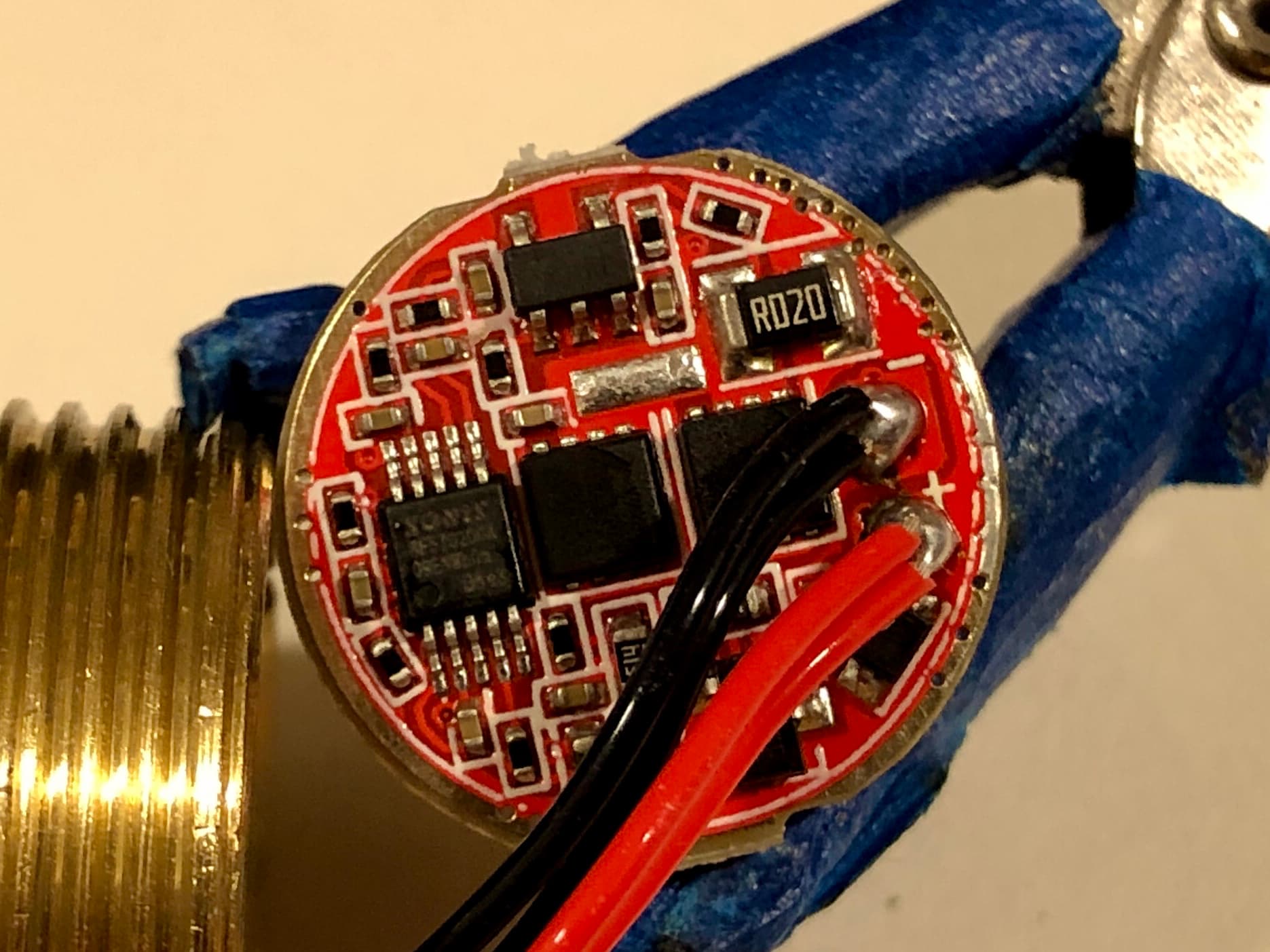
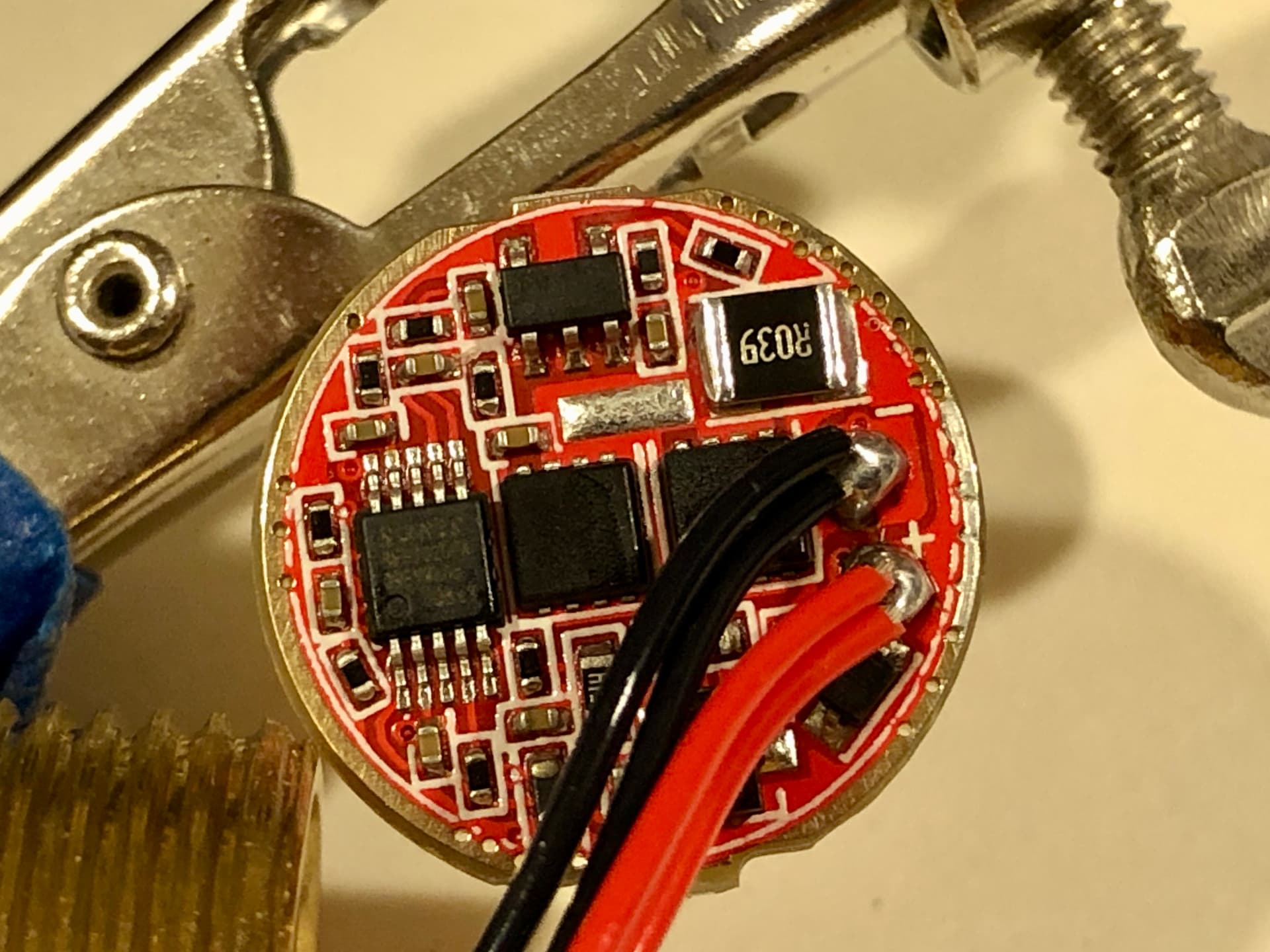
I just tried removing a sense resistor on one of my Convoy 5a drivers, I feel like my iron was in contact too long, the driver started melting its way into the rubber pads on the clamp I was using to hold it (will use a metal clamp next time), hopefully I didn’t damage any parts near the sense resistor.
I did watch a video posted on here somewhere on soldering / desoldering to the driver.
Anyway, what is a good temperature to set a soldering iron to for parts like this? I had it around 700f, which is what I used for a few things in the past, don’t remember if it was because they had silver solder though.
I have a few more drivers to do this to. Should I buy some cheap soldering tweezers to help speed up removal of the resistor? Or is it ok to be heating up the resistor and driver like I did?
Should I remove the leftover solder blobs from the driver before resoldering the new sense resistor and wires? Or is it ok to just reuse them?
For the new sense resistors, I see different options, not sure what is relevant for this application (metal foil, metal element, thick film, anti sulfur, automotive, pulse withstanding etc.)
Are these resistors ok to use? I just chose one that looked “fully loaded”
For 5A driver WSLP1206R0300FEA
If desoldering like this, do I need to lower my irons temperature? Think I might have to get a bigger tip for my iron. At 3:50 it looks like he just heated up the whole resistor, I feel like it would melt if I used my iron at 700f, although I have never done this before. I’ll see if I can find some scrap electronics to try these methods on.
Yes it’s easier if the tip can cover the two therminals, this is where the ”K” tips are useful, but large bevelled tips also work.
Adding a lot of solder help covering the joints even if you have a smaller tip. The generous amount of flux helps the newly added solder wetting the joint and transfering heat to it, adding leaded solder helps lowering the melting point of the lead free solder on board.
Personally I rarely need to go above 350°C
Sounds like I may need to get a couple new tips for my iron and lower the temperature a bit.
Would you use a temperature less than 300c? Would 250c be enough to desolder something this small? I just want to avoid possibly damaging the extremely tiny components near the sense resistors. Not used to working on things this tiny.
To remove resistors I use 2 soldering irons (my old cheapo one and my good one) and put a tip on both sides, melt the solder, and lift it out. I also put flux on the resistor beforehand.
I set my good soldering iron at 700F. My older one is not adjustable, but is certainly much higher than 700F.
Just this weekend I replaced numerous sense resistors on my Convoy drivers. I got my replacement resistors from AE at this store: 50pcs 1210 SMD Resistor 1% 0.5W
They came in around a month and cost less than $3 for 50 of them.
You want to do it quickly so the heat doesn’t have time to transfer into the circuit board through the pads. Lower temps may not be better as it will take longer to melt the solder- resulting in more heat transfer. I usually find 330C is good for most soldering- it should be plenty for removing a SMD. Lower than 300C and you may not be hot enough to melt the solder (depending on what type has been used.)
This is all great info. I plan on doing some resistor mods in the future and they’re pretty intimidating. I’ve never tried, but one thing I’d recommend is a good hands-free magnifying glass!
I will keep that in mind. I’m down to 1 iron at the moment, but if I have 2 on hand in the future I will try that.
I guess I’ll wait to find some scrap circuit boards to practice on with different temperatures and techniques in that video.
The 1210 is about 1mm wider than the 1206, does it still fit ok? Not too big? Thanks for the link but I would never use that many resistors . I also couldn’t find the resistances I wanted in .5 - 1w from them. But will keep them and aliexpress in mind for future component purchases.
Ok, thanks, will keep it in the 330 - 350c area. Although I think I did transfer a lot of heat into the circuit board through the pads . Hopefully the next one goes better.
I finally finished the light. Soldering in that little 1206 resistor was kind of annoying, kept wanting to flip around. Also had a little trouble resoldering the led wires to the driver, but it works now, so
Well, not finished completely, I had removed the old resistor too soon, forgot to try out my triple as a 5a first before making it a 3a, so I put another .020 resister back in. So, still have to reduce it to 3a after I give it a thorough test.
If you’re making a triple, 5A should be good with just about any LED.
Keep in mind too that these Convoy drivers have temperature regulation, so if it gets too hot, the driver will throttle down the amps so it doesn’t overheat.