Fussing with my lights recently I pulled out my old Energizer Hard Case PRO Work Light 550 lumens (HCAL412). Well, pulled it off the refrigerator where it usually resides. Checking the brightness, I found it it had faded some. I'm using 1.5V alkaline rechargeables. They had faded some, and needed recharging. On a whim, and reasoning that brightness is directly related to voltage, I decided to replace two of them with the two 14500s I use for my Nicron N7. Super bright! I get that running two different voltage batts together is not good, so I wonder if I just bought another set to use in the HardCase could do long-term damage to the LEDs. The light takes 4 AA's, but works fine with only two stacked, so it runs with 3V. With 14500s, that would be 7.2V, so that doesn't seem like too much of a stretch?
It really depends on the driver in the light and how the led’s are configured. If there’s a current regulator that helps to ensure that the led’s get what they want, then it’s possible that the (much) higher voltage will be ok, but it’s more likely that it will pop a component soon or sooner. Think of it like a 2-year old punching a piece of drywall compared to an adult punching a piece of drywall…voltage is pressure so the more you have, the more punch it packs, and components have max values of what they can sustain in operation. Often that’s around 6v or so but it really just depends on the individual components selected and what all is going on in there. Your two 14500 fully charged will be around 8.4v by the way…7.2v on those would be just the nominal voltage rating and near the point where many people will start to pull them for recharging. If the emitters themselves actually got that much voltage they most certainly will burn up in some fashion, but most designs prevent that from happening. I’m curious what your light is like, though….running on two cells, ok, but when using four cells is it adding that second set in parallel (same voltage, extra capacity), or is it in series (double voltage, same capacity) and then bucking that off in the driver?
You might consider some of the newer 1.5v rechargeable lithium-ion cells on the market if you use that light a lot and like it brighter. Those cells have a 3.7v cell inside but a circuit board that bucks it down to 1.5v output, so they’re like a fully charged alkaline and have a flat sustained output (until they shut off abruptly at the end of their capacity…not so convenient). Kind of an expensive initial cost but a 4-pack with charger seems to hover around $30 give or take. Xtar and Hixon are larger brand names available on amazon. The disposable Energizer lithium metal primary cells also give a little boost but they get pricey if you use the light a lot.
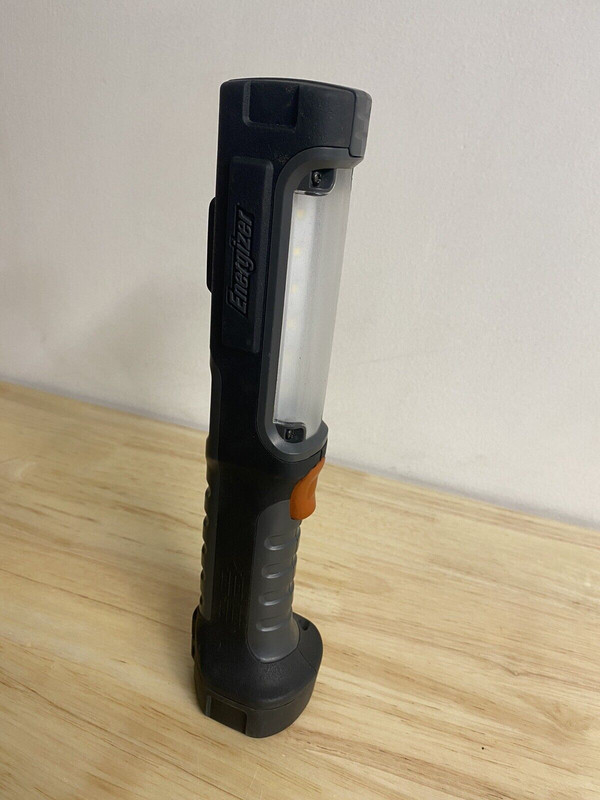
Yep. It has six emitters running presumably in parallel, so I doubt overcurrent would be a problem. Just double the voltage.
Yeah. All the magic (or lack of) happens in the driver circuitry, though. I wouldn’t risk it without trying to learn about the driver and components in there. The emitters they use in this type of light aren’t nearly as robust as what we usually use in flashlights, and just can’t handle much current or overvoltage usually (all emitters have some tolerance there for overvolt and reverse voltage but not a whole lot). But hey, at least nothing went sizzle in your test! Very likely to do so, however.
Correllux explains it well. leds are not linear component meaning that brightness is not directly related to voltage. You should not use lithium batteries in this lamp unless you open the circuit and understand how it works and if it is designed to do. Lucky that nothing bad seemed to happen!
I guess the remaining two 1.5 V batteries limited the current with their internal resistance. With only the two Li-ion batteries the LEDs might have been destroyed.
What you have done is not healthy for the LEDs, the flashlight or the batteries. The LEDs are not made for high power, the light is not made to dissipate the heat and your 1.5 V batteries in series will suffer from the high load and eventually reverse charge.
Rechargeable alkalines are pretty unusual, I wasn’t aware they were still available or that people are using them.
I believe they have quite high internal resistance compared to NiMh rechargeables, so they can’t supply the current that the light wants, which might be the cause of the dim light.
Do not mix cells of different chemistry or different charge status…. At all.
Seems strange to me that the cells are in 2S2P arrangement, normally products are 4S1P.
[Rechargeable alkalines are pretty unusual,]
Mostly they are a contradiction in terms, and generally not a good idea. If you are going pay for RECHARGEABLE, it’s more pragmatic to do NiMh.
People get the idea they can charge……regular……alkaline. There are all kinds of reasons this is NOT A GOOD IDEA-poor performance, much higher leak probability, need to only discharge part of the capacity before charging or they go bad faster, short life-span anyway, and not particularly cheaper since they do reach end of life sooner.
Why bother?
Don’t you mean NiCd (nickel cadmium) rechargeables?
I don’t know the light, but it could well be a 1 mode ON/OFF thing with a resistor to limit the current.
Not a good idea to just double the Voltage, unless you don’t care about the light anyway.