Wuben X4 field test report
Conflict of interest statement:
I’ve been given a Wuben X4, the test subject, free of charge with no contractual obligations in return for a freeform review posted on BLF. I will be keeping the test subject and/ or gifting it to someone in personal capacity because it’s neat (: but also broken ): I’ve also been given access to Wuben affiliate reward programme but won’t be participating to minimise further bias.
After the testing period during which the light fell and broke I’ve provided this text to @william1, who’s been my contact with the company. William has not requested any changes, additions or omissions and has passed my feedback along to R&D staff and as a result next batch is to use optimised materials where the fault occurred. William has also graciously offered me a replacement light- I’ve declined this, planning to find a way to repair the light and not waste it, but somewhat shamelessly I’ve instead asked for a Wuben E1 to use for conference calls. That E1 is on its way and I’ll likely review it also at a later date.
AI statement
No AI has been used as part of the testing and writing process as a matter of principle.
testing conditions
- daily main light use in office, electronics and lighting workshop, home lab
- daily urban pedestrian use in temperate region winter adjusted for the climate catastrophe
- night hike; rain, miserable
- mountain nordic walking/ trail run; freezing, miserable
- carried under a sequin dress
- setup, dismantling and operation of a small but intense open air event
- occasional frolicking
visual and tactile assessment
The light feels very nice in the paw, a good chunk aluminium, well put together. For a light with a replaceable 18650 cell it felt unexpectedly compact. It’s my first non-round light and I do like the low profile when clipped, and the multi-optic arrangement this format enables.
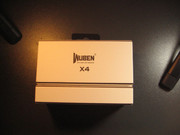
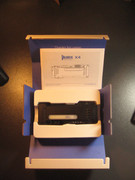
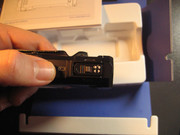
Slider switch has a spring loaded detent and is magnetic for waterproofing with Hall effect sensors on a small aux board inside, connected by an FFC to the main board.
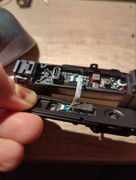
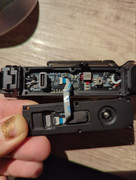
USB type C is cleverly covered by the slider switch to guard the connector from foreign object and debris ingress. I’m not able to test waterproofing of the connector but it does interface with its chassis opening with a thick silicone gasket and likely is an internally waterproof connector.
The switch cover design also limits operation to forced moonlight when charging, which I think is good. Best to not draw pulses of current from a battery undergoing charging.
Sideswitch and dimming thumbwheel are a single part, pressing on both sides of the thumbwheel actuates sideswitch and vice versa. Thumbwheel is continously rotating and undetented. Sideswitch sits nearly flush with the body and is not immediately felt by finger.
Sideswitch/ thumbwheel assembly operates a tiny SMT rotary encoder with a built in button, the shaft passes through a greased stuffing box- unlike the slider switch this control is not magnetic but penetrates the chassis.
Tailswitch is a very pleasant, tactile paddle. Operating force isn’t lowest but the paddle protrudes enough to sometimes cause uncommanded operation e.g. when pressed on by winter clothing.
Battery bay door will spring open by the force of springs on both ends of the cell, kept shut by a spring latch with its own little lock toggle. Two gold pogo pins maintain electrical contact with the battery negative and the tailswitch (also part of the bay door).
The control surfaces make for great fidgeting toys individually but are not all immediately accessible single-pawed without change of grip.
Clip is beefy, attached by 2× tiny torx screws. Clip size matches MOLLE grid, great for marker use.
Default light orientation, when worn on right hip is:
- main optics up
- side emitters right
- sideswitch up, towards the back
This is opposite of my personal preference [optics down, sideswitch under thumb]- the clip is reversible but attachment threads are not centrally located on the light resulting in the light becoming tail-proud/ top heavy, increasing the likelihood of unintended pocket disengagement. Clip does not overhang or otherwise interfere with operation in reversed state.
electronics
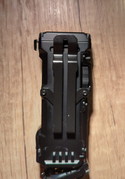
The driver board is well heatsinked to the aluminium body. There is one coil and no obvious linear drive components but the side emitters are on a secondary PCB that is soldered in place and I can’t be bothered undoing that, linear drive circuitry for side emitters might be on the side board. Main and side white emitters don’t seem to be sharing the single switch mode drive channel. More likely this is a boost channel for mains in series, sides paralleled on a linear channel.
optics
Main emitters use a custom moulded composite TIR system with one main throw optical element, 2 deeply inset flood elements and an intermediate beaded TIR element. The resulting combination is a good rendition of a bulkier reflector-based thrower in the middle range, with a boosted spill nicely flooding immediate surroundings. Size and definition of the hotspot is comparable to Emisar D1 with an XHP70.
[Wuben X4] - [Emisar D1 XHP70 HI] - [Noctigon DM11 XHP50 HI]
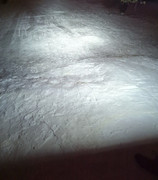
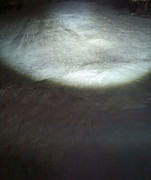
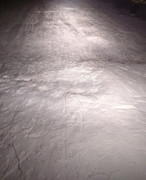
Idea? Version with side emitters replaced by individual control over main emitters, use the thumbwheel to make a virtual zoomie?
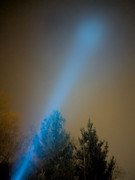
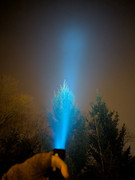
The plastic TIR system is exposed with no glass cover increasing optical efficiency but leaving it vulnerable to scratching and debris buildup leading to progressive loss of optical quality.
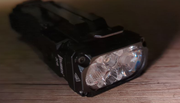
Side emitters are covered by a milky plastic unipiece diffuser. Blue channel of RGB emitter excites the phosphor of white side emitters veeeery slightly. Side emitters in conjunction with the suitably located strong clip make for excellent personal marker light and a decent walking floodlight clipped to backpack chest strap though this configuration glares oncoming walkers and to an extent the user as well.
LEDs
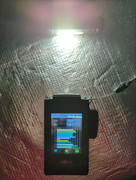
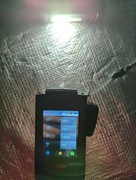
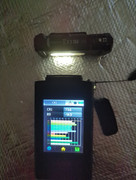
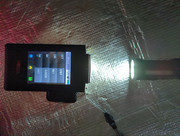
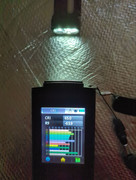
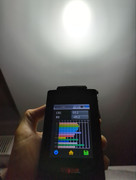
Unknown types but the main emitters achieve quite impressive throw relative to the size of the TIR element. Field-level accuracy spectral tests at lowest and highest intensity below- both sets I consider low CRI, high CCT emitters. I would assume the design intent is to optimise for luminous flux or raw efficiency, not light quality. There are slight differences in luminosity visible between the 6 side LEDs on lowest mode.
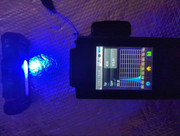
onboard charger
I didn’t get to measuring charger performance but there is only one coil on the main PCB, charger is probably linear so not the most efficient variety- in the field I’d be swapping cells, not charging this off a powerbank. Due to premature failure, I wasn’t able to test PD or other fast charge negotiation.
I do resent one state of the charging indicator being bright blue, best make that more friendly to overnight nightstand charging. Same goes for battcheck…
I would also like to see a powerbank feature in an EDC light with a type C port and a full 18650.
battery
The light came with a long, apparently protected button top 18650, nominally 3400mAh li-ion, measured 3165mAh on a single C>D>C cycle on a SKYRC MC3000 at 12mR internal resistance. It’s decent but the fact it’s a standard, replaceable cell compensates for any insufficiencies.
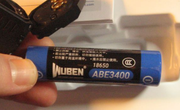
I hope the bundled cell protective circuitry isn’t to offload some protective circuitry from the light itself. I have not checked but there is a CE mark on the light’s body indicating that Wuben declares there is full protective circuitry onboard and the protected cell is an added safety layer.
SPoF
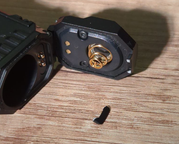
Battery bay hatch has demonstrated a weak point following a waist-level unplanned drop onto wood flooring. This fall has caused the battery door element that engages with the latch to shear off in 2 sites of small cross section and with sharp internal right angle corners creating stress riser points. With a sample size of 1 it’s not possible to call this a definite design flaw as opposed to material defect or freak coincidence but the design of this part may warrant engineering review.
UX
The light is pretty straight forward to use, the only deeper portion of the UI being beacons, flashers and RGB, accessible through sideswitch click patterns. All other UI elements are self explanatory with a labelled slider switch, dedicated dimming thumbwheel.
Aside from mode memories there are no internal configuration states meaning I’d be happy to gift the X4 to a non-enthusiast without worrying about them changing settings inadvertently and locking themselves into a weird configuration.
MX (My Xperience)
The slider switch has 4 positions, 2 intermediate. For light to be always ready this creates the need to either always stow the light in the same configuration, or to learn to finesse the slider position by finger feel without looking; I’ve been unable to achieve either over the course of the week of testing but it would probably come. The need to check, set or pre-set the slider switch somehow would never go away though.
Good thing is that both endstop positions are eye-safe (lockout, moonlight). Moonlight mode is still bright though and there is no way to select side or RGB emitters.
Beacons, flashies and colours turned out to be an important facet of the X4 for me, serving as a marker light and a somewhat limited lighting design colour tester. They’re accessed by different sideswitch actions (1H, 2C in sidelight mode), it might be better to go all in on the slider switch and add a dedicated RGB position.
When in need of quick light I’d resorted to using the tailswitch to get main emitter turbo as using the sideswitch would often result in e.g. green side light coming on, after having used the X4 as a marker. This means often I used way too much light for a given task simply because it’s the faster thing to do.
The rotary encoder has no detents nor endstops, in all modes it increments in 7 preset intensity/ RGB colour steps with a fade time. The fade time suggests the driver is capable of finer control and the number of steps is arbitrary.
Encoder intensity mode has virtual endstops in the form of a brief pulse of darkness when at top/ bottom end of adjustable range. These pulses (about 250 ms of dark) feel a bit too long, shorter blips would be nicer.
The tailswitch will-
- toggle moonlight when in moonlight mode
- do nothing in lockout mode
- do nothing when the light is on
- flash momentary (1C/1H), or toggle strobe (2C/ 2H), when and only when the light is off and in normal main or normal side light mode
-more on this in the following section.
conclusion
I consider the X4 a nicely designed and crafted, good feeling, nicely clicky and fidgetable urban EDC light aiming to cover a wide range of purposes, at the cost of lower immediacy. Main beam shape is a good all-rounder with nearest field use covered by the pure flood side emitters.
I’m picky about CRI and tint and think this type of light more than any would benefit from more refined emitters rather than raw luminous power.
I wouldn’t use it in high intensity field work where it could get knocked about and where one needs immediate, decisive light delivery. Likewise I wouldn’t rely on it for self defence use since the tailswitch doesn’t always behave tactically.
addendum: UX- firmware and daydreams
I believe I’ve shown in my general posting tendencies that I’m a staunch proponent of free/ libre approach to software and hardware design (and knowledge broadly) and this worldview does have strong bearing on my approach to UX design. Spoiled by years of daily use of Andúril lights, GNU/Linux systems and the like I’ve grown accustomed to being able to set everything up to preference and I firmly believe that any device that is opened up to the community of its users will see improvements in aspects the original designer hasn’t thought of.
Over a week of use, here are my ideas of what more could be done with hardware I assume to already be onboard, waiting for software enablement to illustrate my point of open being better.
Items I would have preferred over factory configuration are indicated like this.
ramp
- stepped- configurable count
encoder
encoder memory config:
- last off (factory default now)
- post-off timeout (Andúril hybrid memory-like, last used brightness for set amount of time, preset brightness after elapsed)
- preset (light always turns on at preset brightness)
encoder sync across slider switch selectable modes:
- each mode own memory (factory default now)
- selected brightness carries over across modes
turn on by encoder (not a feature now)
-
always from lowest brightness
-
always from highest brightness
-
depending on rotation direction
-
encoder direction invert (not available now)
-
encoder dynamic direction (akin to Andúril ramp- first 1H when ON will always start upwards, second click or 2H go down) Similar could be done with encoder, first movement would always go in a preset direction regardless if CW/CCW, opposite rotation direction becoming the opposite action.
slider switch
moonlight/ lockout mode configuration
- moonlight main emitters (factory default now)
- moonlight side emitters
- moonlight RGB emitters
- moonlight momentary/ toggle
- possible/ impossible to go up from moonlight
this could be mirrored in lockout giving two individually configurable eye- and pocket safe light presets
side switch
- 1H to moonlight
RGB emitters
- RGB emitter aux mode to better find the light in the dark
- battery indicating colour AUX option
- RGB emitter HSI mode for lighting design use
different styles of battery check-
Battcheck and charge indication is implemented as a four-state (red/blue flashing/solid) indicator. This is very bright during nighttime, especially the blue states, the colour component also makes it inaccessible to people who don’t see colour. Good configuration options would be:
- Andúril-style voltage blink
- simple blink-count 1-5
- post-off voltage display in colour
tailswitch
tailswitch configuration- options:
- momentary main turbo/ 2C strobe (factory default now)
- always momentary main turbo/ preset, no strobe- Morse mode
- always momentary side turbo/ preset, no strobe
- always momentary, current mode and level, no strobe
- mirroring sideswitch
- respecting/ not respecting moonlight mode
- respecting/ not respecting lockout mode
- overriding/ not overriding mode currently ON