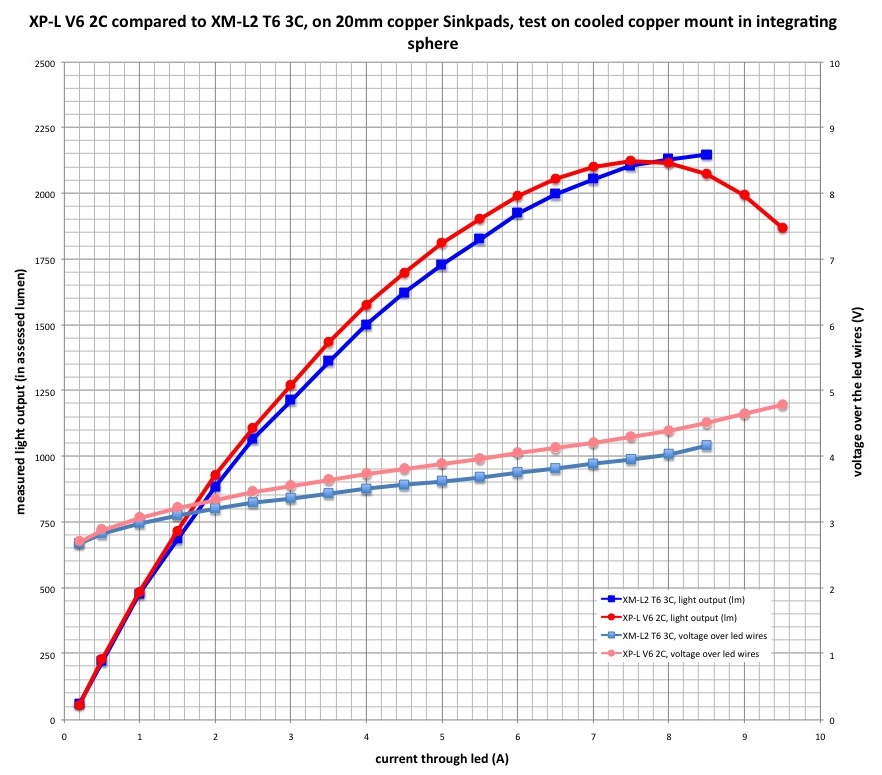
…its seems like the T6 is still the way to go And, the big advantage going for the T6 is the lower forward voltage. But, if one looks at Match’s figure…
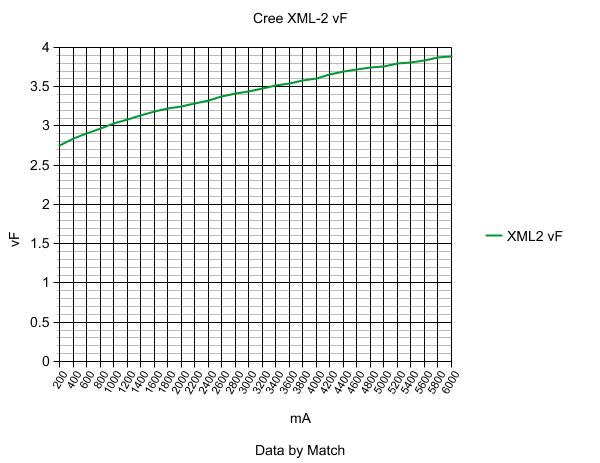
…one sees different figures. The forward voltage of Match’s test on the XM-L2 is quite a bit higher than that of djozz? I’m not sure which bin Match tested though? E.g. according to djozz at around 3.6V the T6 does about 5 amps. According to Match the XM-L2 does about 4 amps. Thats a big difference?
If djozz’s test is accurate, then I cannot see why one should go with the XP-L, rather try to get some T6’s at better pricing and better performance?
Some of that data is older; there have been changes reported on some of the emitters resulting in higher Vf on newer XM-L2 emitters and reduced performance when being pushed beyond spec.
1)I think that match measured a T6 bin, that was the first bin XM-L2 that was on the market if I remember well
2) I would not call 0.1 to 0.15 V difference between match and me 'quite a bit higher'. there's a margin between leds of the same spec. that comes close to that.That said, match reported at the time some uncertainty about his volt measurements because of a faulty meter .
3) my 'djozzlumen' is not the holy truth (and so isn't match's), it is quite constant within my own measurements but is not calibrated with a certified lightsource (using an array of ANSI-rated flashlights is not the way to go IMO, flashlight manufacturers make a mess of measuring lumens too and each copy of a flashlight will vary from the official specs anyway). There is a slight suspicion, based on my re-measurement of four lights that were also measured -in a rather sloppy way- in the LedLenser integrating sphere, that the djozz-lumen may be 9% too high.
I believe my tests are quite accurate when, like here, two leds were measured the same way in one session (or even separate sessions). The uncertainty is when only one led is measured that it may be by chance one that is far from the average led within the same specs.
Hi Keltex. If you’re talking about “newer XM-L2 emitters” are you meaning newer batches of the T6 bin? I’m aware of the higher forward voltages in later bins (U2, U3, U4) thats why I’m asking about the T6 bin specifically.
 And, the big advantage going for the T6 is the lower forward voltage. But, if one looks at Match’s figure…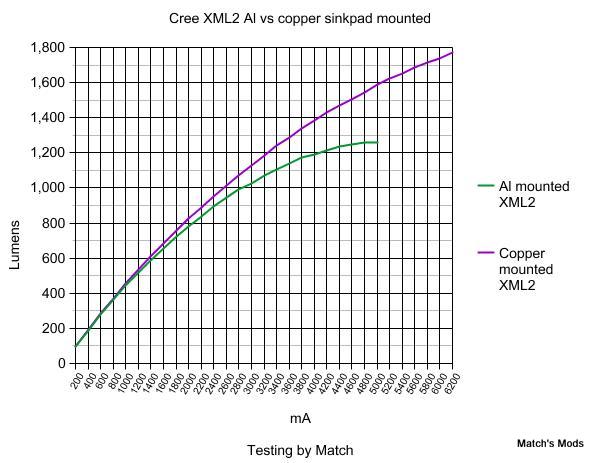
 .
.