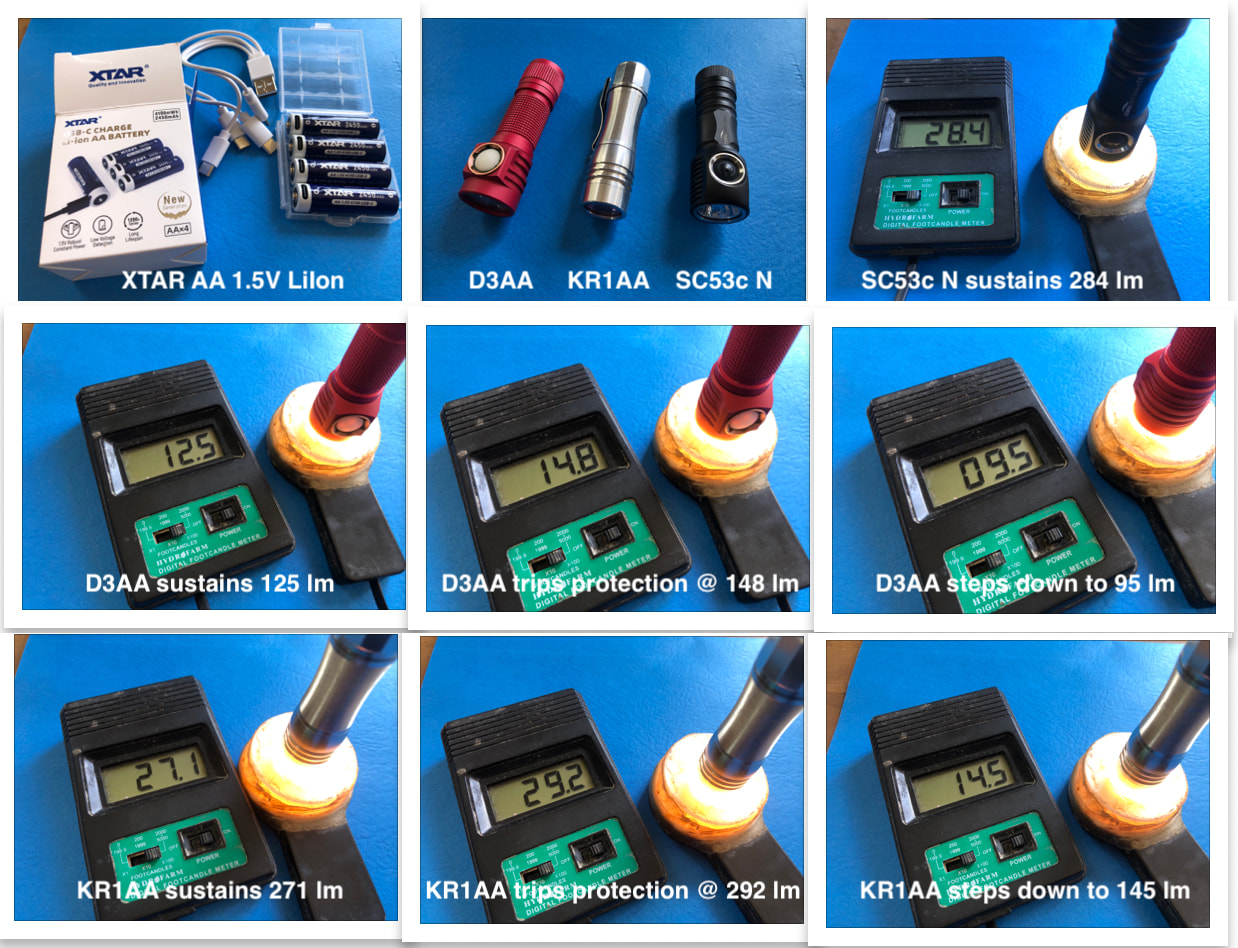
I received these batteries as a review sample, thanks to XTAR. I charged them up with the provided USB cable and loaded them into 3 lights.. An Emisar D3AA with DeDomed 4500K 519a, Emisar KR1AA with NTG50 2700K, and Zebralight SC53c N with 4000K 519a.
I tested each Anduril light with ceilings of 80/150, 90/150, and 100/150. Then tested on each ceiling to determine which level did not trip protection in the two Anduril lights. I tested the Zebra in stock G5 on H1 with no changes.
The D3AA sustained 125 lm, at a ceiling of 80/150.
When testing a ceiling of 90/150, it caused step down from 148 lm, to 95 lm.
The KR1AA sustained 271 lm at ceiling of 90/150.
When testing a ceiling of 100/150, it caused step down from 292 lm, to 145 lm.
The Zebra held its stock H1 with a maximum output of 284 lm without stepping down.
I do not know why these 3 lights behave differently, with the D3AA having particularly low output when it trips protection.
Conclusion:
I can only recommend using AA 1.5V LiIon in the D3AA, if the ceiling is set no higher than 80/150 = 125 lm.
I do think the AA 1.5V LiIon is useable in the KR1AA, as long as the ceiling is set no higher than 90/150 = 271 lm.
It seems the Zebralight works fine with 1.5V LiIon, and sustains its maximum output of 284 lm without stepping down.
I did some runtime tests with 1.5V LiIon and with Eneloop in a KR1AA 2700K and in a Zebra SC53c N 4000K 519a
test summaries
1.5V LiIon test:
Zebra start H1 255 lm
at 30 min 65C 244 lm
ended test, light too hot to touch
KR1AA start level 90/150 268 lm
at 30 min 43C 142 lm
ended test
Eneloop test:
Zebra start H1 270 lm
at 30 min 48C 210 lm
end
KR1AA start level 90/150 272 lm
at 30 min 31C 99 lm
end
===
Conclusions
In Zebra starting on H1 at 255 lm
Zebra sustained 244 lm for 30 min. I ended the test because the Zebra got too hot w 1.5V LiIon, reaching 65C. With Eneloop the Zebra stays below 50C and sustains 210 lm by the end of 30 min.
1.5V LiIon runs 20C hotter than Eneloop in a Zebra. Recommend not to use H1 w 1.5V LiIon for any more than a couple of minutes.. the light gets too hot and exceeds its thermal ceiling of 50C
In KR1AA starting from 268 lm, level 90/150
1.5V LiIon steps down to 145 lm and temp stays below 45C by the end of 30 min.
Eneloop steps down to 99 lm in KR1AA and temp stays below 32C.
best to use 1.5V LiIon below 150 lm to prevent Zebra from getting too hot.
1.5V LiIon sustains 145 lm in KR1AA, for 30 min. Eneloop stepped down to 99 lm in KR1AA after 2 min, temp stayed below 32C
1.5V LiIon sustains higher output than Eneloop in KR1AA
After using a 1.5V LiIon battery that had been partly drained by doing runtime testing in the Zebra on H1 for 30 minutes, at about 240 lm.
I moved the battery to my KR1AA in order to verify if it would give any Low Voltage indication. it does.
After using the light at outputs below 100 lumens for a while, 3C batt check now reads 1.00V and POVD Aux are Green. The KR1AA can still reach 149 lm. If I try to go higher the light steps down to 100 lm
After using 149 lumens several times in a row for a few seconds at a time, 3C batt check now gives 9 blinks (unusual). POVD gives Green and Yellow AUX for a second, then switches to Green Aux.
Conclusion
The Low Battery indicator in 1.5V LiIon is working to change the POVD color to Green, and 3C Voltage Check no longer gives 1.5V. Instead it gave 1.00V for a few tests, and then the 3C batt check started to give 9 blinks.
If I do the 3C batt check again after resting the light for a few minutes it gives 1.00V and POVD gives Green Aux
Imo this 1.5V LiIon works well in my KR1AA. It gives me advanced warning that the battery is getting low. It does not just shut off suddenly.
Some thoughts and my present conclusion about AA 1.5V LiIon use in my EDC Flashlight.
Eneloop can briefly reach over 300 lumens. In extended use it tends to settle below 150 lumens.
AA 1.5V LiIon can briefly reach over 200 lumens. In extended use it tends to settle below 150 lumens.
Most of my EDC flashlight use is below 150 lumens, so either battery will work for my indoor EDC use.
AA 1.5V LiIon has built in charging, which Eneloop does not.
Eneloop has the advantage for storage in a hot car in summer. I dont know if it has any advantage in winter.
AA 1.5V LiIon has a Voltage advantage over Eneloop, which generally operates closer to 1.3V. This may not matter in a flashlight, but it can matter in some other devices that have trouble with the lower voltage of Eneloop.
atm I am happily using an AA 1.5V LiIon in my indoor EDC light, that I was previously using Eneloop in.
One advantage in many lights, like Zebralights, is that they try to regulate the output. So for higher voltage on battery (1.5V LIon), less current is demanded compared to lower voltage (1.3V and lower Eneloop). So this would result in longer run times for the same capacity of the two cells types.
The one issue w using the 1.5V LiIon in the Zebra is that H1 overheats.
Within the first 10 minutes at 238 lm the temp is 58C, that is an overshoot of the built in 50C thermal ceiling of the light..
The heat comes from the Buck driver on the battery. By the 25 minute mark temp is at 65C, which hurts my delicate hands. The heat is a non issue if the H1 output is kept below 5 minutes.
So I just ran a new test on the Zebra on H2, Level 10, which started at 194 lm
Happy to report there is no overheating problem..
after 30 minutes, temp maxed out at 47C and the light was holding at 184 lm.
So imo, these 1.5V LiIon are a good match for an AA Zebra especially when used below H1.
With the added convenience of USB-C charging, and 6.3g less weight than a white Eneloop.
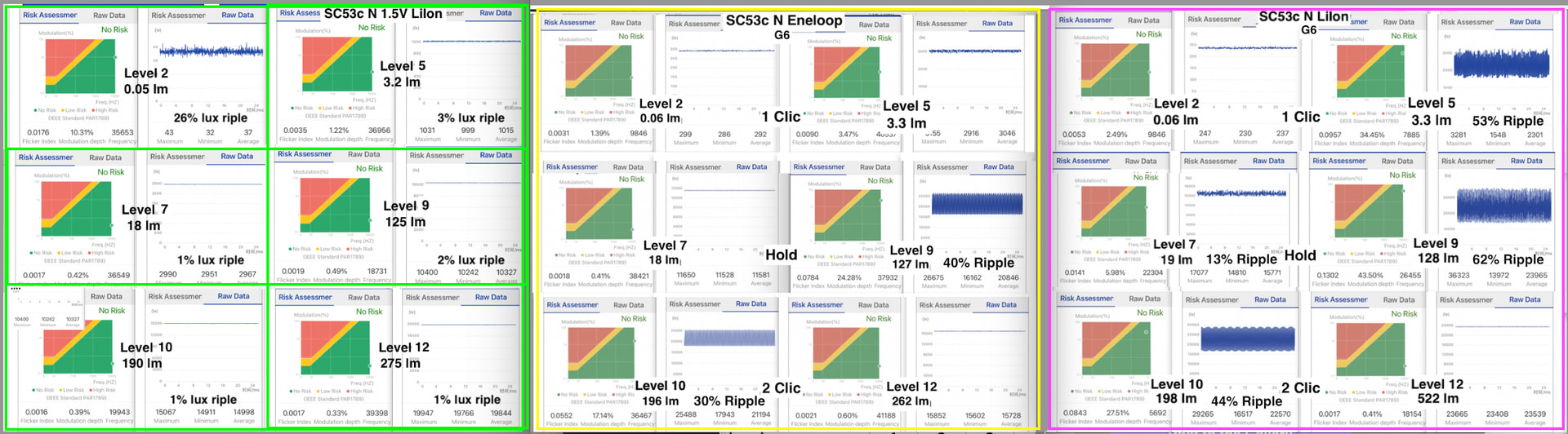
In an AA Zebra, 1.5V LiIon has the lowest Flicker Index and Riple of any power source: (green boxes on left)
(middle yellow box is Eneloop, right red box is 14500)
I dont recommend the 1.5V LiIon for D3AA or KR1AA for any output over 150 lm.. the outside of the light does not get hot, but the output steps way down. I think the thermal sensor is reacting to the heat build up in the battery buck driver that steps the voltage down to 1.5V.
The Zebra thermal sensor must be located differently, because it seems to ignore the heat buildup from the battery charging port. The Zebra will sustain over 250 lumens, the D3AA and KR1AA will not.