Zebralight H600Fc MK IV only 40 min at 980 lm vs Lucifer Lights S2X 1.5 hr at 1200 lm - why?

Hi everyone, I’m a bit confused about the runtimes I’m seeing between two headlamps and was hoping someone could explain what’s going on.

I’m comparing a Zebralight H600Fc MK IV and a **Lucifer Lights S2X. On H2 (~980 lumens) the Zebralight only runs for about 40 minutes, whereas the S2X (rated ~1200 lumens) runs about 1.5 hours on high. I tested multiple Zebralights with different batteries, and I also tested the S2X with the same batteries - the results were consistent.

Is this difference likely due to better components in the S2X, or is there something about how the Zebralight is regulated that explains the much shorter runtime? Any insight would be appreciated!

Thanks!

What cells are you using, and do you have a luxmeter to monitor any drops in brightness?

It is simple. Lucifer using black magic.

1 Thank

Tested how? Are you absolutely certain the 980lm and 1200lm outputs are accurate?

3 Thanks

Please enjoy your time here, casey526!

1 Thank

You have to be able to measure the bright during that runtime.

No way either one of them held that brightness.

My zebra light sc600 gets scolding hot in less than 20 minutes even at 580 lumens

No way yours held 980 lumens for 40

I’ve very interested to see the real runtime of the s2x on all the modes measured, cause that light has been on my list for some time. But Lucifers stated runtimes seem overblown.

I wish the zeroair or 1lumen guy would test that model.

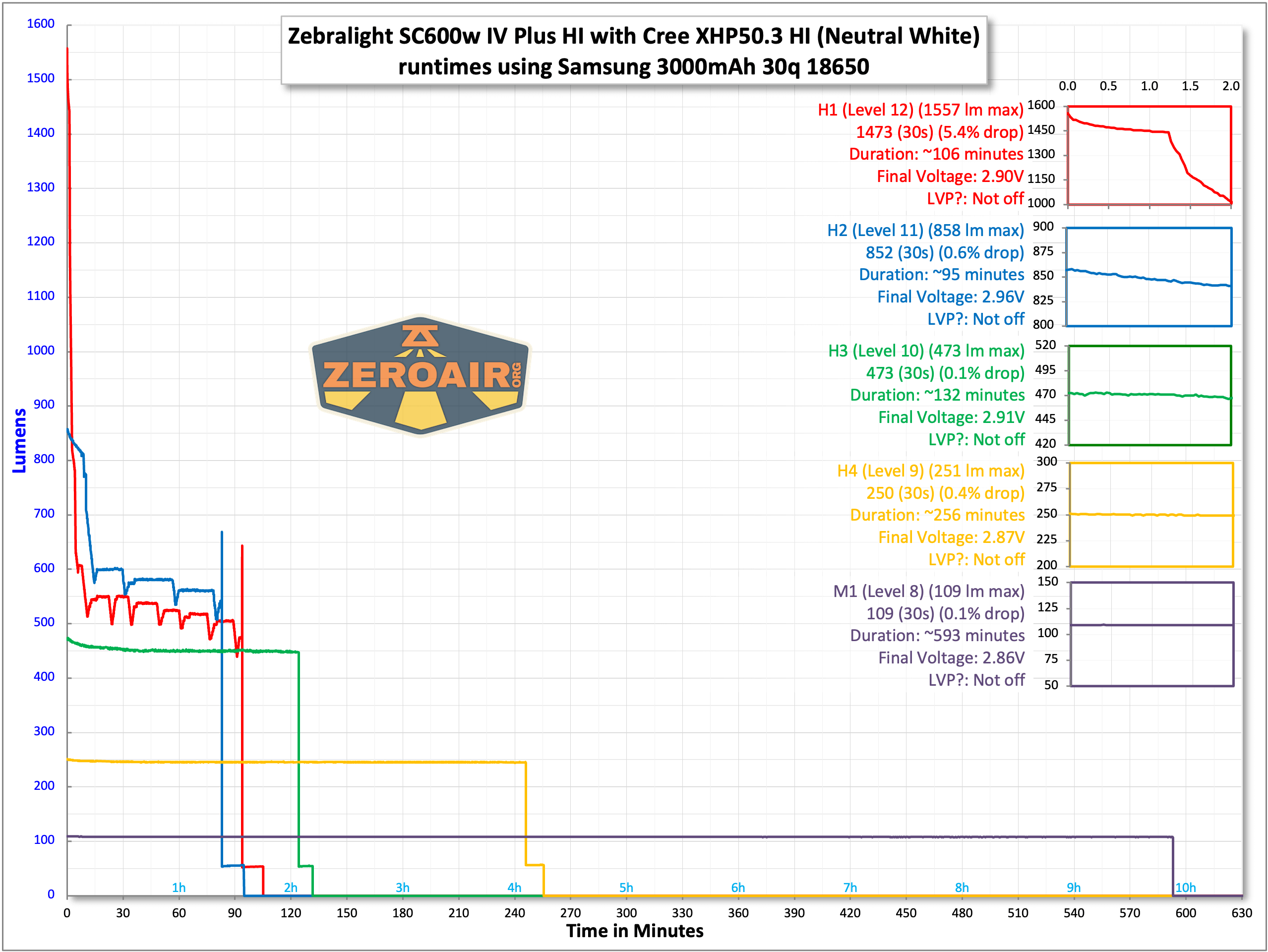
Zebralights are very efficient and even the sc600 model drops to about 500 lumens after a few minutes

5 Thanks

I appreciate the reply. I don’t have a luxmeter, so the brightness is subjective. That being said, I did notice the Zebralight drop some in brightness on occasion even in lower 30 degree F weather. I noticed this by turning the light off and then back on. I have not noticed a drop with the Lucifer headlamp in the same weather, using the same method. I’ve tried the following 18650 cells:
NCR18650GA 3300mAh (from Zebralight)
IMR 18650 (3500mAh
and a Keepower 18650 (3500mAh, 3.7V, 12.95Wh)

The Keepower lasted the longest in both lights.

I just tested them by using each headlamp with the different batteries during my walks and runs at night. So, totally subjective. I am NOT certain the outputs are accurate. I should have clarified those were the lumen settings (H2 on the Zebralight, Boost on the Lucifer).

Thanks for the reply. I tested two Zebralights, and on H1 (1568 lumens) both ran for about 30 minutes, though I did notice a brightness drop during that time, so the actual sustained output was likely lower toward the end. By contrast, I haven’t noticed any visible drop with the Lucifer, so I’d be very interested to see its performance in a controlled test.

1 Thank

I would like to see a test of that headlamp too.

Preferably not by Lucifer, frankly I don’t trust the guy.

Preferably by the zeroair or 1 lumen guy.

I really like that model, if it can actually hold even 500 lumens without stepping down, I would love to buy me one.

Lucifers don’t do “turbo” modes (which is partly why I like them). All the modes are sustainable for the intended usage, which is moving sports (orienteering, skiing, running, dog sledding, etc.) that inherently have a cooling from movement, with the higher modes intended for higher speeds. If you are talking about usage without movement, such as a work light, Lucifers will hold the mid mode and maybe high depending on the ambient temperature. They hold the lumens flat. If it gets hot enough or if the battery is depleted enough that the lumens can’t be held flat, the light kicks down to the next lower level (all of this runtime behavior is exactly what I bought the light for as a sport headlamp). There is no slope in the runtime graphs, just flat lines and step downs when necessary.

I have had the L+ for a year. To give an example, in boost mode (3500 lumens), I’ve found that the amount of cooling needed for that to be stable is, for one combination of speed and ambient temperature, about 17 minutes per mile (a moderate walking speed) in 20s degrees Fahrenheit. Slow down to 20 minutes per mile in the same mode and ambient temperature that’s the borderline where it wants to kick down from “boost” to “high” (1800 lumens). In real life when not playing around with a new headlamp, I don’t use 3500 lumens at a walking pace.

I bought it for its capability at the “high” (1800 lumen) level and picked the battery pack to cover my typical 2- to 3-hour workouts (cross country skiing in winter mostly). Theoretically, it should be good for about 3 hours to where the battery is depleted enough to have to drop down to “mid” (850 lumens) with the 2x21700 battery pack that I use. I have used it on night skis up to 2:40 long without dropping from the 1800-lumen level and haven’t tried to go longer. 850 lumens is great for skiing most of the time, but higher is nice when the woods are darker out and reflect less light back, such as when things are wet. The levels pass my sniff test of being at the same level at the end of my skis as at the beginning, pointing it at my house and seeing which trees are lit up behind the house.

I have a screenshot of a runtime graph from a YouTube review of the older “L” 3200-lumen model from when it was posted on Lucifer’s website (but later removed) presumably tested by Petr of Lucifer on his older integrating sphere (he just bought a much fancier, presumably more accurate one). It didn’t quite match up with his runtime tables (a bit higher in lumens, a bit lower in runtime to 70% of initial lumens, assuming battery was fully charged) but unless you believe it was entirely faked, it at least shows the runtimes are all flat with none of that turbo drop in the first 1-5 minutes that I hate for sport usage in almost all BLF-favored lights. I doubt it was faked based on the half dozen times the output dipped down and back up immediately as well as what I’ve seen with the Lucifer headlamp I have. Maybe he pulled this graph from the website because he wasn’t happy enough with his old integrating sphere.

I’m curious about what Lucifer will post from his new integrating sphere. His teaser was testing the L+ at 30 seconds getting 3,8xx lumens.

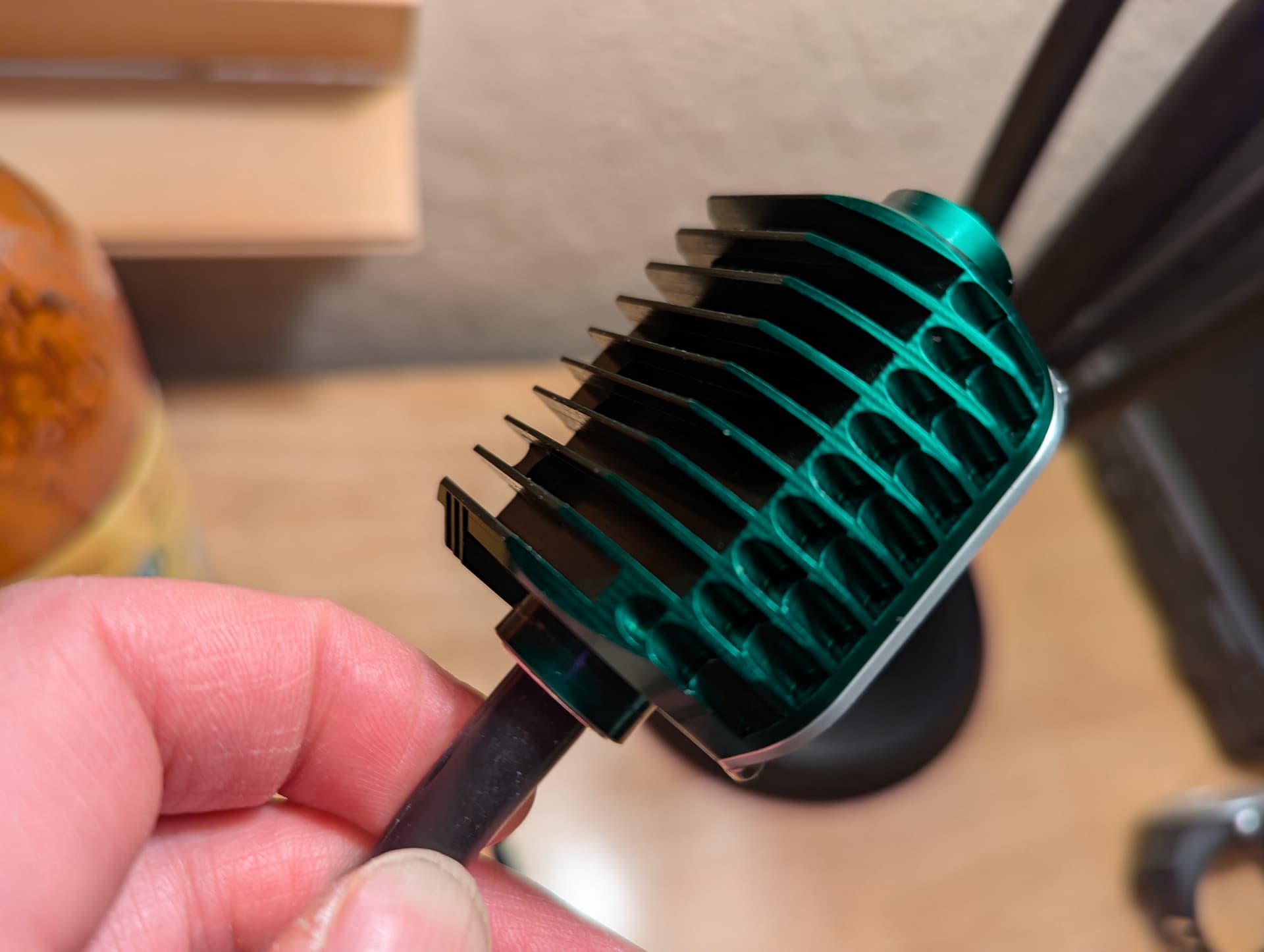
By the way on the L+ at least, the cooling fins have quite a large surface area:

Additional notes: I wear the headlamp under an “active insulation” hooded jacket when skiing in cold temperatures, so the battery pack stays warm against the back of my head even when it’s -15 F, while the lighthead is exposed to the wind/cooling from my movement on skis or running, so a remote battery pack headlamp is much more useful for winter usage (a point for Lucifer S2X+ over the Zebralight for winter use). An L-shape 18650 headlamp typically needs to be run pretty high for the battery to stay warm from the internal resistance to not to lose performance because it’s exposed to the cold. If you start a ski before it gets dark with the headlamp off and then try to turn the headlamp on an hour later when it gets dark, there’s a good chance the battery will be dead. An L-type headlamp needs to kept warm kept next to your skin (hand pockets on my jackets are not warm enough) or turned around backwards on your head and kept under an insulated hood until you need to turn it on, which can be annoying.

1 Thank

Preferably by the zeroair or 1 lumen guy.

Based on an old Instagram post (Jan 1, 2024) where Lucifer posted his sale numbers in different countries, he only sold most of his headlamps in his home country 670 of 821 in 2023. Only 11 headlamps were sold to US buyers. So, if those reviewers want to test one, they’ll probably have to buy one, which seems to not be their business model (getting free stuff to test). The runtime graphs are useful, but those reviewers and BLF in general don’t really understand the product category of sport headlamps and why the design choices are different than hobby flashlights/headlamps, so just as well they don’t test them.

1 Thank

Assuming the 2×21700 has 3.7×10000mAh or 7.4V×5000mAh, that 1600 lumens for 3 hours is feasible. As it pertains to the OP, a single 18650 (assuming 3.7V×3500mAh) running at that 1200lumens shouldn’t really be exceeding an hour unless it has stepped down, right?

1800 lumens and 7.4Vx5000mAh. And yes, I know it’s feasible. I’m familiar with the lumen-hours area under the runtime graphs of the most efficient lights.

Lucifer claims 1:10 for 1300 lumens in the S2X+. The OP’s S2X was probably also rated at 1:10 (to 70% initial lumens), not 1:30 though for 1200 lumens. He just started selling 4000mAh 18650 batteries and battery packs. (I’m tempted to get a 2x18650 with the 4000mAh 18650s for my headlamp.) I’m familiar enough with his website (having followed Lucifer since he first was developing headlamps and posting on CPF more than a decade ago) that the runtimes are still based on 3500 or 3450mAh 18650s though.

1 Thank

Thanks for clarifying. Would you happen to have any experience with Zebralights, particularly the model or form factor which the OP mentioned?

Nope, though I’ve seen and nerded out over all the reviews/repeatedly going back to the H600 Mk IV runtimes graphs over many years.

1 Thank

Most zebra runtimes in general are nerdworthy, lol

Compare Zebra with more similar by size and weight Z3mini. Don’t forget to measure Wats in, Wats out, temperature.

No running. Fixing my car in 80 degree ambient temi flhate whey people give me an unnecessarily complicated answer.

I asked a simple question

What is the highest output the s2x and the L+ model can hold in approximately 78 degree fahrenheit ambient temperature without me moving too much such as fixing my car ?

I have a feeling it’s around the 450 lumen

You’re making stuff up

“Those testers don’t understand design choices” I’ve never heard garbage like that

I don’t care about cross country skiing I live in a place where it has snowed once in 20 years

I need to know what the headlamp can sustain in 78 degree weather

As far as them not selling too many headlamps in the USA, that’s cause nobody has heard of them here.