It’s like when everyday drivers buy supercars but can’t / don’t / won’t learn how to properly use them…
It is in the enthusiasts’ best interest that more basic users use Anduril flashlights so we can have wider choice. Anduril lights can be kept within safe operation limits and basic use is really simple. For this reason I wouldn’t compare it to supercars which indeed require special skills.
Supercars require practice and training to unlock their full potential, same as what develops any skill for the average person. It takes either a highly experienced, or unique individual to pick something up cold start, read or do it once, and fully understand everything behind the object/product.
I do agree that it might be in the best interest to convert the average/basic consumer into an enthusiast, otherwise you just get dinosaurs who like single mode lights exclusively regardless of usage scenario.
The most hightech supercar is the Rimac Nevera. In that car you can select driving profiles. You can select and never turn away from normal street car setting so an average driver can drive it. It also has advanced modes like drifting. A normal driver should never ever switch to that mode.
Anduril could be something like that. Actually it is something like that, this is why Simple mode exists. On a Nevera they could just ignore advanced modes and never pretend being a race pilot. This is how I would like the non-enthusiast world see the Anduril flashlights. Easy to use. There’s a hidden beast inside you never need to see if you don’t want to. Anduril 2 can do this, only the public needs to be taught for it.
1 Thank
As you’ve said, that supercar is anduril 2 incarnate. Perhaps you’ve missed my other posts saying that ALL massed produced Anduril 2 lights should default simple mode with safe limits set, i.e. NO turbo, ceiling at maybe around 120.
This analogy is still not a good one, as the street mode is still for the enthusiast to drive it on the street. It allows the enthusiast to have flexibility, not the other way around. That’s what scatpacks are for.
Good call. Also, in addition, the way the TikZ diagram is set up makes it possible to very easily define whether a function is (Extended) Simple UI, or Advanced UI only. This is demonstrated in an exemplary model-specific diagram for model number 0135, hank-emisar-2ch (source), which also includes the model-specific default settings. In case of interest, such model-specific diagrams could readily be forked from the vanilla generic diagram (source) over at GitHub.
Let car analogies alone, I completely agree with you regarding default Simple mode and safe limits for Anduril lights meant for wider audience. And yes, I missed a lot of posts, my apologies for talking about matters already discussed before. I was in deep health crisis, barely even survived. Had a skull surgery and more not so pleasant things. Even my memory fell out for some time, I’m still trying to catch up. This is why I missed a good half year from this awesome chat I followed before. I’m lucky though, after two decades I got a proper diagnosis and getting effective therapy.
1 Thank
Good to hear about your diagram and manual expertise! And I surely wish you a complete recovery. I consider documentation (be it a manual or a diagram) to be an important part of a project, which is why I have been focusing on the documentation for Anduril. Regarding the text manual, so far, I have contributed a couple of details to ToyKeeper’s excellent Anduril User Manual; see the pull requests I have created over at GitHub, which might serve as a starting point, if you are interested.
3 Thanks
Again, very good call! I am still afraid that the user complaint “LIGHT NOT BRIGHT” might be a challenge to overcome here. But getting back to a “vanilla” ceiling of around 120 for Simple UI that you suggested: 110 might also be a suitable choice here. For example, in the Anduril source code for hank/lume-x1, 110 is set as the default for Simple UI, even with the comment about ~12W.
Actually, I have been setting 110 as the ceiling on a couple of Hanks recently, because my testing of the sustainable ceiling for a DA1K with NTG50 4200K (outdoors, cool ambient temperature of about 5-10°C, default thermal settings) resulted in 110. And just recently, I noticed over at Reddit that someone else arrived at a sustainable ceiling of 105 in a different configuration. To me, all of this suggests that 110 could be a suitable general setting for this.
3 Thanks
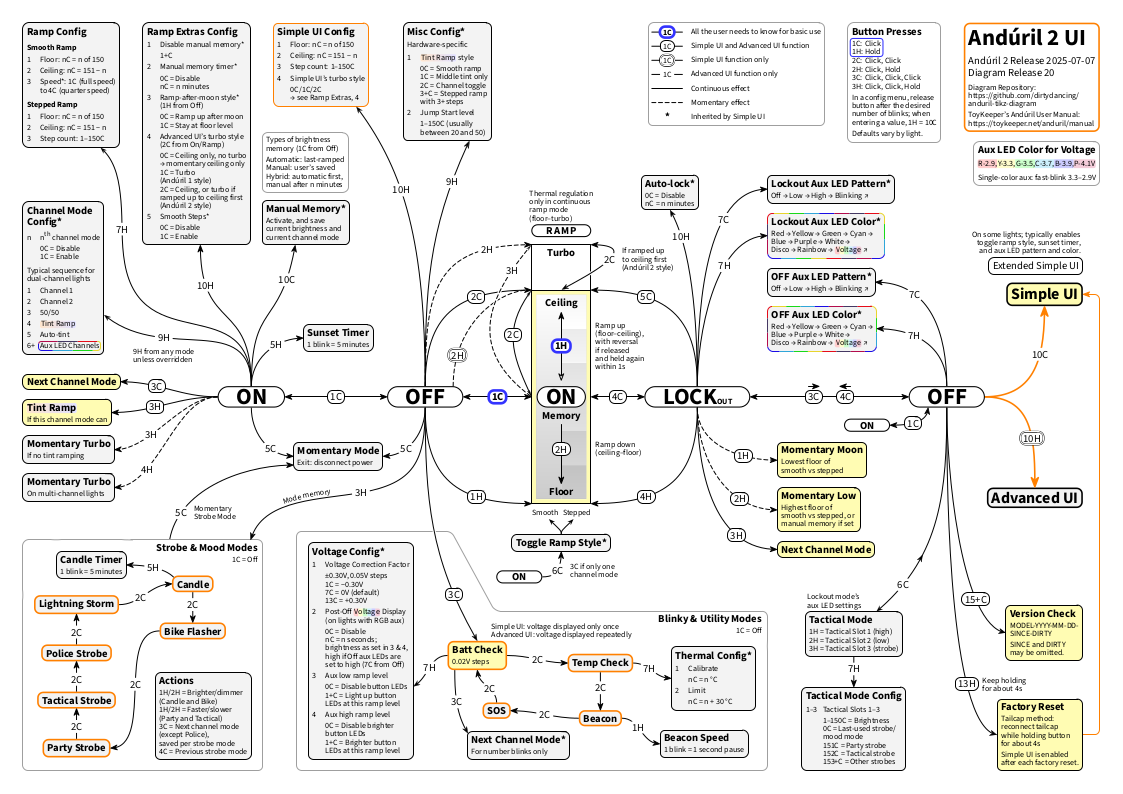
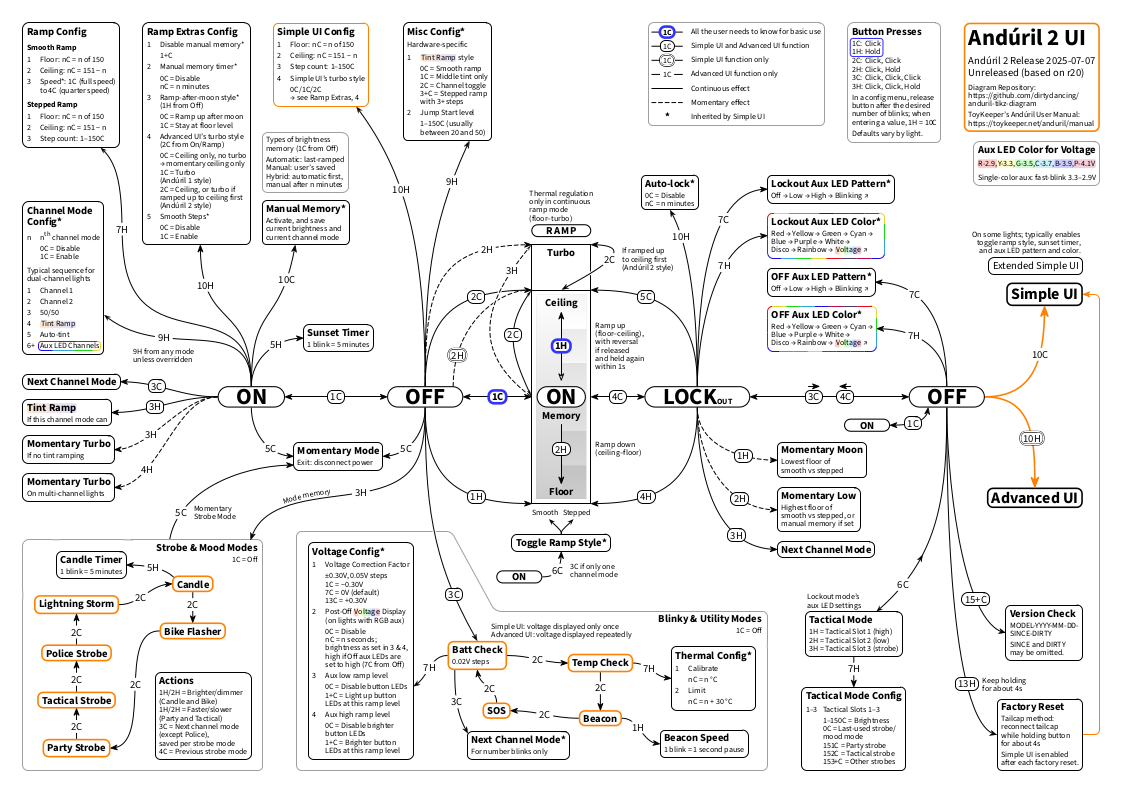
For those interested, here is an insight into the diagram’s background colors. In case someone would like to have a white diagram canvas, a sort of blank slate to start from, possibly with different color schemes, once again, all it takes is to change two values in the TEX source file:
First, yellow!30 to anybutton-fill (which is white), and second, gray!10 to advancedbutton-fill (which is anybutton-fill, which is white). You could also just keep setting white, but this way, white is only set once, and is referred to subsequently.
This will take the diagram from the current layout:
to this white layout:
2 Thanks
It’d be cool to have a live interactive map simulator of what happens when you use the inputs, for practice. I believe someone was building one, but I don’t remember who…
You’d have a virtual workbench with a virtual circuit of an Anduril 2 powered light, load the version into, and interact by clicking the button on screen (or wired in light, but dunnow how that would work)
1 Thank
Wow, sounds great. I have not come across that yet. Maybe someone else knows what this is about.
1 Thank
Coming back to this: I agree that the quick start / basic use section of ToyKeeper’s online manual is a great place to get started. Click and Hold, done.
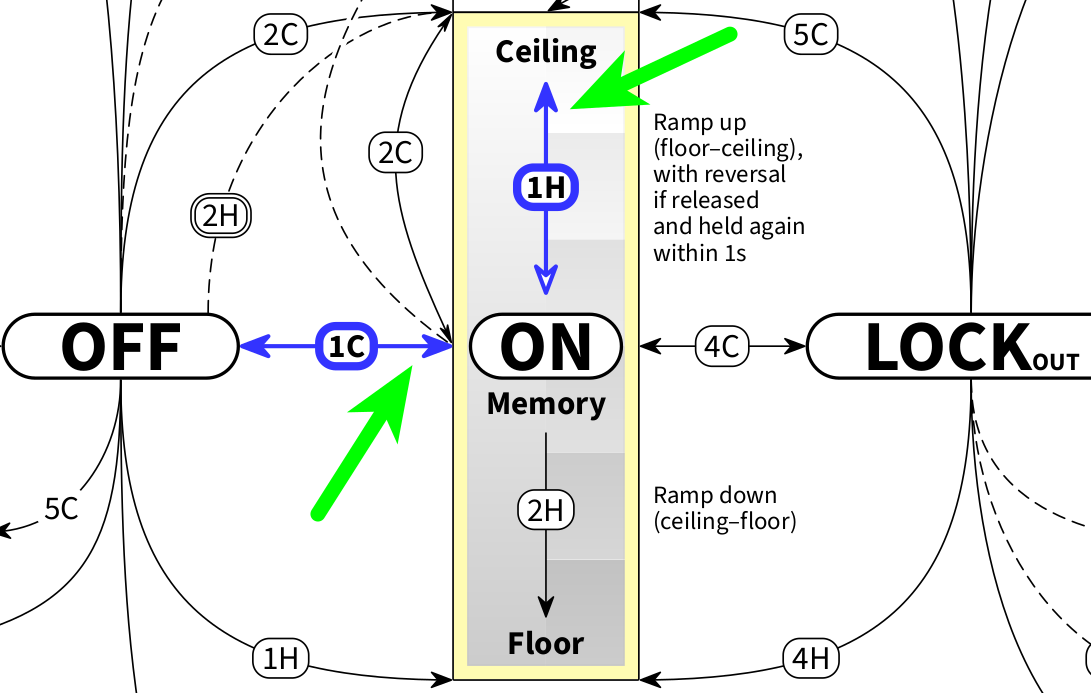
Regarding visual representation: In order to make Anduril as accessible as possible, even if a newcomer is suddenly confronted with a complete diagram like this one, I have highlighted the basic use in the diagram’s center even further, now with larger and blue arrows.
Just one more visual detail, but hopefully a helpful one (source):
1 Thank
Continuing with this, I have reduced the use of highlight colors in the diagram.
In ToyKeeper’s manual, factory reset follows right after the quick start / basic use and the button presses. So in order to keep the visual focus on the fundamental Anduril 2 operation, basic use and factory reset (more specifically the line from factory reset to Simple UI, combined with the UI switch lines) come with highlight colors:

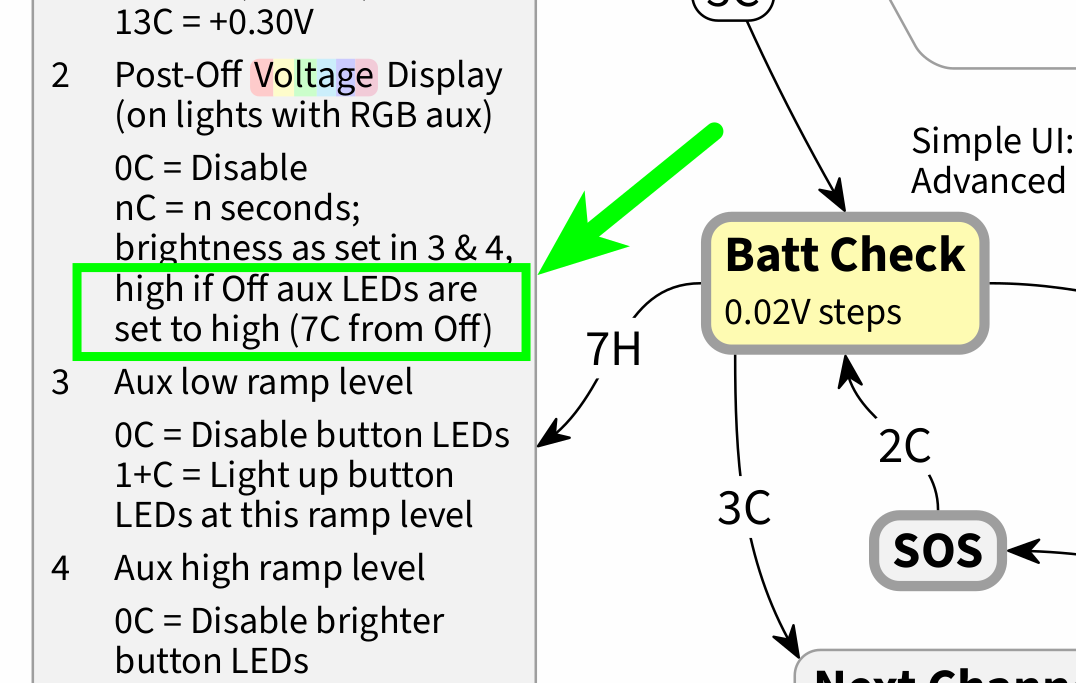
Here is a diagram detail update regarding Post-Off Voltage Display (POVD) brightness.
I recently removed the additional POVD brightness info high if Off aux LEDs are set to high (7C from Off). Back in July 2025, I had created an issue about this over at GitHub, but it had not been in ToyKeeper’s manual. But by now, there has been another bug report about this over at Reddit by @jon_slider, and ToyKeeper has added this information to the text manual over at GitHub. So in order to document the current status, I have included this detail in the diagram by myself again (source):
And on another note: Great to see that just yesterday, jameshome has updated his Anduril 2 guide (source), see over at Reddit here and here. It now comes with a basic usage and Simple UI progression. So there is some Anduril 2 diagram development going on, which to me is very good news!
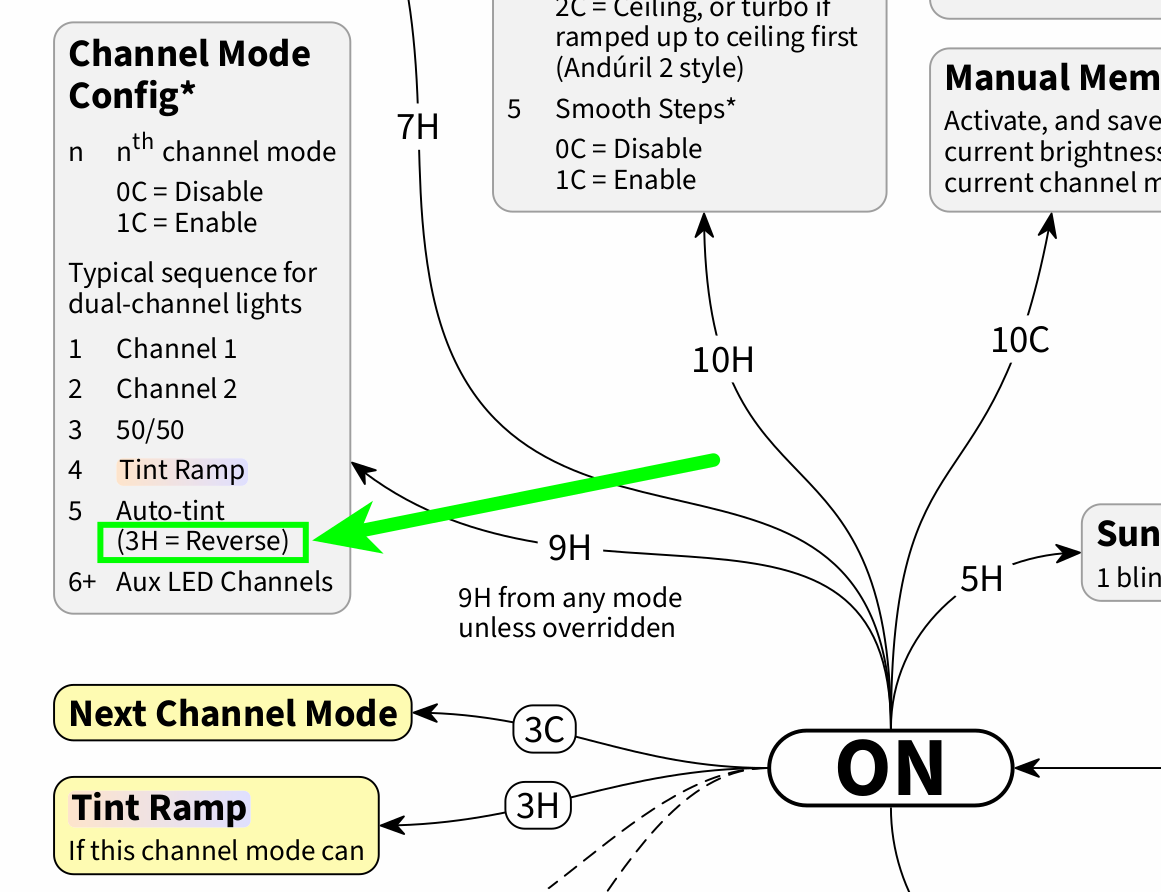
This is just to keep track of yet another detail of Anduril 2 documentation: 3H to reverse the ramp in the auto-tint channel mode on dual-channel lights.
There was a post over at Reddit demonstrating auto-tint, and this prompted me to include this 3H detail on the generic diagram by myself. Currently, this feature is not documented in ToyKeeper’s manual. A year ago, I had opened a pull request to document this (and closed it again, as this only goes for dual-channel lights, not for example for triple-channel lights):
This feature is documented in the exemplary model-specific diagram for hank-emisar-2ch by myself (source), and now also in the “vanilla” generic diagram, which includes the “typical sequence for dual-channel lights”, as this comes up the most when it comes to multi-channel lights (source):
The problem with advil is the people making diagrams are into more maps more discussions and like the complexity .
The manufacturers are into making lights and don’t want to play these kinds of games and also bear the extra burden of a cultural and language barrier.
The main problem is no one is selling it to the customer. … no one .
I like the idea of a list instead of diagrams .
Prioritize the list according to most commonly used . Like #1. On / off … then in the same line include a [ link to a text answer ] ….
and a [ timestamped link ]to the answer in a video .
Any normal person can understand a basic table of contents listing features . It easy enough to ignore something you’re not interested in and simply move to the next item in a list . # 14. Auxiliary dim lights to spot your light at night #15 . How to change auxiliary light colors , # 16 . Brighten or dim aux lights , #25 battery check . #32 changing lock out colors .
If you have a feature packed product… why aren’t you telling people how it can benefit them .
1 Thank
An Anduril 2 feature list with corresponding videos like you proposed sounds great! And apparently, a follow-up question to this idea would be: Who is up for making and maintaining it, and so the community can participate, preferably in a free (as in freedom) and open-source way?
The preference for a (linear) list comes up regularly. What there is right now is an overview in table format at the end of ToyKeepers manual, a UI Reference Table. Furthermore, recently jameshome released an updated version of his diagram, which follows more of a linear style, see over at r/Hanklights.
Apparently, different users prefer different approaches to deal with information. For example, to me, the “mind map” style (I am using this term loosely here) of the diagram by myself seems “natural”, with a picture (the brightness ramp) in the center and further information and details branching off from this. I mean, there is an entire information mapping industry, so this is not something obscure or esoteric. To give you an example, for a long long time now I have regularly been using a piece of software called TheBrain (in an ancient Java-based version that still keeps on running on Linux) to manage information; with this software, you navigate from central topic to central topic, with other related topics branching off.
In addition, a use case for a one-page diagram like this is to mark on one piece of paper (manually or digitally) what kind of settings you have for a given light. I am doing this, and I have seen others doing this as well. Personally, I prefer this kind of approach to a linear list, which lacks any kind of visualization, but I am aware that different folks prefer different styles. Still, this would not make me complain about a linear list and request a flowchart instead. 
In general, there seems to be an interest in flowcharts for Anduril, as already this thread itself demonstrates. This BLF diagram thread has been moving along for almost 5 years now. The entire point of me posting here from time to time is to make it easier for someone else to branch off from here and have all the information available of how the community arrived at this point (I know this already, no need for me to look into this thread). And here is another example for this interest in flowcharts: I recently joined Reddit (as dirtydancingagain, because dirtydancing was already taken), and shortly after I joined, the mods over from r/Hanklights asked me if it is OK to include a link to the diagram by myself in the subreddit’s community bookmarks. Of course it was OK, so now there is such a community link over there (“Anduril 2.0 Chart”).
Anyway, the point I am trying to make here is that these types of documentation are not mutually exclusive. On the contrary, they can help each other to improve and to advance. Making and maintaining a proper and complete documentation for Anduril 2 is no easy feat. So this is back to square one: Anyone up for making and maintaining such a list? I currently do not have the bandwidth to do it, but I would be happy to help.
1 Thank
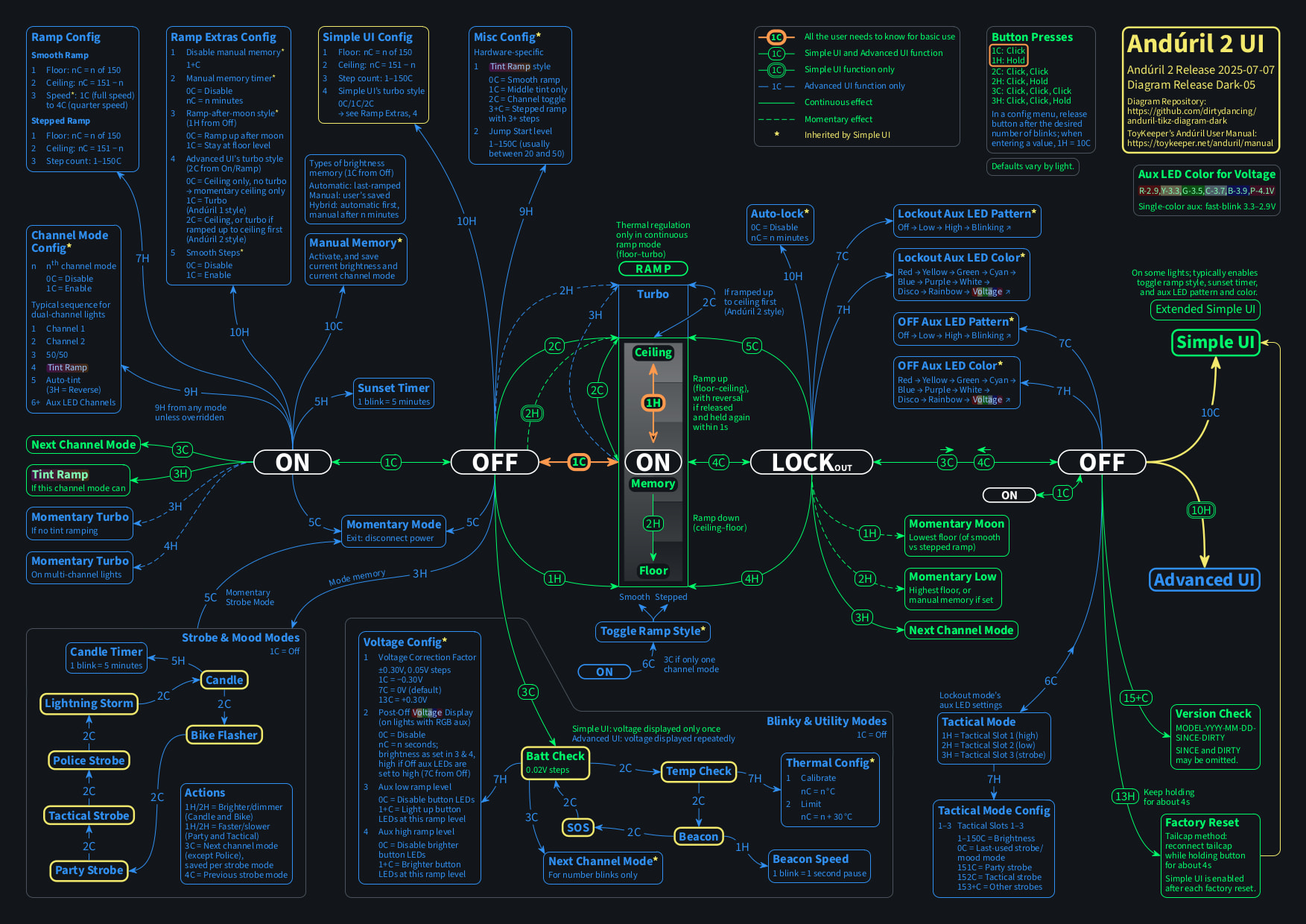
Hey folks, here is a diagram update for those interested: I finally got around to updating the exemplary dark mode edition diagram to the latest status (for Anduril 2 release 2025-07-07 only). This is a follow-up to this previous post of mine back from last August. If you have any thoughts or feedback, please let me know.
In contrast to the standard generic diagram, the dark mode edition is not designed to be printable with a basic black and white printer. This allows for more color flexibility, and the dark mode edition showcases how adaptable the diagram is to different color scheme preferences.
Here is what it looks like now (source):
2 Thanks