As per title, which one/s are thought highly of these days and why?
Both AA and AAA sizes - thoughts and recommendations much appreciated.
1 Thank
Xtar. Active in BLF with lots of reviews. Very good, very expensive.
Many of the others are lots cheaper, but their performance and reliability may be all over the map.
Brands seem to come and go at random, at least on Amazon.
Don’t trust Amazon reviews. 90% of them have no clue.
In general, I personally would avoid the USB-charge varieties. That’s extra hardware in the can that compromises capacity…usually. If you MUST have that feature, expect a capacity hit.
If you actually expect a ‘decent’ AAA, then disappointment will be your probable result. Can size is WAY TOO SMALL for the electronics plus the actually battery chemistry. I’ve tested 4 brands, all cheap-yes, but they were all about 300mAh or less, with limited current capability. Pathetic.
What makes you want 1.5V LiIon?
I have a couple of items that don’t much like 1.2V.
4 Thanks
That’s the reason I would buy them too.
Be aware that Xtar has 1.5V li-ion cells that don’t have a flat discharge curve and try to mimic a normal cell, and in those devices you wont be able to use the entire capacity with them. So chose the flat discharge ones.
Self discharge comparison: https://www.akkuvergleichstest.de/
2 Thanks
Thanks for that info.
I have been in to batteries/chargers/flashlights for quite a while now, but the 1.5V liion looks confusing with brands/types coming and going - so if you have a link to the ones you are referring to that would be much appreciated - maybe on AliE?.
1 Thank
They show the discharge curve on the product page, it’s the ”LR” models that mimics alkaline discharge curve : XTAR AA 1.5V LR 3000mAh USB-C Lithium battery - XTAR

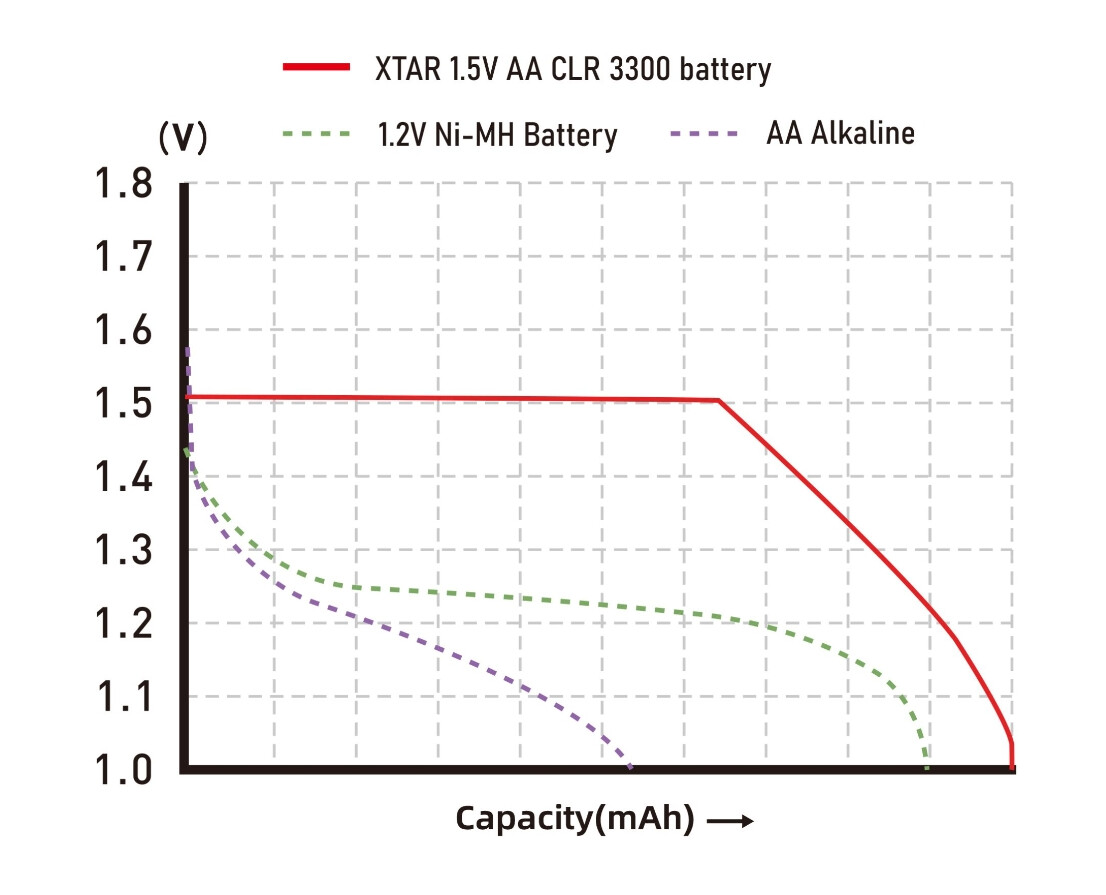
A device with a cutoff at 1.3V for example would waste a good part of the capacity so it’s not a good choice for high cutoff devices.
CLR has a flat then gradual decrease curve : XTAR AA 1.5V CLR 3300 Lithium battery - XTAR
And then the normal ones with CV discharge and a step at the end : XTAR AA 1.5V 4150mWh Lithium battery - XTAR
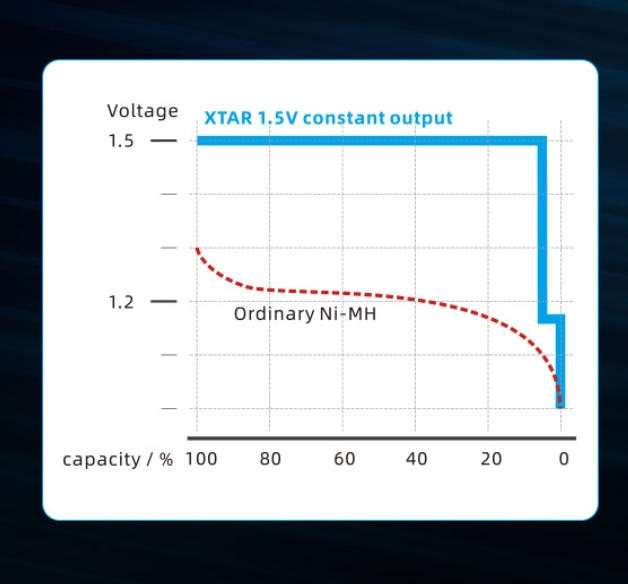
Both CLR and normal allow a device with low batt warning to give that warning. But CLR would have better compatibility since it’s a gradual drop, for example if the device has warning at 1.25V and turns off at 1.2V then with the normal version there would be no warning.
6 Thanks
I’ve been using the Xtar 4300 and so far they seem to be working ok. I’m testing rested runtime vs. fresh off the charger runtime, I have a feeling that some of them might be exhibiting pretty high self discharge when left sitting in the battery cases.
**I have a limited control sets, 1 pair sitting on the desk exposed, another pair in the included battery carriers.
The ones tested on the German website had 20% self discharge in a year, which is basically the same as low self discharge NiMH (e.g. Eneloops), I hope it’s consistant across their models and not that some other have higher self discharge.
1 Thank
I thought the loops maintained that charge over a few years…
The sudden complete voltage cut-off can be a ‘feature’ to notify you the battery is running out, or a loss of some usable capacity.
I have devices that ‘complain’ (an annoying icon) but still run fine at 1.2v. A few other things don’t work well.
Some things, like small electric motors may run WAY better at 1.5v.
So…depends on your requirement.
Took a brief look at Aliexpress. The only battery that I have seen decent reviews of is Hixon. Price isn’t quite crying out for a purchase, but it may be worth an experiment.
You DO need an appropriate charger. Older multi-chemistry chargers that have not SPECIFICALLY been provided with a 1.5v mode will not work.
1 Thank
Great summary, thanks!
I went on my usual biannual peruse of the Xtar website as I’d like to try out 1.5V Li-ion mostly from curiosity…
Promptly remembered why I don’t own any of these, their website is difficult to navigate, they lack summary comparisons between products, and compatibility between cells and chargers isn’t clear…
I’ll be back looking in 6 months but for now the curiosity has been satisfied and my wallet saved.
Someone tested the self discharge of Eneloop here : Eneloop Self Discharge study | Candle Power Flashlight Forum
And it was 84 % retention after a year, so, not quite the 20% loss I recalled and the Xtar are slightly worse, but I think still pretty close.
Important to note, it’s an older gen, I dont know if current gen 4 and 5 have lower self discharge.
1 Thank
Not exactly. Eneloops are rated at 70% capacity after 10 years. They slow the self discharge with lower voltage. I believe the Xtar cells are linear in capacity drop over time. The First year generally works out to about 14% for Eneloops and slows from there. But sure, as the Xtar cells have a circuit that is always powered, still pretty impressive. But not really that close to the Eneloops .
2 Thanks
That’s likely but also matters less as the first year or years are more important. The device they are being used in are discharging the cells and they’ll need to be replaced at some point and generally that’s much less than 10 years.
For actual ready to use long storage cells, better use lithium Primaries.
Also I can’t find it again, but I recall a longer study and I’m prety sure it went lower than 70% in much less than 10 years.
That’s like the cycle life, most tests don’t go remotely close to the specs (2000 cycles).
1 Thank
I found this in a post over on Candlepower Forums in a post by Xtar.
"When the cells are stored in the fully-charged state, the self-discharge rate typically remains below 5% per month. If the internal cells are stored with the voltage below 3.6V, (no way to check this) the self-discharge rate is less than 3% per month. You can rest assured that these 1.5V Li-ion batteries won’t get over-discharged within one year of your purchase. … Besides, please remember to charge these batteries at every 6 month during long-time storage."
So it comes down to the power requirements of the device. If it will empty the cells within a couple of months (or less), the self discharge would not be critical. If the cells can power something for a year, then the power loss is significant. For example, I have been using the Xtar AAs in a few clocks. They are very low drain so changing them out at every time change works fine. I tried them in “atomic” clocks that will set themselves. They will not last the full year. Eneloops will and have gone as long as 15 months in the same devices. I think this is caused by self discharge as the energy capacity of the cells is very close.
So these 1.5 V LiIon cells do have their place, but one needs to pick the application carefully.
1 Thank
That’s significantly worse than the results from the german website (-20% in a year), 5% per months would be 10 months down to 50% SOC which is just terrible.
Are they just being over conservative with their numbers (would be strange for battery sellers lol), or some testing error, orparasitic drain varies wildly between models so they have to give the sefl discharge rating for the worst ones?
But I wonder how they would get such high self discharge, li-ion itself, past the first 20% has very low self discharge, and even before that it’s still quite low.
Then there’s a buck converter but modern bucks are extremely efficient, for example TLV62595 has 10uA Iq at no load, that’s 7.2mAh per months. Not sure what’s the capacity of the shorter cell inside, they make 1500mAh 14500, I hope at least 1000mAh 14400, that’s 0.72% per months.
Finally there is some kind of battery monitor IC, but usually those also have extremely low Iq as well. Maybe they use some exotic ones that consume more.
Edit: could be that the 14400 used are lower quality that the typical li-ion cell with higher self discharge and maybe variable.
1 Thank
I was wondering, because after 5ish years, my loops were sitting between 77% and 82% on average, measured by amount charged, full discharge, then full recharge.
**needed to add, full recharge capacity sitting above 1900mAh
3 Thanks
That is an excellent summary with lots of work - much appreciated - thanks.
To be fair, they all pretty much charge via USB, at least 5V.
14500s use 14430 cells (pretty standard), so cell size is pretty much the same whether charged by plugging it in (C or micro, no diff) or via the backflow method, ie, the “charger” just hits it with 5V directly with zero circuitry except maybe an LED to let you know that slot’s charging.
Pretty sure those with sockets can also be backflow-charged.
Anyhoo, point being that the 7mm for the board/circuit is the same regardless, as is the 43mm for the cell.