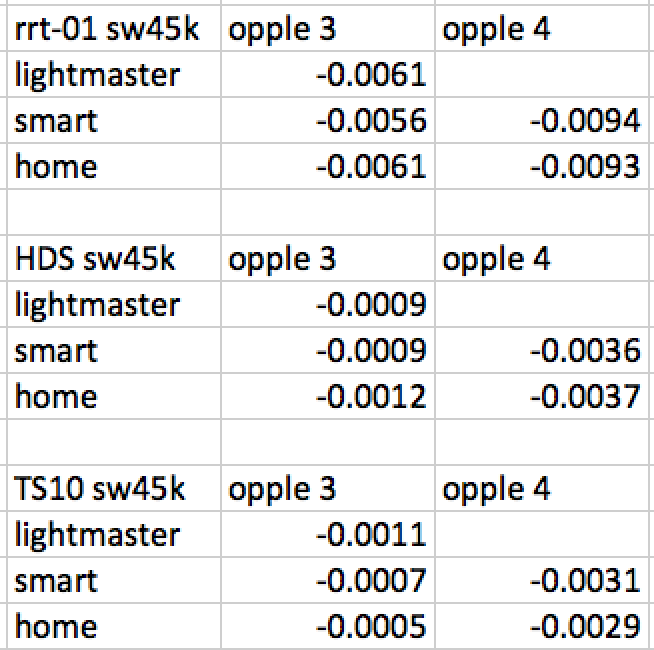
In the past I have recommended against the Opple 4 because I felt it worked poorly with Low CRI LEDs. Although I still feel that way about Low CRI use, I have changed my opinion about the Opple 4 when used for High CRI LEDs and I now Do Recomment Opple 4.
I tested a very pink sw45k D200 in an RRT-01, and some not very pink sw45k D220 in an HDS and a modded TS10
For High CRI LEDs, Opple 4 is very convenient because it calculates DUV automatically.
Although the Opple 4 gives values that are about -0.0030 lower than Opple 3, both the Smart App and the Home app seem to give almost identical values. I do not have Colormunki, so I dont really know whether Opple 4 is more accurate than Opple 3, but Im liking the Opple 4 values better, but only for the specific sw45k lights shown above.
fwiw the Smart app works better than the Home App on Opple 4 when testing Low CRI LEDs
My conclusion is that the Opple 4 works well with High CRI LEDs.
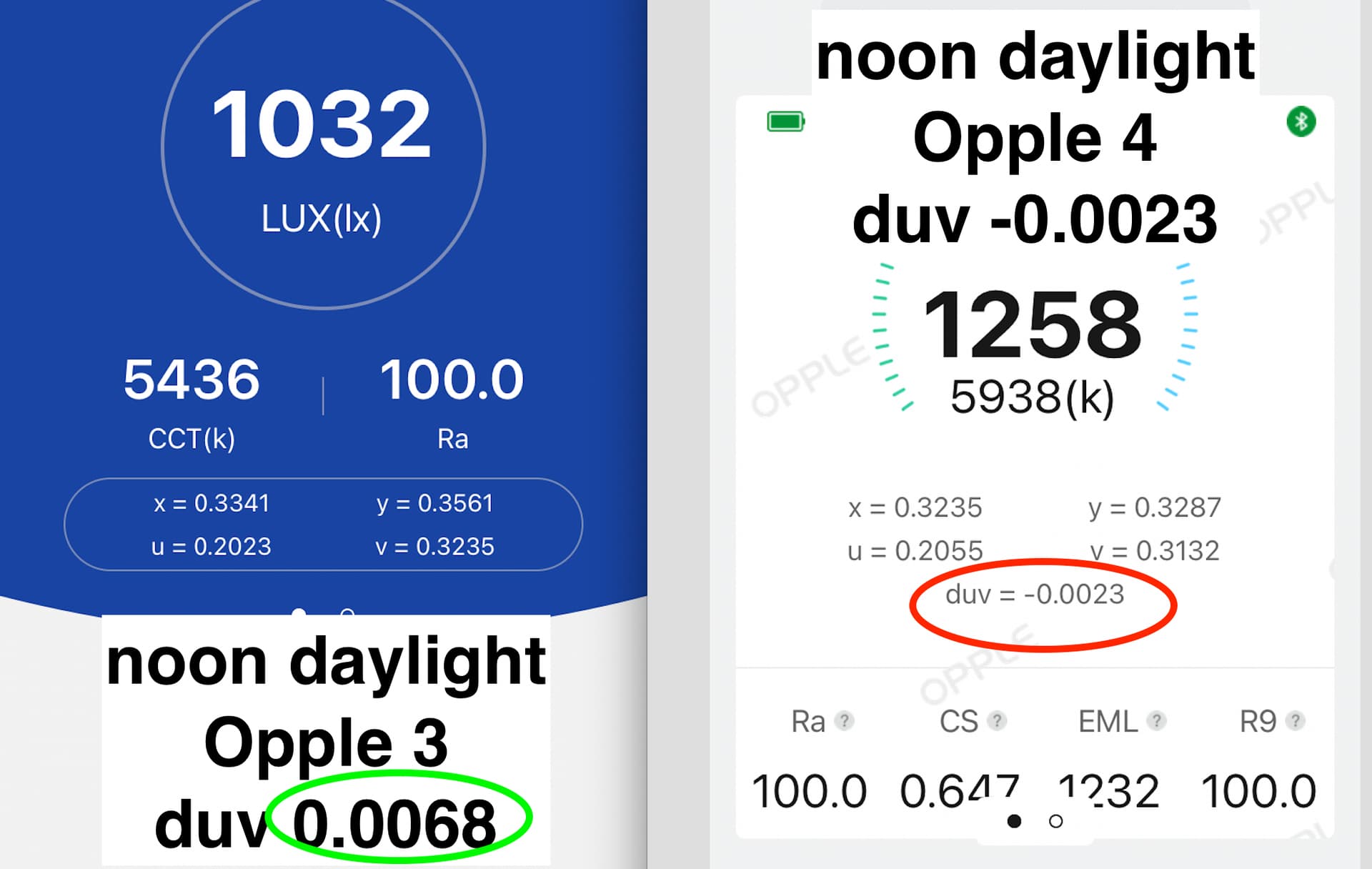
otoh, comparing Opple 3 to Opple 4 measuring bright overcast noon daylight, the 3 gives a positive DUV of 0.0068 and the 4 gives a negative DUV of -0.0023
These are already quite large deviations between Opple 3 and 4, not really useful for more precise measurements. A deviation in the Duv of 0.003 is already significant and can significantly change the statement on the measurement result.
The fact that it makes a difference whether the light source to be measured has a high or low color rendering (which also has to be checked before the measurement, which makes the measurement somehow superfluous, precisely because you don’t know the color rendering you want to carry out a measurement) shows me that something is not quite right.
true
a variation of 0.0030 when measuring an sw45k w Opple 3 vs Opple 4 is indeed quite significant.
it gets worse, when measuring daylight, the Opple 4 gives a DUV of -0.0023, while Opple 4 gives a DUV of 0.0068. The variance is 0.0091… quite ridiculous…
bottom line is neither Opple 3 nor Opple 4 can be considered accurate. They are only useful for comparing my own LEDs to each other, with either Opple model… but the two models dont produce the same results even with my same LEDs
Colormunki or Sekonic are a much better option than any Opple.
That question can not be answered. Because there are many variations between sw45k LEDs, some are D180, some are D200, some are D220, And even when comparing two sw45k from the same reel, they are not identical.
The only way to know if an Opple is giving close to accurate data is to use Colormunki or Sekonic to measure the exact same LED as is being measured by Opple 3 and Opple 4.
So we would need someone who owns both an accurate tool such as Colormunki or Sekonic, as well as one or both models of the Opple.
I agree, but there are almost no more Opple 3 available. I had hoped that I could show some hope for someone interested in buying an Opple, that the 4 might be useful. It can be, but only for comparing my own High CRI LEDs to each other…
The advantage of the 4 over the 3 is that the 4 calculates DUV automatically (but the results are not the same for the 3 and the 4), plus the 4 gives R9 values (but they are not accurate w Low CRI sources.)
The tint depends not necessarily on light flux bin. D180 or D220 is the code for the light flux bin. The tint is sw45k, which indicates a color group at 4500 K CCT below BBL. Even on the same reel it can be everything in the given color group.
But if the same LED under same measurement conditions gives such different results, the devices are not good for doing measurements. Maybe Opple LM are okay to get a first estimate (like finding High CRI variants of emitters which are normally only available in low CRI), but noting more.
And the problem with the LM is not only the cheap 8-channel sensor, but also the software - who knows if the algorithms in the software are the right ones? Even with different software types and same measurement conditions there are differences, which is also not good.
Software is basically the most important thing for any light meter, like Opple LM, if the software is bad, the best sensor does not help at all.
For everything with more precision a photospectrometer is needed…
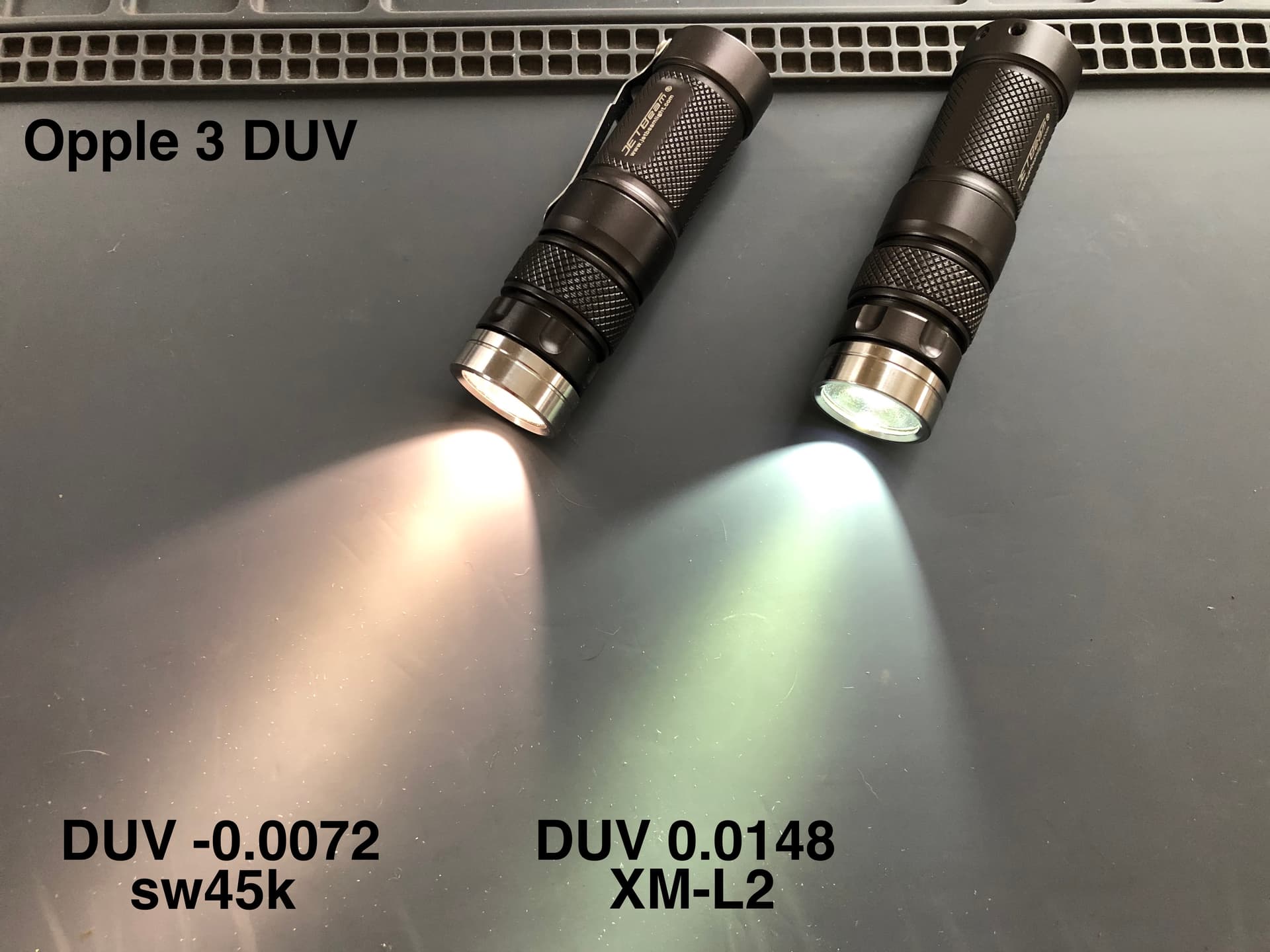
however, in the specific three sw45k LEDs in my first photos, you can clearly see that the one on the left looks more pink than the other two lights.
also, my experience w D200 sw45k is that they Do have more pink tint than D220, as a general rule of thumb.
I agree the Opple 3 and 4 are not accurate. imo they are only useful for confirming what my eyes see, in the photos in the first post… iow, the more pink LED has a lower DUV… but the actual DUV Numbers are not exactly accurate.
The numbers only compare the Relative amount of pink, as shown in the photos.
we can see the DUV changed, but we cannot say that the actual DUV numbers will be the same for any other specific 519a 4500K. Nor can we say the Opple DUV numbers are the same as the values from a more expensive instrument, testing the same exact LED.
Yeah, but also the Opple LM devices are unique to each other… the sensor has tolerances, also the additional components on the PCB … it is not sure that my LM4 (if I have one) will give exactly the same results as your device would do.
I think we must accept that the Opple devices are only useful for rough estimates, not for real measurements. This is also the reason why I am generally very critical of such LM measurements in reviews from LEDs or flashlights, because there are no more or less precise measurements…
LED bare in integrating sphere, spectrometer with additional software and calibration of raw data according to inside coating used. More like in a lab, not a measurement “on the fly”
I have found Opple 3 to be generally true to what I see with my eyes as far as being positive or negative dUV depending on the light. It seem repeatable in it’s own accuracy. More importantly to me is changes such as minus green or AR tints have an impact to the measurements so I can tell if changes are worthwhile. The Light Master 3 for 40ish dollars or whatever it was when it was purchased has been worth the buy in and provided lots of entertainment and knowledge. It is a shame I was an early purchaser of the IV and has since been put away somewhere. The only reason it stays around is using the shell and USB-C charging port to do a swap incase the 3 battery dies.
Just to be clear though, even with the updated and new apps, the 3 is still best used with the Opple Light Master Pro and there is no way to automatically calculate dUV or get a semblance of an accurate R rating correct?