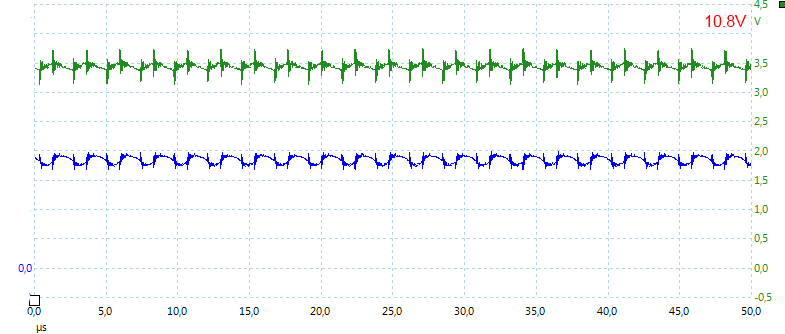
I did some tests yesterday.
It was battle between nanjg(3 Amp version) vs. this driver (PWM vs. PWM-less) at low currents.
I used xm-l u2 on heatsink with small tir and hs1010A for lux measuring(at some distance).
First,I measured current and lux for nanjg at low (5%) mode:

Current:151mA
Lux:2620lux
Then,I did the same with this driver(current is as close as possible):

Current:153mA
Lux:3480lux
That's ~33% increase in brightness compared to 3Amp nanjg at same current.
Similar,I wanted to see at which current this driver will have the same brightness as with 3A nanjg:

Current:115mA
Lux:2600lux
3A nanjg consumes ~31% more current to get the same brightness.Same result as test #2 if we consider measurement errors.
Answer to question why this happens is:
Efficiency of xm-l u2(from cree pct) at 3Amp,25C: 98lm/W
Vf of xm-l u2(from cree pct) at 3Amp,25C: 3.34V
Efficiency of xm-l u2(from cree pct) at 0,150Amp,25C: 165lm/W
Vf of xm-l u2(from cree pct) at 0,150Amp,25C: 2.68V
Nanjg runs led at 3Amp on every mode,this driver runs led with constant current(no pwm).
Overall efficiency gain can be calculated as: (165/98)*(2.68/3.34)=1.68*0.80=1.34 or 34% which is very close to measured values.You can see that led is 68% more efficient at 150mA vs 3Amp,but driver burns more voltage because lower Vf of led at 150mA.Overall,gain is still pretty impressive.
BUT,to be fair this test should be 5Amp stacked nanjg(or DD fet driver) vs. this driver,since this is 5Amp driver.
Similar to upper calculation (this time I used some numbers from match graphs,since cree don't show 5Amp numbers):
Efficiency of xm-l2 u2 at 5Amp,25C: 84lm/W
Vf of xm-l2 u2 at 5Amp,25C: 3.8V
Efficiency of xm-l2 u2(from cree pct) at 0,150Amp,25C: 188lm/W
Vf of xm-l u2(from cree pct) at 0,150Amp,25C: 2.8V
Overall efficiency gain can be calculated as: (188/84)*(2.8/3.8)=2.23*0.74=1.65% or 65% increased brightness for same current or reduced current to get the same brightness.
And 65% reduced current means at least 65% longer runtime (that's like you have panasonic 3400*1.65=5600mah).
This is example for just one low current (150mA),but conclusion is pretty obvious.
When you consider one more important fact,that 5Amp pwm driver losses regulation very quickly(because of high Vf),pwm-less driver can maintain constant current/brightness until battery is empty (again because of very low Vf at low currents),advantages are even more clearer.
Edit:
Let's consider one more case: 5Amp buck driver(pwm regulated) vs. this driver.
You'll expect that buck is always superior compared to linear when we talk about efficiency.Let's assume 90% efficiency for buck.
At low mode (for ex. same 150mA) we have next data for buck driver which is pwm regulated:
Efficiency of xm-l2 u2 at 5Amp,25C: 84lm/W
Vf of xm-l2 u2 at 5Amp,25C: 3.8V
Driver efficiency:90%
Input voltage:4.2V
Led power=0.15A*3.8V=0.57W
Battery power=(1/0.9)*0.57=0.63W
Current draw from battery(voltage depended,using 4.2V)=
=0.63/4.2=150mA
I used 4.2V because this way I got same batt. current as lin. driver,so it's easy to compare.
Led lumen generated=84lm/W*0.57W=48lm
_______________________________________
This driver:
Efficiency of xm-l2 u2(from cree pct) at 0,150Amp,25C: 188lm/W
Vf of xm-l u2(from cree pct) at 0,150Amp,25C: 2.8V
Input voltage:4.2V
Led power=0.15A*2.8V=0.42W
Battery power=0.15A*4.2V=0.63W
Driver efficiency=2.8/4.2=67%
Current draw from battery=150mA
Led lumen generated=188lm/W*0.42W=79lm
So,at same battery current of 150mA 90% efficient pwm regulated 5Amp buck driver will generate 48lm,while pwm-less linear driver will generate 79lm.That's 79/48=1.65 or 65% more,same as above calculation for 5A nanjg or DD fet drivers.
Note that linear driver efficiency is just 67% vs. 90%,but 188lm/W vs. 84lm/W of led efficiency totally changes final efficiency result(and that only matters).
The point of this calculation is to show that there is no advantage of having high current 5Amp buck driver(at least not for single li-ion),unless it's also pwm-less controlled(as we can see from various driver threads,even much simpler pwm controlled buck is PITA,not to mention size and cost).Also,that hypothetical buck driver looses regulation very quickly,since it can't increase voltage.