Probably any transparent solid with some intermediate index of refraction would do!
Turns out it’s neither! The shortest description would be that it reduces the average number of times a photon gets absorbed/re-emitted within the phosphor, which means that more energy is retained by the time a photon exits. Hence the shift to higher CCT.
To elaborate more on the mechanism: the main mechanism at play is the thickness+curvature of the dome making it easier for light to exit. Consider what happens when you put a round dome on a flat-domed LED (like XPL-HI):
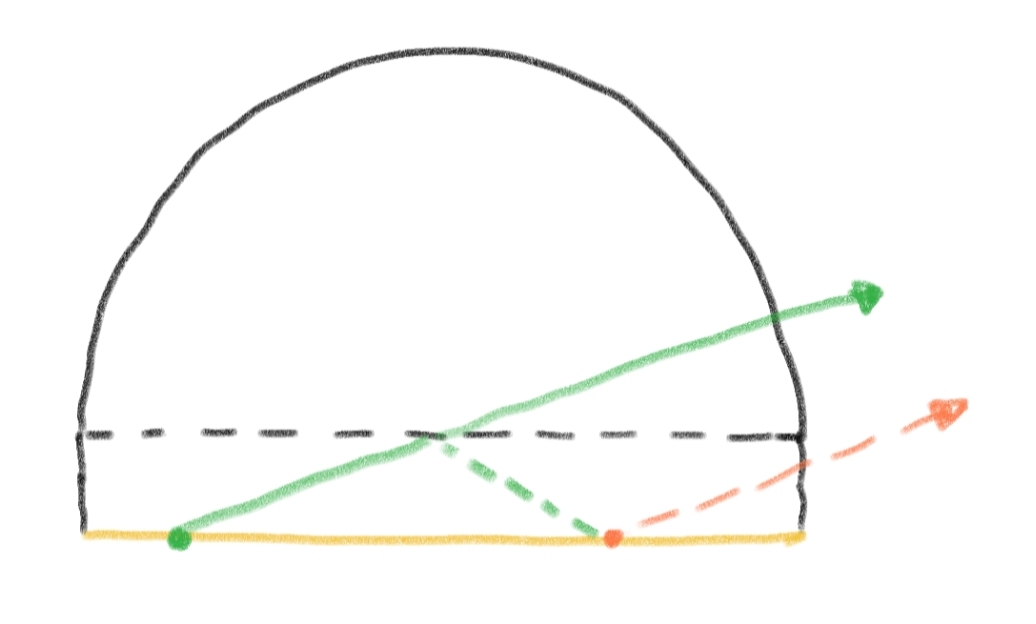
With a flat dome (dotted black line), the ray of light (green) coming from the bottom gets reflected back to the phosphor by the solid-air interface, due to the oblique angle of incidence (i.e., total internal reflection). Thus this ray needs to be down-converted at least one more time (turning orange) before exiting.
With a round dome, the ray passes through the dotted line because it no longer separates 2 different materials. When it hits the hemispherical boundary of the dome, its angle of incidence is very close to perpendicular, which gives it a good chances of exiting immediately.
For truly domeless emitters (e.g., SFT40, LHP531), there’s a secondary mechanism at play, and a short explanation would be that the added clear silicone material has an index of refraction between that of the phosphor and that of the air, and having this intermediate step increases the overall transmission, due to a concavity property of the transmission function. Below is the long version of the explanation:
Long version
For simplicity assume that all incidences are perpendicular. Given a boundary separating two materials with reflective index ratio r, the transmissivity T(r) = 4r/(1+r)^2 follows from direct simplification from Fresnel’s equations. Note that even though “reflective index ratio” is ill-defined without specifying the order of the two materials, T(r) is still well-defined as it is invariant under a reciprocal transform to the input.
The statement “having an intermediate material increases transmissivity” translates roughly to: for all positive r, s, T(r)T(s) > T(rs). One can reword this as F(a)+F(b) > F(a+b) for F(x) = ln(T(e^x)), which essentially just says that F is concave/subadditive.
It has the same bulge that water does, which should be more effective than a flat surface, per the diagram above!