There is a point of diminishing returns when it comes to light output. Now we are at or near 200,000 lumens. We need 800,000 lumens to appear twice as bright and that is just not practical for real world use.
I do see them making a light with similar output but with larger reflextor wells and likely putting out 1.5M candella. That is the only foreseeable upgrade i see in the near future aside from new battery tech. I dont think fans have upgraded much in the last 50 years and i dont know if they would even consider a liquid cooling system for longer more sustainable output.
Sorry if this has all been said before. I didnt read the entire thread
1 Thank
I can still think of quite a few technological or engineering upgrades I’d like to see:
- High power violet-pumped ultra-high CRI emitters. Right now the only practical options for flashlights are Nichia Optisolis and Seoul SunLike, rated for a measly <50 lumens. I would like to see them upscaled to handle power like a 519A.
- More thoughtful design/choice of optical elements. Ringy beams, misshapen hotspots, Cree rainbows, angular tint shift…all problems that can be resolved with small optimizations to the optical element used. With an ideal point source, a paraboloid is the ideal shape for a reflector. But LEDs are not ideal point sources, and there is no reason to assume that a paraboloid produces the most pleasing beam; this applies especially to small floody lights with a yellow hotspot and purple spill.
- More modular design among lights of the same class and battery type. For example, being able to swap heads across the entire Convoy S21 series.
- Better mechanical clicky UIs. Right now not a single driver combines the customization of both mode groups (like the Convoy 12-group driver) and exact drive currents and mode spacing (like the Convoy ramping driver). This results in a difficult choice between awkward UI and awkwardly spaced modes. I’d rather see something like a choice between groups containing 1 through 7 modes, where the output of each mode can be set by the user with arbitrary precision.
1 Thank
The head is basically the flashlight. A body tube is just an empty aluminum shell which costs 50c to produce. I wouldn’t worry about swapping heads on tubes.
Meanwhile Sofirn keeps pumping out brand new light with SST40, FET driver and Anduril… Talking about advancements.
2 Thanks
I think, eventually, we’ll probably see torches reach 200 lm/W out the front with good color rendering and a good tint. This, in turn, means a significantly higher thermally sustainable brightness level for any size of host.
Part of the improvement comes from better LEDs, and part comes from better drivers.
I think batteries will continue to improve. Some of the research prototypes indicate it might someday be possible get like 15,000 or even 20,000 mAh from a 18650 cell and still recharge it hundreds or thousands of times. This then allows lights to be smaller while still having a useful amount of brightness and runtime.
I think open-source will gradually become more common too, and easy methods of installing it. This, in turn, means gradual improvement in functionality and user interfaces. And probably better consistency between different lights, yet also more diversity in total… which are both good things.
I think it will also be more common for lights to include charger / powerbank functions, since it’s such an obvious and useful thing to do with devices that are effectively a really shiny battery.
Other types of lighting are improving too… like, I recently got some very nice dimmable high-CRI bulbs for $3.50 each, which look and perform quite a bit better than the old Cree bulbs I paid ~$14 each for about a decade ago.
But I also think we’ll continue to see cheap junk lights with imaginary specs sold for a huge markup. Because almost anyone can connect a battery, LED, and switch, and make up some numbers for advertising in markets that don’t enforce honesty or quality. Even these, however, will probably improve over time. Remember, this entire site was founded in recognition of how actually-not-terrible those budget lights can be sometimes.
5 Thanks
Ahhh yes, 120+999,999,999,000i lumens
I have not seen any mechanical clicky drivers that permit flashing of custom UIs, while side switch drivers seem to be quite mature in the development of this sort of customization. Is this a technological limitation or just that few people have looked into it?
There are some… like the old BLF-A6 and Bistro lights from ~2015, and almost every driver from MtnElectronics. However, they typically require soldering to pull out the driver and get access to the MCU. BLF hadn’t started using pogo pin adapters yet, back when those lights were made.
There’s no reason why clicky-switch lights couldn’t have easy firmware updates. They just haven’t been very popular since before pogo pads started appearing on drivers. BLF lights mostly changed to e-switches around 2017, but pogo pads weren’t common around here until 2019 or so.
1 Thank
Id absolutely hate that, but probably unlikely it will happen anytime soon, if it is, might as well stock up on ‘original’ flashlights!
I definitely think there could be big improvements made on the driver or user interface, but how much is too much, either too expensive, or impractical. Lets take a better example: an older and more modern car is the metaphor for the flashlight switch. Imagine you are driving and want to turn up the radio. On the old fashioned car, you turn a dial, probably some kind of variable resistor. Its cheap and simple, and does the job. Now youre driving the modern car. It has a touchscreen and you probably have to go through menus or risk getting distracted, or press the wrong thing. And on top of that, it will add more cost to buying the car and if it fails it will be very expensive to fix. (Actually, a relative of mine recently purchased a very new car which needs both an account and app to use, and updates over the internet while parked.) Its a great car, but there is a lot of electrics that could go wrong.
Now back to the flashlight switch/UI. I do think there could be improvements. I heard about andruil UI being overcomplicated with too many functions, all being controlled by 1 button. Its very easy to accidentally get into a hidden strobe or other mode by clicking the wrong amount of times (think like the overcomplicated menu of the new car). Now I dont personally own any andruil lights, but some have more advanced UIs. One of my biggest problems is having to explain the light if I hand it over to someone else. They will most likely access strobe/moonlight or keep ramping up and down. If I had to choose an idealized UI for me, it would be a dual switch style light, such as the convoy L7, or a dual tailswitch like some tactical lights. A mechanical switch like a lockout that interrupts the circuit and prevents parasitic drain, and an Eswitch for modes. Either with or without memory. Another benefit is I could preset a mode, and hand over the light to someone else without experience with UIs and tell them the mechanical switch is on/off.
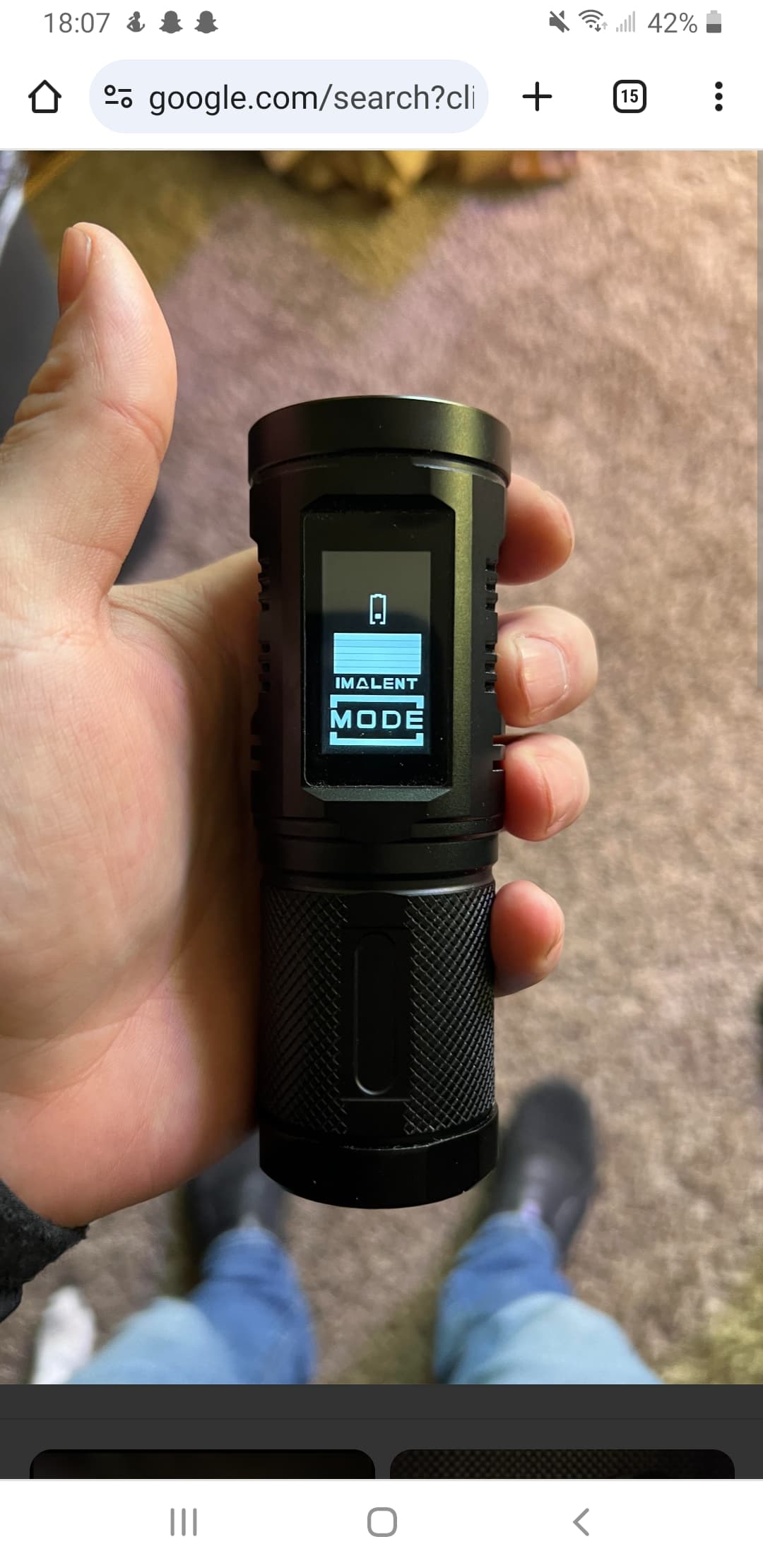
Now how can we improve the UI further? I guess imalent was thinking the same thing when they came out with a touchscreen-controlled flashlight a number of years ago. I also believe its discontinued (and probably for good reason!). Now I never had such a flashlight, but I can already imagine how impractical that is. Firstly, it looks expensive to build. Now imagine using that thing with gloves, or wet or dirty hands on the rain. It would be a nuisance. Plus if the flashlight takes a bang and breaks the screen, you cant control it and it will make an expensive paperweight or cost a lot to fix. Similar to my example of the car radio touchscreen. Imagine if for some reason most new flashlights sold had this feature. Although somewhat useful, such as quickly reading the battery level or currently used mode, it would be horrible to live with. I believe imalent fixed this issue in their new flashlights which include a screen. The tiny Oled display is a great idea and at least the flashlight has a physical button.
Still on a similar topic about drivers, it would be great to see high current drivers sold for modding. The highest im aware of is convoy’s 12A fet and lumencrafts 10A driver.
Yes, it can do that. Here are a few ways:
- Ramp to the brightness you want. Turn the light off. Tell the person it’s just 1 click on/off, and they shouldn’t do anything else. It takes virtually no time to set up, but much like the case you described, it also requires the person to cooperate.
- Configure the simple mode with the settings you want someone else to use. Go to simple mode before handing it to them. It gives them a very limited UI with no menus or settings to break, and you could reduce it to only a single brightness if you want. It’s “click for on/off, hold to change brightness”, and you can eliminate the hold part if you choose to.
- Put the light in momentary or tactical mode before handing it to someone. Then they can’t change anything, and it only stays on while the button is held. This is handy if the person isn’t responsible enough to turn things off after use.
I’m kind of tempted to add some sort of “child mode” too… which would be even more limited than the simple UI, and would automatically shut itself off after being idle for like 5 or 10 minutes.
3 Thanks
Until we have cold fusion powered lights that are smaller than a 21700 and produce in excess of 1 million lumens at 40C with 98CRI, with a runtime measured in months, we have not peaked.
1 Thank
I’ve been wondering if it might be possible to power a light via quantum entanglement. Like, if you could create a stable entanglement between two macro-sized objects the size of a LED die (which is a big “if”) … then perhaps you could put one inside a flashlight and launch the other one into orbit around the sun. Then any light which hits one gets emitted out of the other. It’d make a light which is very small and always on, with 100 CRI and unlimited runtime.
But I don’t know if physics actually works like that. At a guess, probably not.
Nah, if you accidentally run your car over it, it will burn the entire city down. Current Li-Ion batteries have enough energy to be dangerous.
I’m pretty sure it doesn’t work like that…
Thanks for the explanation, and I do think child mode is a great idea. Its should be best limited to a handful of lumens so the child wont accidentally shine the light in someones eyes (or stare in it), or get burned if it overheats.
EDIT: Im talking from experience. So my niece is only 2 and was always obsessed with flashlights. She would sometimes come over to my house for babysitting. Any chance she gets, shed ask to see my flashlights. I only limit her to a small twisty AAA flashlight because its so dim it isnt harmful or annoying. She would either aim the flashlight in everyones eyes who is in the room, and run away laughing, or look in it herself (although I tell her I will take the light away if she aims it at people). So again, id say limit it to a weak brightness. The 10-15 min timer is a good idea in case the child forgets the light turned on, in order to prevent wasting the battery. It should have some kind of “password” to prevent the child spamming the button to try to unlock full power.
1 Thank
Manual memory?
For a kid, set it to barely above moonlight, for The Muggle something medium-ish, and for someone more in need of a bright 1-mode light, something like regular high.
1 Thank
Muggle? What does that mean.
It’s the word in Harry Potter universe to describe the ‘normal’ non-magical people.
For flashlight community, it is taken to represent regular people (those unfamiliar with complex UI’s, who don’t have esoteric knowledge on flashlight technology).
2 Thanks
I’ve seen it used in many a technical/enthusiast community where it’s - varyingly - the ignorant, the uninterested, the incapable.
1 Thank
In this community it is generally “folks that would burn themselves with turbo or get confused with multi click interfaces.”
2 Thanks
This, but in general, people who don’t want to have to learn Morse code just to use a flashlight.
7 Thanks
My TS80P active soldering iron acts like a thumb drive when connected to my PC. Just drag a new binary file onto it to update the software.
The small display is really useful. You can easily see the temperature and change the settings without having to interpret the morse code of the torch LED.
This is an existing technology that will hopefully find its way into the next generation of torches.