Please tell me in case I missed: exactly which TIR is OP using?
he replied to YOUR post with parts he ordered, 7/21
I have no idea what you’re referring to, please quote it for me.
post 7, can you scroll up?
2 Thanks
Post 7 does show a parts list with a reflector, but the conversation has moved on to TIRs. You might want to scroll up to post #9.
I feel that I have sufficiently communicated my points on the technical side, and will not continue to respond unless doing so would be helpful to OP’s project.
What tir are you talking about? cuz they are all different, even same led with tir of same rated angle from different manufacturers will give you different beams, Tirs are more tricky than reflectors, in my experience.
So where can I see your build? it would help op greatly to see the advice he is given are from practical pov not just hypothetical thinking without any specifics.
2 Thanks
I agree with your statements on the differences among TIRs, and on their complexity relative to reflectors. I refer to the 20mm, 3535 or 5050 wide-angle beaded TIRs from Convoy’s store. I find that different narrow TIRs tend to produce very different beams, but wide-angle beaded TIRs have much less distinction. Particularly those from Convoy’s store, which all have the hexagonal-lattice beading pattern.
I’m not sure which build you’d like to see–I’m not the OP and not pursuing the same project. Lots of different LEDs, drivers, and TIRs have gone in and out of my small collection of hosts, so at the moment I probably don’t have a ready-made light with your desired configuration.
Since OP already has a collection of S15-compatible TIRs to try, I propose that we leave them in peace until they have further inquiries. PM me, or start a separate thread, if you wish to continue the conversation.
Bang on!
Well, I will still reply to things that I believe are wrong, you may react or ignore, but i’m doing it for OP, not you.
Like this one for example;
If the 1mm^2 emitter makes a 5-degree beam, then applying a 60-degree diffusion gets you a 65-degree wide beam. Under the same setup, the 4mm^2 emitter makes a 10-degree beam, the same diffusion gets you a 70-degree beam. Not so different after all.
It could not be farther from the truth, for 2 reasons, 1 you do not add angles, it does not work that way, you need that angle to match the tir, the tir is made to work with certain angle leds, if angle is different it will not be focusing in a way it was designed, the difference maybe small, it may still look ok, and in some cases pretty good, but it is not as efficient as rated with a proper angle, and it may not give you the otf angle as rated, So you do NOT add or subtract angles, it just does not work that way in real world,
Second reason, there are no leds with 5 or 10 degree angle, not on this planet’s market, (there are 10mm led exception, there were 10 degree leds but they have been outdated by 15+ years, so ignore those), look up datasheets of xpl, xpe, sst20.40, luxeon…pretty much any led, they are all 110-130 degree, the smallest one I’ve used in my builds, were 65 degree uv leds, but its primary optic was like 3/16 high and and an egg shaped, vs half dome with the rest of leds, sure enough it did not focus correctly with any tir, ledil cute tir gave acceptable result, but not ideal. even the smallest die led osram mn1 is 120 degree.
1 Thank
I will respond to this one, and hope it’s of some interest to OP or the broader community.
As it turns out, diffusion does roughly work in an additive way.
When you diffuse a beam, what you’re essentially doing is convolving the un-diffused beam with a point spread function (PSF), which is an intrinsic property of the diffuser that describes the image you get when you diffuse an infinitely narrow pinpoint laser beam. (Hence the name–it describes how a point is smeared.) The resulting diffused beam is just a superposition of these PSF’s applied to each tiny slice of the original beam. The technical term for this operation–breaking a shape into tiny slices, blurring each slice, and then putting the blurred slices back together–happens to be known as convolution.
Convolution happens to satisfy the following very nice property (stated informally): if you convolve a shape with radius A with another with radius B, you end up with a shape with radius A+B. Here, take A to be the angle of the non-diffuse beam, and take B to be the angle of the diffuser’s PSF.
I recall seeing an early BLF discussion with a nice illustration, let me see if I can find it.
Could you elaborate more on “certain angle LEDs”? As far as I know, most surface-mount LEDs share approximately the same angular distribution: the Lambertian distribution.
It appears that there was a misunderstanding of what I said. When I said
what I meant, more precisely, is: if the 1mm^2 emitter makes a 5-degree beam in a flat, non-diffuse optic. It refers not to the emission of the bare LED, but to the beam through a non-diffuse optic, pre-diffusion.
Please see the excellent exposition in this post:
Additionally, here’s a nice article on diffusion as convolution: Gaussian blur - Wikipedia
Maybe in your articles, or wherever you read stuff, angles add, but in real world they do not. I’m not sure where you got your 5 and 10 numbers but they are not in datasheets, nor they have any practical purpose, 30 degree tir will give you 30 degree beam with a led that it was designed for, use a different led, it may not be 30, or it may not even focus correctly with a different focal points, due to different size/shape of primary optics.
These articles offer the most accurate+understandable explanation we have of how the “real world” works, and my experiences in the “real world” thus far do seem consistent with what the theory predicts.
Since this example uses 1mm^2 and 4mm^2 LEDs for comparison, the beam angle of the larger emitter must be approximately double the beam angle of the smaller one. The pair (5,10) is a fairly simple pair of numbers, and happens to be a decent-ish approximation of the beam angle of the Osram W1 and SFT40 in an S2+/S15 host, with a narrow clear TIR–before the beading is added.
I agree with this partially. Ideally the optic should produce a hotspot with the specified angle, with a specified LED, but in practice I’ve never seen Convoy specify for every TIR the intended LED. Also, most beams have a smooth fall-off, which makes “beam angle” ill-defined–one needs to impose a threshold cutoff before the term “beam angle” starts making sense.
Some optics will play better/worse with some LEDs, I agree with that. With strongly diffusive optics, however, whether the LED is “focused” or not is less relevant because strongly diffusive optics don’t even produce a coherent real image; consequently, there is no exact “focal point” to speak of.

I found these, too, but with shipping they are like 8$ per pop for a no-name emitter of unknown quality.
The order with the osram verdure should be here this week, then I will see what that LED can do for me.
And to make the situation a bit more clear, this is the situation at work, the lamp is relatively far away from the viewing area:

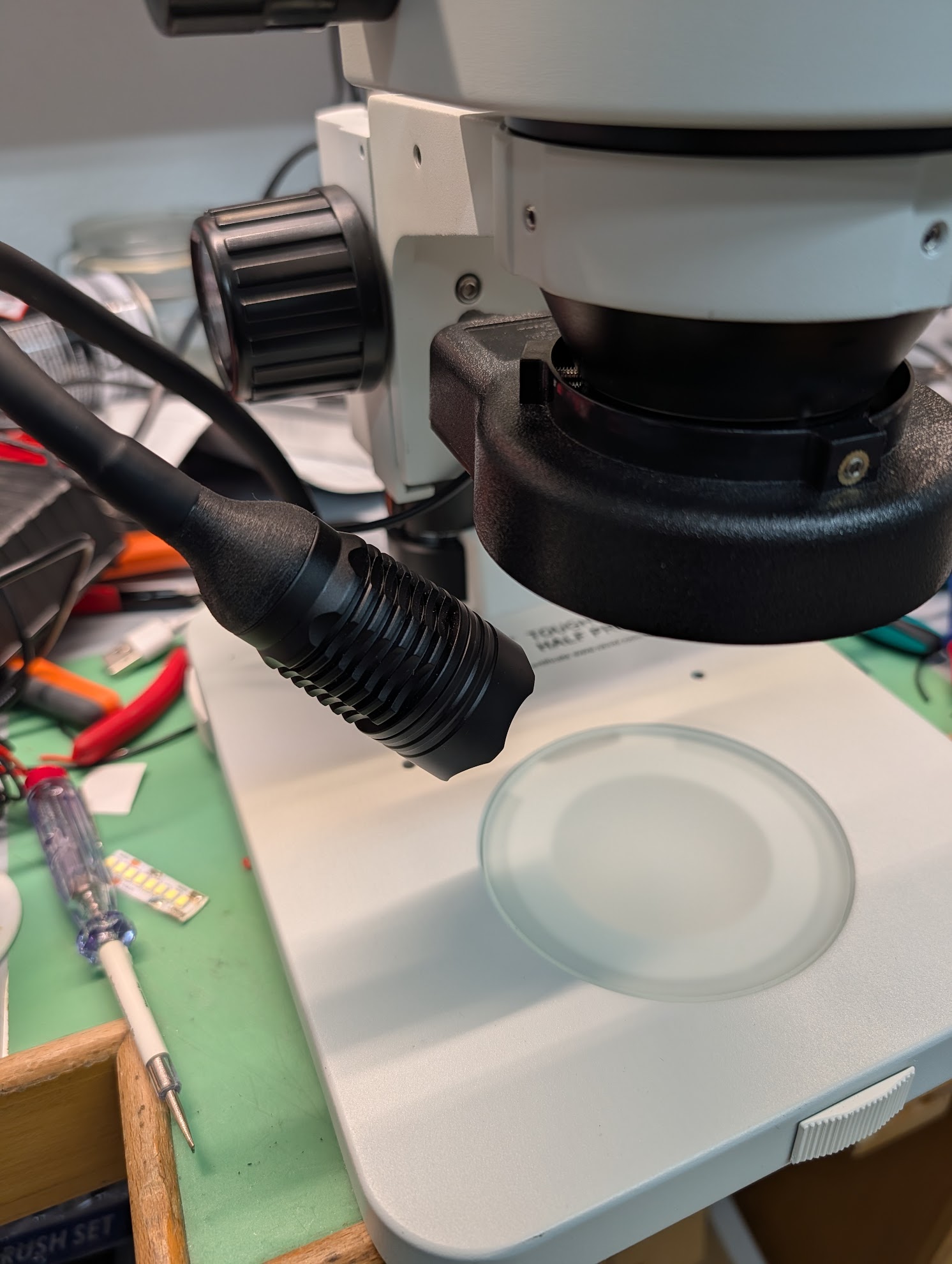
At home, I have a cheap Vevor microscope where the distance is much less:

So I need a relatively broad angle, but I will see how broad it needs to be, maybe I am overreacting a bit.
This is the M21B head with a 519A 5700K in it at around 1.5A (4 mode driver), which helps tremendously to light up the picture if I use the camera which need a lot of light for a crisp picture.
3 Thanks

This would be another option. Since you don’t need a concentrated beam, you could put a mule together. These are genuine Cree XP-E2.
2 Thanks
That’s also an interesting Idea, I would just need some sort of guard so that people behind or besides me don’t get blinded.
1 Thank
In this case you can mount the star like you normally would and leave the reflector out. You’d get plenty of cutoff by the housing and the light would still be somehow directed forward
1 Thank
With that little distance, you do not need any optic, thou in that particular head, the reflector is pressing the star against the pill, and the glass against the bezel, you’ll have to make something that will do the job of the reflector, a short tube for example. Led will be sitting 10mm+ lower than bezel so no one will be blinded, or even see the led. unless they look directly into it.
Have you given beaded TIRs a shot with your existing 3535 Aliexpress green emitters? They should be much more effective at generating a wide (yet still intense, at least much more so than the mule) beam compared to the existing reflector.
A mule might or might not be enough–distance alone doesn’t determine the illuminance, it depends on both distance and the sine of angle of incidence. In your setup, the light is positioned obliquely enough from the viewing surface that the angle of incidence deviates nontrivially from 90, which penalizes the illuminance. The first photo suggests an angle of incidence around 30 degrees, which halves the illuminance compared to perpendicular incidence.
A (preferably single-emitter) mule could be good for the reason @gravelmonkey stated, i.e., having dust cast clear shadows. To improve collection efficiency while still maintaining the small-die, low-etendue beam, a convex lens can be used in lieu of a TIR/reflector, with the focal point positioned far behind the LED. The lens slightly magnifies the apparent size of the mule LED (thus increasing illuminance), while narrowing the beam proportionately.