Is there anything on the market now that can get hours of solid 200ish lumen light from a battery? I’m not looking for 20,000 lumens for thirty seconds runtime, I don’t care about illuminating the surface of the moon from here, I don’t want to melt someone’s face like the ending of Raiders of the Lost Ark, I want enough light to be able to see well for at least ten meters at night or in a lightless room, and I want it to not crush the battery so I can get as much runtime as possible, preferably automatically scaling to fit whatever’s loaded in it. I’d prefer to be feeding it 14500s, but sometimes you just gotta grab an Eneloop out of the drawer and make do. Several flashlights seem able to be dialed down to that level, but I have always wondered if a light designed to run at that power would be more efficient than one with a big pile of LEDs in it that could crank out 1,000 lumens but is being stepped down by a driver.
This is difficult because of efficacy constraints of LED tech and battery capacity.
The Nichia 519A in 4000K, paired with an extremely efficient Zebralight driver, can do 200lm for around 50min on a single 14500. With a low CRI emitter, one might get +40% efficacy, so 1h10min. So you’re looking at essentially 1 hour per cell, which makes it difficult to sustain 200lm for hours. So if you insist on sustaining 200lm, a light taking larger batteries is required.
On the bright side, you might not need 200lm to see 10m at night. With a well-focused beam 100lm is plenty.
Agreed. In a lightless room, especially after your eyes are in dark mode, 200lm is a lot.
Nichia or other high cri are not a efficient leds.
Look for something with XHP 70.2 and boost driver, like wurkkos ts22 or Sofirn SP33S, or for more throw Convoy M21E xhp 70.3.
But if you really need 14500, here are some of the most efficient lights to date:
-Lumintop Tool 2.0 (more flood) or 3.0 (throwier than 2.0)
-Manker E05 II 6500k
-Wuben E6 (very throwy)
-Convoy T4( 2aa or 2 x 14500)
-Acebeam Tac AA 6500k
the best way to picture how long a light will last is to look at a runtime chart
larger batteries last longer than smaller batteries
lower outputs last longer than higher outputs
it is most helpful if you look for information about a specific light, instead of speaking in vague generalities.
Here is a site that reviews lights, and shows runtime charts
here is a review of a Zebralight from that site
go see the runtime chart he posted. It will help you see how long the light will run, at different output levels.
Do you see how many hours that light will last, at 160 lumens? Do you see what size battery it uses?
The D3AA should be included, the driver of that light is ridiculously efficient. On moonlight modes it struggles a bit, but on any mode higher than that it is very efficient. Have hank or jlhawaii put some low CRI LEDs in there and it will be even better. 3 SFT40 5000K for example should make for a very efficient, slightly throwy light.
It really depends on the driver. A very efficient boost driver will remain very efficient even at lower loads. Actually, the eff curve usually peaks somewhere around medium loads. This is essentially the same driver tech (different PCB, similar schematic from the same designer) as used in the D3AA, with some nice efficiency measurements: thefreeman’s HDR Anduril 2 high efficiency drivers - update : FWxA boost driver - #319 by thefreeman. 200lm out of somewhat efficient low CRI LEDs should be ~0.5A.
EDIT: I forgot this is a 9V boost… 0.5A 9V would be way higher than 200lm, 0.5A at 3V should be in that range.
Based on my testing of the Skilhunt H150 (519A), it makes 114 lm/W at 314 lm. If it had a 200lm mode with the same efficiency, it would require 3.5 Wh to run for 2 hours. The Vapcell F12 comfortably exceeds that number.
The H150 (519A) is not very efficient running on a 14500 because it uses a linear driver, and the 519A prioritized color quality over absolute efficiency. OP’s request is well within the limits of current technology.
AA/14500 size you can get 200 lumens for about 1 hour from a Skilhunt M150:
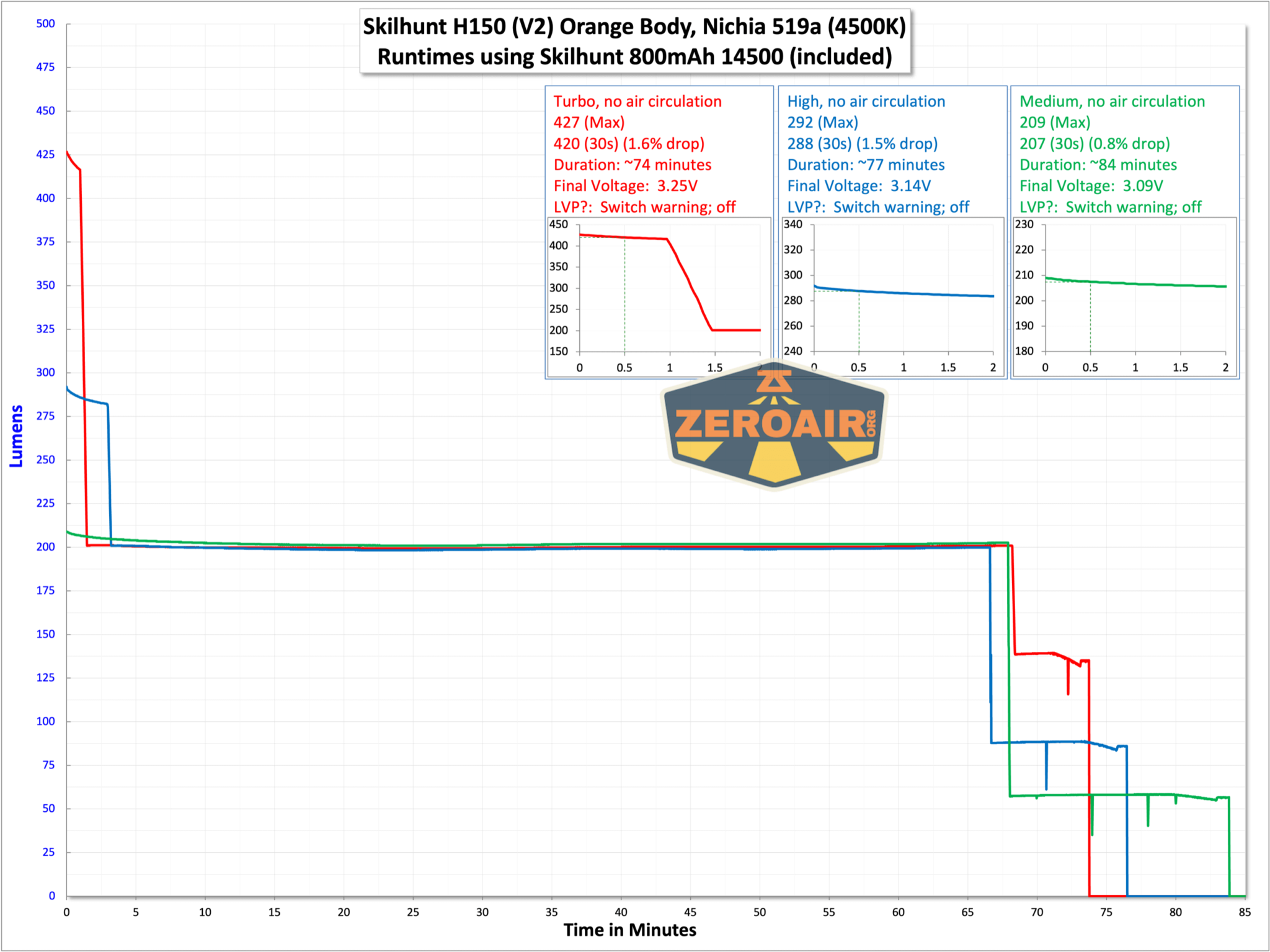
(pic links to review)
or about 250 lumens for 1 hour 20 minutes from an Emisar D3AA: (the green line)
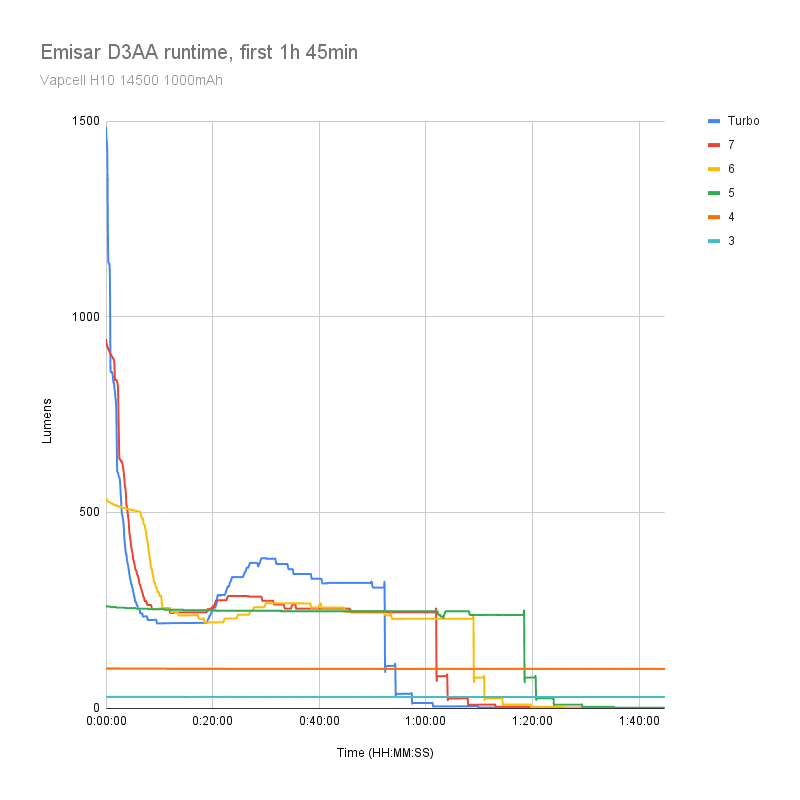
(pic links to review)
Thank you all for your feedback, it’s been very useful. I picked up a D3AA with 4500s, figure that level 4 or 5 on it will more or less be the brightness to longevity ratio that I’m looking for. Lights’ve come a long way from my old Romisen RC-N3s from back in the day; more light and more life out of half the AAs and a much smaller form factor is nothing to sneeze at.
Congratulations! Solid choice, and very realistic output goals.
If its your first Anduril light, I will be glad to help answer any UI questions…
I hope you enjoy it!
I have not seen your test before–now that I’ve seen your test of the light and those by zeroair and 1lumen, there appear to be quite a bit of variability in the measured output in the H1 mode, and I’m not sure whose data to rely on.
Both zeroair and 1lumen measured around 1h15min (equivalent) of sustained output at that level, but zeroair got barely over 200 lumens, and 1lumen got barely over 150 lumens, which is quite different from the 314lm you measured. Having a 2x multiplicative difference in efficiency makes a decisive difference on whether such output/runtime specified by the OP is achievable or not.
I am generally skeptical of nominal capacity ratings on cells–the actual capacity till flat tends to test lower than claimed, sometimes significantly. I have yet to see a reliable test of a 14500 whose capacity is actually over 1000mAh. Also, the light would stop sustaining 200 lumens a while before the cell is empty. Maybe a buck driver would make a difference over linear, but it’s probably hard to come by a good one. There are plenty of buck-driven lights out there (e.g., Wurkkos TD01C in SFT40 6500K) whose efficiency is astonishingly bad, quite a bit worse than linear even.
But as jon_slider pointed out, the D3AA is a promising option with (i) what I’ve heard is an actually very efficient driver and (ii) triple emitter setup which is good for efficiency. So maybe that light would sustain 2h of 200lm with lower CRI emitters and a good cell.
The metric discussed here may be useful in comparing how much total light one may get off a flashlight: Luminous capacity - does it make sense?
Ah Rominsen lights are a blast from the past, I regret not picking up one of the 1xAA versions.
I think these were quite moddable, if you were inclined, a new LED and (possibly) driver would modernise the light somewhat.
Here are some runtime charts too:
Lumintop Tool 3.0 can hold 200 lumens for 1h20min with an Eneloop
Manker E05II 300 lumens for 1h20min with 1 14500:
Wuben E6 220 lumens for 1h40min with an Eneloop
Acebeam Tac AA 250+ lumens for 1h:
there appear to be quite a bit of variability in the measured output in the H1 mode, and I’m not sure whose data to rely on.
I’m not either. We’re all using shoeboxes or plumbing fixtures as integrating devices and there are a bunch of possible sources of error. Max@1lumen got 199lm@30s with the H150 3000K while Rob@1lumen got 160lm@30s for the M150 4500K. The 3000K should have less output.
I am generally skeptical of nominal capacity ratings on cells–the actual capacity till flat tends to test lower than claimed,
You’re right to be. I use tested capacity, and lately usually the exact amount the charger says it charged after the test (I think high internal resistance could throw that off a bit).
100 lm/W @ 200lm is not a difficult target though. A switch-mode driver and most modern LEDs should be comfortable over that.
Thank you for pointing out the difference between the 3000K and 4500K reviews–that is pretty crazy! It would be nice if someone could pass around a calibration light to all reviewers, a twofold multiplicative error is just too much.
By tested capacity, do you mean the reading off chargers such as the Xtar VC4? I do wonder how they compare in accuracy to HKJ’s tests, and how much variability is there among models and brands. A really nice feature to have in a light review (which is probably difficult to accurately implement) is to have a power-over-time (measured from the cell) plot, in addition to lumens-over-time (which can be taken as correct up to a constant scaling); this gives a good idea of the driver’s performance.
I do agree that a system efficacy of 100lm/W @ 200lm should, in principle, be easily achievable, given current-day driver technology and the very high asymptotic efficiency of LEDs at low power densities. What is annoying is the often-subpar implementation of boost or buck drivers that make them not really more efficient than linear in practice–the incredibly low efficacy of the Wurkkos TD01C is an example (though it is possible that the optic could be to blame). Even supposed upgrades, such as Convoy T3 driver (claims 90% efficiency) over the Convoy T2 driver, seem to be substantial downgrades in efficiency, at least for the boost function in this case.
The 1lumen H150 review states that 1lumen does just that for their reviewers. The M150 review states that calibration was done using a light that had been sent to a calibration lab. A single calibrated light source does not guarantee accurate readings though. Here’s a short list of things that could produce incorrect results:
- The integrating device might not actually integrate, such that differing beam profiles affect the reading. I think tubes are especially bad about this; boxes are better; spheres are best.
- The light meter might not accurately represent the luminous efficacy function, so that only a close match tho the spectrum of the calibration light will produce an accurate reading.
- The surface of the inside of the integrating device might absorb certain wavelengths, or fluoresce, altering the result.
- The light meter might not have a linear response, so calibration at one level does not guarantee a different level will be accurate.
By tested capacity, do you mean the reading off chargers such as the Xtar VC4? I do wonder how they compare in accuracy to HKJ’s tests
An Opus in this case. A $40 analyzing charger is not going to be as accurate as the $7000+ Kiethley 2450 Sourcemeter HKJ uses. Of course there’s a little variation between individual cells when new, and I’m not usually using brand new cells. Charged capacity is also going to differ from discharge capacity in large part because LVP thresholds differ between lights.
A really nice feature to have in a light review (which is probably difficult to accurately implement) is to have a power-over-time
Yes, that’s difficult. Ideally, you’d use a four-wire setup like a battery tester to log volts and amps separately. Measuring amps is a problem though; series ammeters are not accurate at higher current, and clamp meters are not precise. The absence of the tailcap also makes the test condition significantly different from the operating condition; the extra length of a protected cell compressing the springs more results in 10% more output in some lights, for example.
A bench power supply is another option for testing efficiency. It can provide more accurate and precise power numbers, but that differs even more from the actual operating environment of a flashlight.
What is annoying is the often-subpar implementation of boost or buck drivers…
Very compact buck/boost drivers, as required for the ideal implementation of AA/14500 lights are evidently particularly difficult. I like that Emisar sidestepped the problem with a boost-only driver and LEDs in series, but I think the choice of optics results in a light that’s too fat for the battery size. A single 6V emitter in a light with a diameter under 20mm would be very appealing to me.
These are all excellent points! I am a huge fan of Ceilingbounce for measuring relative intensity and output; since you are the developer, I am curious to hear your thoughts on how well the app does on these fronts (of course this may vary with phone hardware, but a rough idea would be good to have).
(1) Bad integration due to pathological angular distribution/beam profile of the source. I couldn’t think of an obvious way to directly address this, since all reflections are lossy and nonuniform over angle, and some shapes are worse than others at this. But maybe one can get upper/lower bounds by calibrating against a mule and an LEP, and hope that all other beam profiles behave somewhere in the middle.
Assuming a radially symmetric beam profile, I wonder it would be feasible to obtain intensity readings at a collection of sample points along one radius (essentially a Riemann sum approximation), and then integrating that (times radius) over radius to get the total output of the entire beam. This bypasses the problem of physical integration and reduces it to a collection of intensity measurements. I imagine that the difficulty lies in the number of points to sample along the radius–many points would be necessary to get a good idea of the behavior near, say, the boundary of the hotspot, where intensity changes rapidly with radius. But perhaps sparser samples suffice for the spill.
Fortunately, the problem of integration does not apply to intensity measurements (I think), so I can, in principle, get a pretty decent estimate for total flux based on information such as hotspot size/intensity, spill angle, Lambertian intensity distribution of the spill, etc.
(2) Bad approximation of the luminosity function. Yeah this is a tough one, and so many spectra from flashlights are pathologically different from reference spectra. How well do you think Ceilingbounce does on this, and how much variability is there among different phones? Fortunately, this presents no issue in comparing lights that use the same emitter, or different modes in the same light.
(3) Spectrally non-uniform absorption of the integrating surface. I don’t see an easy way around this either. Fortunately not a problem for relative measurements, same as above issue with luminosity function.
(4) Nonlinear scaling of the reading. This is the greatest concern for me because it affects both total flux and local intensity measurements, even relative/comparative measurements. How well do you think Ceilingbounce does on this? If there is an error in scaling, would the intensity reading grow faster or slower than (convex or concave relative to) the actual intensity?
I see your point about driver size being a constraint. Iirc the Acebeam E70 mini also uses a series setup for the triple emitters, which makes a lot of sense now that I’ve read what you said.
The app only takes a single multiplier for calibration, so it’s all about the hardware and/or driver.
I wonder it would be feasible to obtain intensity readings at a collection of sample points along one radius
See Parametrek’s beam profiler for a project doing this sort of thing. I’ve thought about trying to do something similar using the accelerometers in a phone.
How well do you think Ceilingbounce does on this, and how much variability is there among different phones?
Variability in hardware is the only relevant factor, and it can be significant.
Spectrally non-uniform absorption of the integrating surface… Fortunately not a problem for relative measurements,
It’s a problem for relative measurements between different light sources.
Nonlinear scaling of the reading… How well do you think Ceilingbounce does on this?
Again, it’s all about the hardware. The app just records what the hardware reports, multiplied by a number the user supplies.
Indeed, what you are looking for is between level 4 and 5 based on these results.