Guys,
I haven’t been online for a very long time. I fell like time run over me…
Can you please help me out…
What is current highest intensity LED emitter? Current LED throw King?
Thanks
Guys,
I haven’t been online for a very long time. I fell like time run over me…
Can you please help me out…
What is current highest intensity LED emitter? Current LED throw King?
Thanks
CSLNM1.TG and CSLNM1.F1 (green version of the same LED).
Consider also the SFT-25R, it has larger LES but it can take 8A and produce double the lumens, so the throw could be similar to the CSLNM1.
Thank You Sir!
I hoped things changed on the better in meantime but it seems Osram LED’s are still Thrower kings after more than 3 years! 
I remember there were also that Yinding round leds…
Incredible we see very low progress in this field…
But yes CSLNM1.F1 in good 50mm aspherical lens does anywhere from 400-500k candela or lux (driven at 3-4A) so very hard to beat that yes…
In practice, the throw of flashlights is limited not by just the intensity of the LED, but also the precision of the reflector. Some recent Convoy lights exhibit precision issues that result in larger, less throwy LEDs out-throwing smaller, throwier LEDs.
For this reason, large-die LEDs sometimes have an advantage in throw, and something like a SFT25R or SFT42R still has potential to out-throw an Osram in some hosts.
Yup… Precision, depth, width and coating of reflector.
Older generations here will remember Jacob A60(old ultra budget thrower flashlight) with plastic reflector but some kind of good mirror coating inside that which was much better regarding throw than some premium flashlights of that time…
I like reflectors yes but my most used flashlights are zoomies or aspherical flashlights and for them LED intensity is everything if you are hunting for performance…
Are you sure guys? Maybe there is some newer high intensity LED but we just haven’t found it yet?
It hasn’t been tested yet.
PiercingTheDarkness measured great throw in the Convoy L21B host using the new SFT-42R with Convoy’s 10A buck driver, despite the larger LES. The SFT-42R just pushes out so many lumens that it brute-forces the throw.
The SFT-42R also beats the CSLNM1.TG in some Hank’s hosts: Candela confirmation for the SFT-42R : r/flashlight.
Nice data! It is worth pointing out that the SFT42R out-throws the smaller emitters like Osrams not due to higher surface intensity, but due to the larger LES being more tolerant of imperfections in the reflector.
Nobody mentioned the new Cree XM-MR. Same package as SFT-42R and les 0.04mm larger in diameter. It’s rated for 14A though Vf is high. 4.1V@14A high. Which might not be a bad thing as you can direct drive it from any single Li-Ion cell. I got one hooked to a fet driver and EVE 50PL.
SFT-25R in C8+ on the right
Do you have SFT42R and XMMR measurements (output, throw) with the same driver or in the same light? Would be very interesting to see such a comparison.
You really wanna hook the SFT-42R to a fet driver and a 50PL?
I have no way of measuring anything but the battery voltage.
I could however put the SFT-42R in the other L21A with a 10A buck driver or even 20A buck driver but that will still be apples to oranges.
If you have the time to do this, I would really appreciate it! I’ve seen a few reports of the SFT42R doing fine on the 20A buck driver, which suggests that it is not receiving anywhere close to 20A (presumably due to Vf rise), and is essentially direct-driven, making the comparison somewhat useful. I would start with a low-current cell though to reduce risk of frying the LED.
The 20A driver is a buck driver, so I’m assuming the driver itself drops some voltage before it starts regulating current so the 42 will never see the full current as the battery voltage is gonna sag some under 20A load too. Might have a go at it. All I have to do is swap the led mcpcb. I’ll also try to measure the voltage going to the led at full blast.
With the same driver, and in a quite thermally limited flashlight, so not really a fair comparison.
There are smaller LES lower lumen output LEDs that can outperform it.

Hey thanks for sharing this data!
I’m not quite sure what to make of the cd/mm^2 figure and how well it translates to real-world throw, perhaps you can shed some light on this.
Assuming that all emitters have the same (say Lambertian) angular distribution, then cd/mm^2 should be proportional to lm/mm^2 by a universal constant, via the relation (cd/mm^2) = (lm/mm^2)/pi.
However, this assumption does not hold for many of the emitters listed in the test. For example, the SFT25R achieves only 215.1 cd/mm^2 compared to the SFT42R’s 246.3; however, the SFT25R certainly achieves more lm/mm^2 than SFT42R, at 895 vs 668 (from koef3’s output tests and LES estimates).
The above discrepancy suggests that these emitters have different angular distributions; in particular, those with a lower-than-expected cd/mm^2 (equivalently, low cd/lm) should have a distribution that is less concentrated, because the cd/mm^2 figure is presumably measured on the LED’s axis, i.e., directly in front. This raises the question of whether cd/mm^2 or lm/mm^2 is a better predictor for throw.
I’m inclined to believe that a high lm/mm^2 and low cd/mm^2 (measured on axis) is a good thing for forward-reflector-based throwers because it indicates the angular distribution puts more mass off to the side to be collected by the reflector. At the same time, the apparent area of a flat emitter should always be close to Lambertian, which means that: for 2 flat emitters of equal lm/mm^2, the one with a lower cd/mm^2 on-axis has a higher cd/mm^2 off to the side. Consequently, lm/mm^2 should be a better predictor for forward-reflector-based lights.
What are your thoughts?
P.S. Interestingly, the Yinding 5050 glass 5000K has both lower output and larger LES than SFT25R, so one would expect it to throw poorly. Yet it achieves a cd/mm^2 rating of over 27% greater! Perhaps this alone suggests that cd/mm^2 might not be the right metric to look at.
Throw is directly proportional to cd/mm2 multiplied by the frontal (2D) area of the optic.
This is why cd/mm2 is critical for throwers.
The issue here is that cd/mm^2 is only invariant across viewing angle for a perfectly Lambertian emitter. However, most emitters deviate significantly from the ideal Lambertian distribution, and cd/mm^2 changes a lot over viewing angle.
For this reason, only the cd/mm^2 values emitted in directions that hit the optic are relevant, and I suspect that lm/mm^2 might be a better predictor for throw. The previous post of mine goes into a bit more detail on this discrepancy and how it affects throw in a forward reflector.
No they’re all pretty much the same for non-domed flip chip leds.
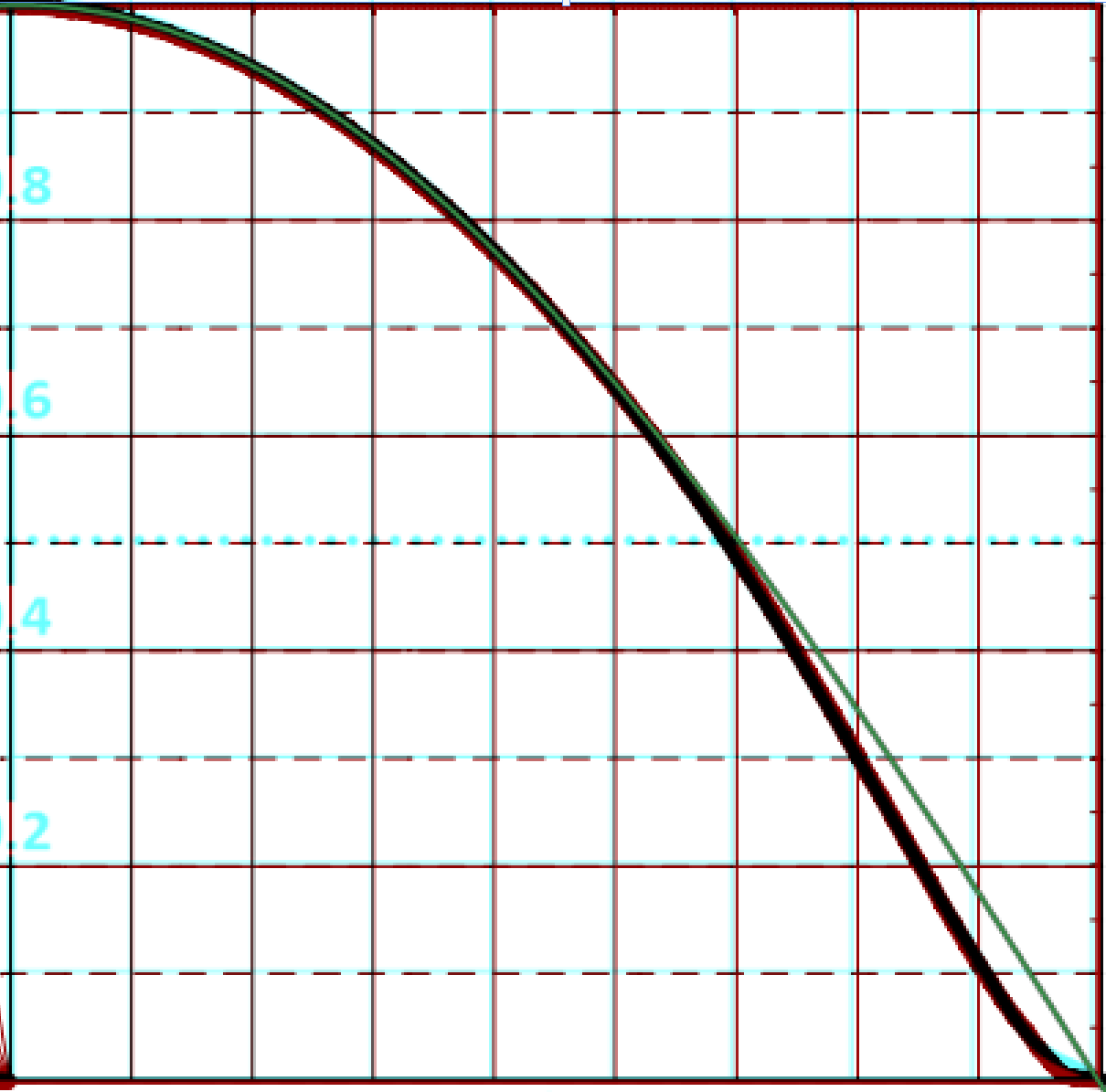
I overlayed the intensity charts, the black line is the black flat, the red line is the SFT-25R, you can see they are identical.
Green line is a cosine, so the LEDs do lose some intensity at more extreme angles, but not much.
This is due to the surface roughness of the phosphor, internal reflections, and the small lip around the die or chip.
Thank you very much for this data!
Now I am truly puzzled: if the angular distribution is more or less the same among these emitters, then how does one explain the discrepancy between cd/mm^2 and lm/mm^2 from the above post?
Recall that for an ideal Lambertian, it holds that cd = lm/pi, so higher cd/mm^2 should always imply higher lm/mm^2, and vice versa.
Yeah, it should, not really sure what’s wrong there.
I redid the same overlay with SFT42R on top of SFT25R and the angular distribution is exactly the same again, as expected.
In koef’s SFT-42R test he mentions “The luminous area is approximately 5 mm2. Despite the 4.3 mm2 specified in the data sheet”
In the datasheet it is actually a 2.32mm diameter emitter area, which is 3.64mm^2, not 4.3 or 5mm
If you use the datasheet emitter values you also get 2.67mm^2 for the SFT-25R.
Using 2.67 and 3.64mm2 respectively you get 754 and 917lm/mm2 per LED.
The 42R is ~1.2x higher lm/mm^2 than the 25R, and this matches closely with the ~1.15x higher intensity measured in the test.
But then again, the cd values he measures should theoretically be divided by the same area he used previously in order to obtain cd/mm^2, so I don’t know.
Instead of taking a cd measurement with a luxmeter and dividing it by the guesstimated area of the LED LES, which is very hard to accurately measure (especially when it is not perfectly uniformly lit) a more accurate way would be to use a lens (or reflector) of known diameter, and calculate the front area of the optic.
Then you take a lux measurement at a further distance, calculate it back to 1m, and divide by the optic area.
Assuming you have taken the measurement at a far enough distance where the whole optic is “filled” with the LED die when looking at it, you now have a much more accurate known area to use to back calculate cd/mm^2.
But yeah, that test data doesnt make very much sense to me tbh.