Yes the bezel comes with it’s own O-Ring installed. As @Ledhead discovered, you need to remove the glass and reinstall it in the replacement bezel. I also missed it too. Unless one looks closely the glass is easy to miss.
3 Thanks
Yeah. Most aux LEDs are too bright, even on low. I’ve seen a few which were dim enough, but it’s uncommon. I would really like to reduce the aux brightness… but it’s not really my decision to make.
Specifically, I like to keep the standby power at 100 uA or lower when aux LEDs are lit up in low mode. Especially on lights with small batteries like this. 100 uA is about right to get 1 year of standby time per charge on an average 14500 cell, or 3 years on an average 18650.
Not the same thing. The LEDs in most lights are not actually lit by parasitic drain when the light is off. The LED just has a phosphor coating over it which can retain a tiny amount of charge, like how a glow-in-the-dark item works.
For example, try it with a clicky-switch light which physically disconnects power. Or try unscrewing the tailcap after you turn a light off. You may still be able to see a very dim glow even with power physically cut.
Yes. That flash means it has power, booted successfully, and is ready to use.
With these AA / 14500 duel fuel models, it tests the battery at boot time. If the battery is good, it does 1 flash. The flash is required in order to test the battery, because it is doing a very quick ramp-up while measuring battery voltage to check if the battery is strong enough.
If the battery is weak, it does 3 flashes to warn the user… and limits the maximum power. The limit is set based on how weak the battery is, so on a nearly dead battery it might only have low modes.
1 flash = all good
3 flashes = weak battery
10 Thanks
agree!
I find Tritiums to be too dim to be useful in colors other than green and blue..
Since I like Red markers, I much prefer Aux.. Red trits are a waste of time.. too dim
here is a photo that shows how much dimmer trits are than Aux:
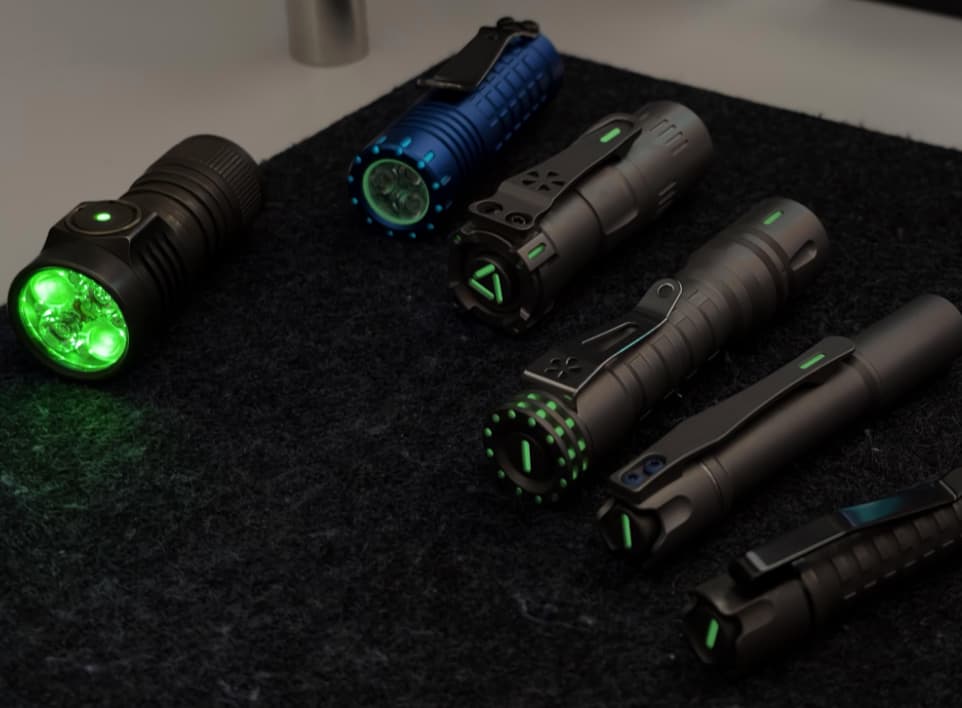
Aux also have the added benefit that they can be turned Off if desired 
4 Thanks
I agree. I’d like low aux to allow me to find the light in the dark, not for it to act as a night-light.
5 Thanks
Just a few more thoughts on the KR1AA. I was playing with it last night along side of the D3AA. A comparison came to mind. The KR1AA being like a Tesla Model S and the D3AA like the Cybertruck. The Kr1AA is just so much more refined and pleasant to hold and operate. The D3AA chunky and rugged… and a cheese grater.
I do like the width of the beam for the triple a bit better for close up light at my feet right in front of me. Other than that I call the KR1AA the winner.
3 Thanks
Ouch. Teslas were hip a decade ago, but being compared to one now is considered an insult.
15 Thanks
You’re going to love the KR3 then, 18650, slim & triple emitter!
3 Thanks
Perhaps by some segment of the population.
I figured as I wrote it somebody would comment…
Visualize form factor of the vehicle not the reputation of the owner…
How about a Hummer H3 and a McClaren 600LT… is that generic enough… Or did someone involved in the production of one of them step out of line somehow? In any case, does that make it easier “get” the intended description of the contrast better?
6 Thanks
I almost pulled the trigger on the D3AA before but at the last minute found out about the KR1AA and I’m glad I did. It feels good in the pocket and anything bigger would be too much. I find the KR1AA has plenty of spill/flood. I don’t have a reason to also buy the D3AA anymore.
6 Thanks
Well said.
Still waiting on a gradient Vino red or speckled emerald green finish :zipper_mouth_face:
The intended meaning was never unclear.
8 Thanks
No need to be so defensive, it’s a flashlight forum, chill out.
6 Thanks
I like both the KR1AA and D3AA. However, if I had to choose just one, I would choose the D3AA. In my opinion, it’s a better light because:
- The D3AA has a superior clip.
- The D3AA’s clip provides much better retention to pants pocket or sweat pants.
- The KR1AA’s clip is too loose and too flimsy. Modifying the KR1AA’s clip by bending it in a couple places for increased retention helps slightly, but it still comes nowhere close to being as secure as the D3AA’s clip. The KR1AA’s clip is slightly too thin and needs more metal.
- Comparing High-CRI versions the D3AA is both brighter and throwier.
- D3AA with 3xNTG35 v. KR1AA with 1xNTG50 all at 5000K: Beam pattern is very similar except that the D3AA is both brighter (more lumens) and throwier (more lux).
- The only place where a high-CRI KR1AA beats a high-CRI D3AA in throw is if you compare 3000K SFT70 v. 2700K NTG35. That’s fine for those who like extremely warm color temperature, but not so great for anyone else. SFT70 isn’t available in high CRI above 3000K.
- Comparing low-CRI versions the D3AA is both brighter and throwier.
- D3AA with 3xSFT-25R v. KR1AA with 1xSFT70 all at 5000K. Beam pattern is similar except that the D3AA is both brighter (more lumens) and throwier (more lux).
- Switch.
- D3AA switch can be easily modded by adding an o-ring between the boot and the switch for increased resistance. The mod makes lockout unnecessary during EDC pocket-carry.
- However, I was only successful in modding the KR1AA V1’s switch in a similar manner. O-ring mods did not appear to work with the KR1AA V2.
- With the o-ring mod the V1’s switch is superior to that of a similarly modded D3AA.
- Unfortunately, the V1 is no longer available. The V2 with its switch that can’t be modded is much worse than a modded D3AA switch. Lockout is pretty much mandatory with the V2 during pocket-carry.
- D3AA is less prone to malfunctions - In my experience, the KR1AA is a little more finicky than the D3AA.
- This is pretty common with lights that use an inner contact tube like the KR1AA. The FW3A was known for being finicky.
- I’ve had issues with all lights of similar construction except the TS10. The issues are usually easily solved simply by loosening and tightening retaining rings. Sometimes the fix is temporary as it can recur usually after a battery change. In contrast, side switch lights like the D3AA don’t have these problems.
- We’ve already seen a few complaints on the forum from people who purchased the KR1AA and are having problems with malfunctions. That doesn’t happen with the D3AA.
- Battery changes at the head feel more natural
- D3AA can change batteries at head. KR1AA v2 can only be changed at the tail unless you special-order an unglued version.
As a collector I like the KR1AA and am looking forward to the Ti-Cu version. But in my opinion, the D3AA is the better light.
8 Thanks
…D3AA is less prone to malfunctions* - In my experience, the KR1AA is a little more finicky than the D3AA.*
** This is pretty common with lights that use an inner contact tube like the KR1AA. The FW3A was known for being finicky.*
*** I’ve had issues with all lights of similar construction except the TS10. The issues are usually easily solved simply by loosening and tightening retaining rings, but side switch lights like the D3AA don’t have these problems…*
good point. one more point of possible failure. i am surprised you said the d3AA is both brighter and throwier however. for such a small light i think its plenty bright so wont chase that.
1 Thank
Here is Hanks posted output data:
KR1AA:
NTG50 5000K/4200K - 1600lm OTF
D3AA
NTG35 5000K/4200K 95 CRI 1620lm OTF
unfortunately he does not list candela for the D3AA, so I dont know if it throws as much
the two lights are just different.. each has its pros and cons
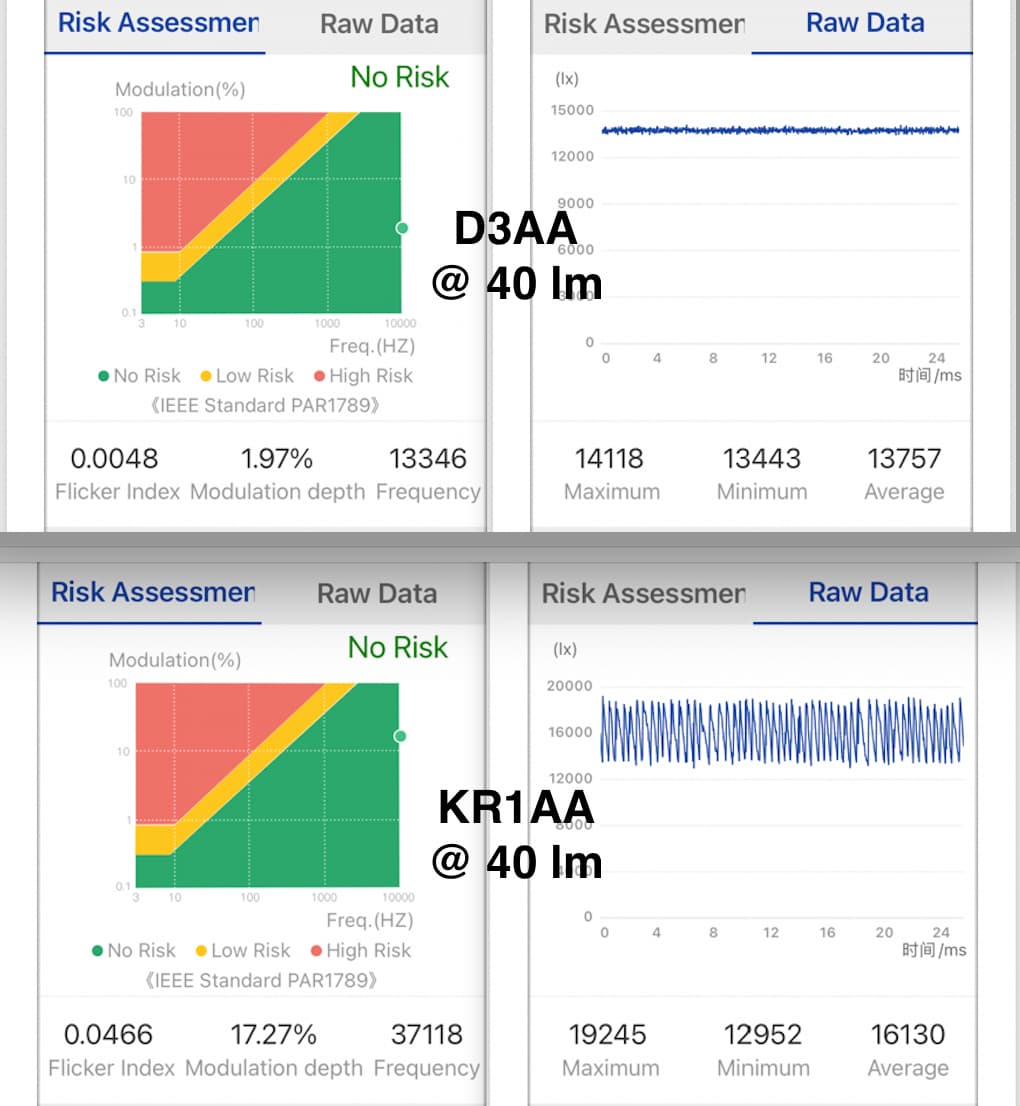
I dont prefer the D3AA form factor, otoh, I do prefer that it has a lower Flicker Index..
2 Thanks
It’s strange that there’s any measurable difference. Regardless, a 17% ripple at 37 kHz is way beyond the limits of human visual perception.
1 Thank
its not visible, but it has noticeable differences in Flicker Index (red and green arrows), and lux oscillations (red and green text min max lux percent change)
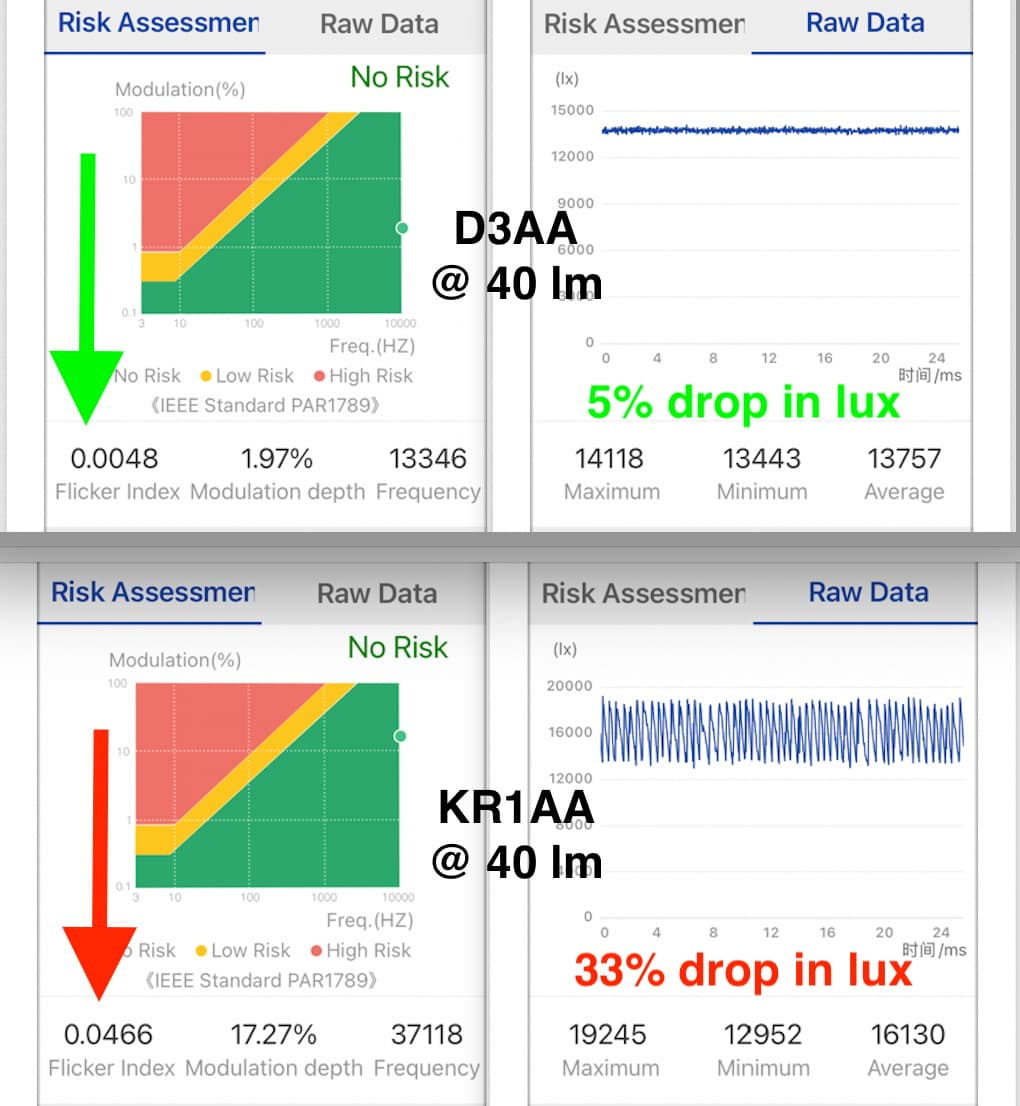
I understand the graph, and am pretty familiar with similar heuristics which were created specifically because of BLF.
The reason why it’s strange is because,as far as I’m aware, the two lights use the same driver… just slightly reshaped to fit in different hosts. They should have the same measurement results.
Could you make sure they have the same product number, same firmware version, same configuration, and same ramp level, and then measure the output ripple?
They might not have exactly the same lumens, but they should have the same ramp level, to ensure the hardware is receiving the same control signals. Most lights change the ripple pattern as the brightness changes, so the difference you saw could easily happen even on a single light, just comparing one brightness to another.
Depending on how the regulator works, it’s also possible that there might be some differences depending on battery voltage.
2 Thanks
My 5000K NTG35 D3AA looks noticeably brighter than my 5000K NTG50 KR1AA.
The difference is immediately noticeable to the eye, which means its likely more than 20%. Same goes for the low-cri lights mentioned in my last post.
I suppose it could just be ordinary variation in LED output. Or maybe the D3AA has a more focused beam even though to my eyes the beam shape looks about the same.