the V2 on left is clear ano
I have not found that to be true.
There is a lot of repeated misinformation online, that lacks first hand confirmation.
My Raw Aluminum V1 KR1AA does Not turn my hands black. Not even a little bit.
the V2 on left is clear ano
I have not found that to be true.
There is a lot of repeated misinformation online, that lacks first hand confirmation.
My Raw Aluminum V1 KR1AA does Not turn my hands black. Not even a little bit.
I thought it was odd myself, I’ve handled various aluminium things over the years and have never noticed any kind of skin blackening.
Thanks for your contributions to the discussion.
I do get blackened fingers when I polish my raw aluminum light with Sunshine Cloth.
I believe it is caused by aluminum oxide powder being abraded off the light.
But this does not happen with normal handling.
Thanks for the KR1AA max output with Eneloop
Do you or anyone else reading this, happen to have data for a 1.5V LiIon max output in a KR1AA?
It’s kind of a nonsense use case. It supports li-ion natively so it has no need for a crippled li-ion with a buck circuit built in, only to have to boost the voltage again afterward. On a device like this, the 1.5V limiter circuit built into the cell only serves to make things worse.
It should still work… but it’s throwing away a lot of efficiency and capacity for no reason.
There are a couple of potential benefits to 1.5V LiIon
update:
A recent test shows they trip protection at level 110/150, but work at ceiling 100/150 and produce less than 400 lumens. Turbo should be disabled to prevent tripping protection.
I’ll try it in a bit. However, I have the Xtar ones, and I have a feeling the draw might trip the protection circuit.
**Wouldn’t want another burned hole in pocket case…
 That’s why I didn’t test one.
why not?
The 1.5v li-ion uses a buck driver to reduce the voltage to 1.5 volts. In a high drain application using a boost driver like the KR1AA , you’re losing any advantages the higher energy density the li-ion offers at the lower voltage. There’s losses in the buck and boost conversions. You’d be getting basically the same output as the NiMH and maybe a bit longer runtimes. You’d still lose the highest outputs also, so it’s really diminishing returns.
Not everything is about maximizing output at high levels, lol…I’m checking continuous runtimes between 2700mAh 1.5V Liion and 2500mAh 1.2V NiMH right now. SPECIFIC to the KR1AA, that constant voltage might not mean anything, but for direct drive components, that flat output might be beneficial.
As it pertains to the Kr1AA, some of the higher modes are inaccessible with a 1.5V LiIon AA, but that is kind of intentful for this particular exercise.
I will be interested in your test results. I am not sure how the relatively high self discharge would work for me though. I have so many lights stashed around that don’t get checked or recharged regularly. The recommendation that they be reccharged every 6 months is worrisome for my use case.
I guess it would not be a big deal for lights that I use a lot. I find that I top those off regularly. But then, I have so many NiMH and LiIon cells, I don’t see how buying a bunch of more expensive LiIon 1.5 V cells would be cost effective.
Still, I am curious.
I happened to have bought some, intended for some outdoor wireless cameras because they drop into a lower voltage state to trigger the low voltage warning.
So far, the first cell (not sure if it was 100%) lasted 95 minutes semicontinuously on level 104/151, with a total of 4 shut offs to check the voltage and temps (resulting in a restart from 104/151 each time and skewing the “continuous” aspect)
The second cell has been on for a little over an hour continuously now, and has settled to around 230-250 lumens due to throttling at 45c.
Later tonight I’m going to test a couple of 2500mAh NiMH at that same level to see how the runtimes compare.
**added:
I’ll create a separate post, as to not clog up Hank’s update thread, sorry Hank! I keep forgetting this isn’t a KR1AA dedicated thread lol
This may have been answered, but I’m trying to gauge the beam profile of the kr1aa. With the ntg50 is it a defined hotspot and spill or is it diffuse like a domed 519a in a d3aa/d4v2?
I’m leaning towards a kr1aa if that is the case. I like being able to “aim” a beam and I like a little bit of focus
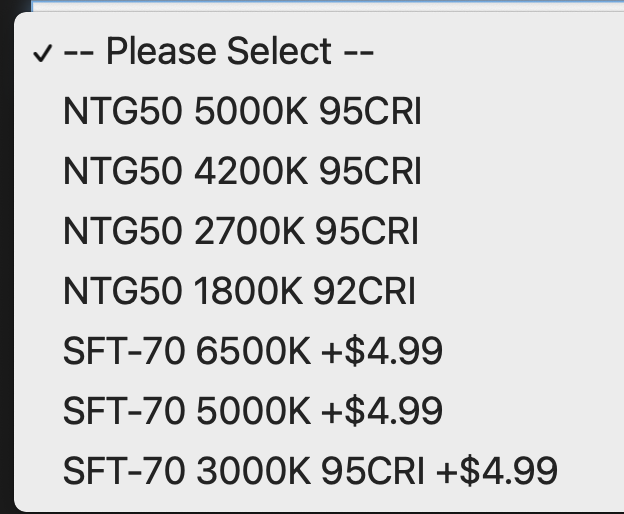
only 2 different emitter choices?
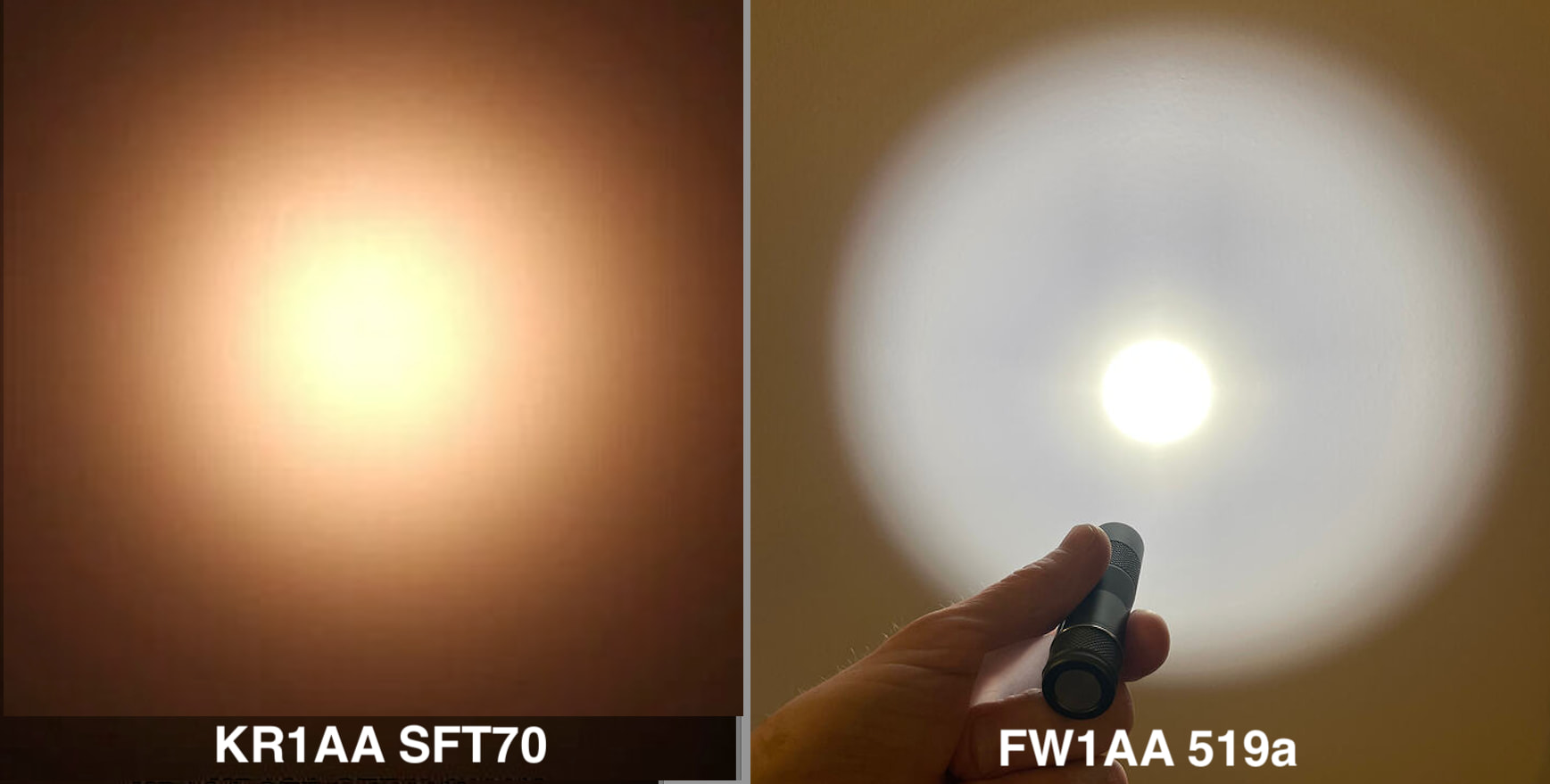
I have 4 KR1AA. Between the NTG50 and SFT70 I much prefer the SFT70, mine is 5k. It’s a good defined hotspot. The NTG50 has a wider more floody hotspot but still a hotspot nonetheless. This is mainly due to the optic.
agree the SFT is a narrower beam, but it is not like the beam from a Lumintop FW1AA, which has a much more defined hotspot because it uses a reflector
here is a photo of each beam, from separate sources, so not to scale.. maybe you could post an actual side by side beam of your FW1AA and KR1AA side by side from the same distance to a wall to give a more accurate comparison, but here is an approximation:
great photo, thanks.. I have been considering buying a KR1AA w 5000K NTG.. or maybe 4200 NTG.. but Im a bit concerned whether they are excessively Rosy.. what do you think about the amount of Rosyness?