Don’t have S21E with 3V driver but from what I’ve read this is true.
At least in 3V class you have options: linear CC or Fet with good UI (Anduril).
1 Thank
It depends which one, S21E uses old 6A driver with LHP531 and while brightness is very solid it’s not the brightest Convoy out there.
Linear is somewhat regulated but it burns the difference between battery voltage and and emitter Vf as heat. Since LHP emitters are known from their very low Vf I can tell it gets hot way faster than XHP50.3 variant with 6V boost driver.
FET has high and bright turbo but it’s unregulated (brightness drops over time) and overall pretty inefficient. If you want your light to run cool and for a long time avoid old style inefficient drivers.
Are FET drivers truly inefficient? Certainly they are more efficient than linear drivers which burn the voltage difference.
Old FET lights are considered inefficient as a system because back then, direct drive often results in pushing the LED close to the maximum, where the LED becomes inefficient. However, this is not a problem for setups where (1) the emitter has very high Vf and therefore cannot draw much current, or (2) the emitter can handle much more power than the battery can provide. Situation (2) is becoming increasingly common, especially with the newest LHP series.
In these cases, the real issue with FET drivers is lack of regulation and PWM lower modes.
This is why I bought S21Es with a boost driver only 
We have quite recent examples from early Sofirn/Wurkkos flashlights that started with FET and were either upgraded or replaced with similar models featuring regulated buck/boost drivers. Brightness to runtime ratio went up dramatically despite using pretty much the same emitters.
I see, one would definitely expect low systemic efficiency with low Vf and relatively low power emitters like SST/SFT40 and 519A.
SFT40 handles 8A lik a champ and LHP531 is rated at 10A. I don;t see how LHP531 with even lower Vf will be more efficient on lower modes?
My bad.
I was thinking the XHP50.2 might be similar to the XHP50.3 HI, with the latter being a better throwing emitter. 
It’s basically the same emitter domed vs. dedomed, they can’t be similar. LHP531 doesn’t throw much worse than XHP50.3 HI, its hotspot is just 20-25% bigger.
Excellent review, especially the discussion of the driver. The current measurements also much appreciated.
Lastly I didn’t know the button’s brightness change when this light switches from 7135 to FET. Great catch!
I have both versions btw: S21E + 519a 4500k with FET+1, and S21E + B35AM 4500k with CC driver.
LEDs are increasingly inefficient with higher power density. With huge emitters like LHP531/LHP73B, the light-emitting surface is so large that even at the drive current a low-current cell can supply, the current density is still fairly low, and consequently the efficiency is still pretty decent.
With higher-current cells, certainly a buck driver would be preferable. Though pretty much every linear/buck/boost driver I’ve ever seen suffers from extremely low efficiency at the low to moonlight levels; my mtn FET-only driver cranks out quite a bit of light at 4mA, while the Convoy boost/buck/linear drivers produce less light from 8mA to 18mA. With the buck driver for red light, the lighted tailcap cranks out a few times more light at less than 1/10 the power…
I agree with the first sentence. The rest doesn’t make sense and it has nothing to do with LED size or driver type. Yes emitter efficiency plays a role in a overall system efficiency but we were talking more about the driver side.
In that case, a FET driver is pretty much as efficient as a driver can get! No burning off of excess voltage as a linear driver does, and no conversion losses like a buck/boost driver.
Then not really. Wurkkos TD01 (FET) vs others from selfbuilt’s review:
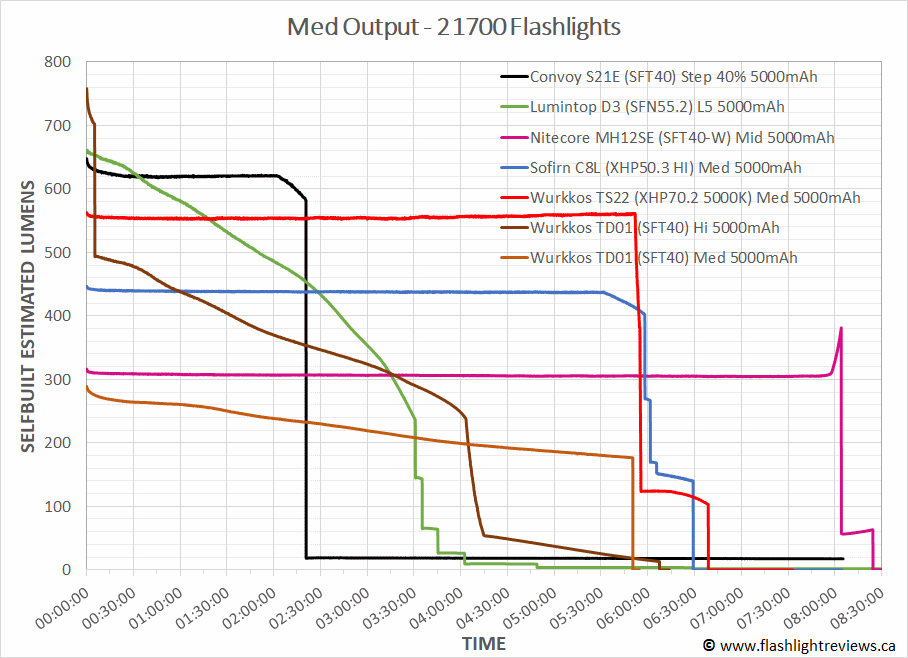
Ts22 and C8L have boost drivers (and slightly more efficient LEDs), Nitecore has exactly the same emitter and well regulated pbobably buck driver.
Sofirn SP40 vs. HS40, HS is basically an improved SP including the driver:
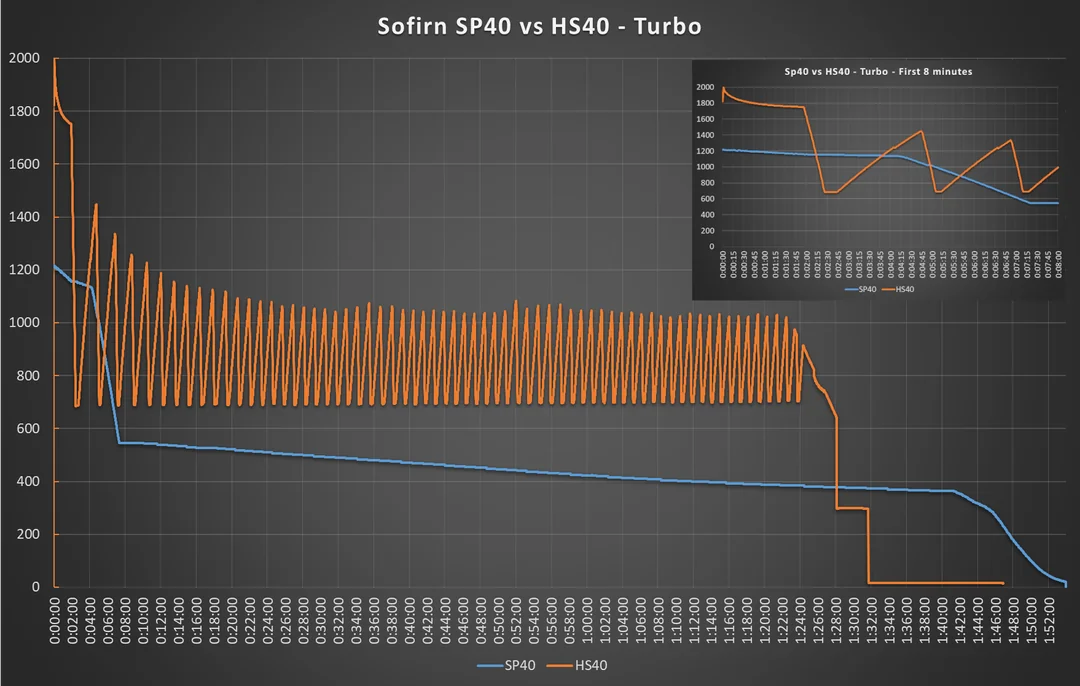
by Grzybek: https://www.reddit.com/r/flashlight/comments/zvnxf4/sofirn_hs40_photos_and_some_of_my_impressions/
The larger the area the more efficient the driver is.
Where do any of these sources perform a driver efficiency measurement?
Do not confound driver efficiency with system efficacy, which is the product of 3 things: (i) driver efficiency, (ii) emitter efficiency at measured power, and (iii) emitter spectral efficacy. Runtime graphs tell you about system efficacy but not driver efficiency. FET lights tend to have bad system efficiency due to low (ii), not (i). High CRI or warm CCT lights suffer from low (iii).
The correct conclusion is “the more efficacious the entire light is”, not “the more efficient the driver is”. An easy counterexample is a UV light that has area 0 under the runtime curve but certainly has nonzero driver efficiency.
For a less extreme example, just consider a SFT40 6500K vs 3000K driven by the same driver. Same driver efficiency, only half the runtime area with 3000K.
First graph - Nitecore and Wurkkos TD01 use exactly the same emitter - SFT40 6500K. Second one is SST-40 vs. XP-L2 which have virtually identical efficiency at 3A. Which actualy means that SST-40 ran at worse efficiency point (was brighter, because as you said: LEDs are increasingly inefficient with higher power) throughout almost the entire graph, until the lines crossed. So not only more efficient driver made up for less efficient emitter, it was way more efficient overall.
Thank you for clarifying. I find both comparisons problematic:
Even the buck TD01C achieves abysmally low efficacy, which suggests that perhaps some other part of the light, such as the TIR, may be to blame for the low output. The Nitecore does not have this issue.
You meant to claim that they have virtually the same efficacy (lm/W), not efficiency–see the tag next to my username. I don’t think that claim is true. Based on the only tests of both done by the same user (koef3), the SST40 achieves a bit more output with significantly lower Vf, so it is nontrivially more efficacious. The different electrical behavior between the emitters may also cause the driver or entire light to behave differently, e.g., cutting out early.
Also: the runtime plot of the SP40 is not consistent with those of lights with known FET drivers. Take Maukka’s runtime of the Astrolux S1 (BLF A6) for example:
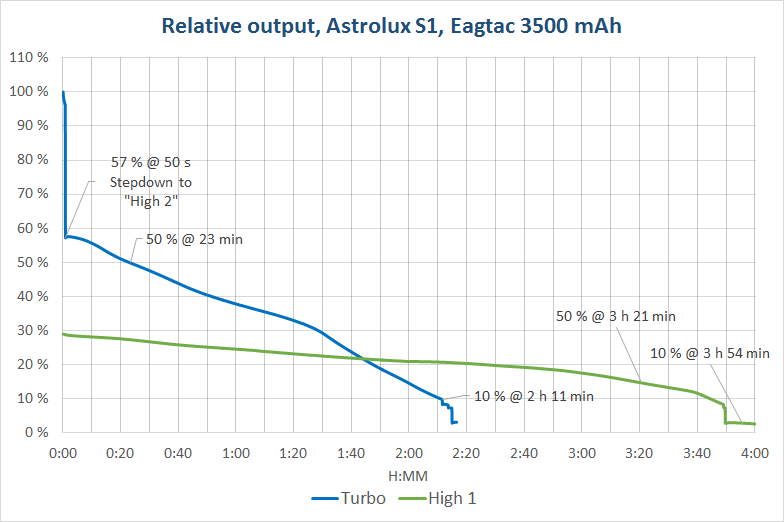
The plots show quite a number of smooth convexity/concavity changes that reflect the irregular voltage drop in a battery’s discharge curve, unlike SP40’s plot above, which looks piecewise-linear. To convince you that the SP40’s curve is indeed close to piecewise linear, I included a horizontally compressed version, which amplifies irregularities in curvature.
This suggests that the SP40’s driver is not a simple FET driver but some modified variant that could very well have lower efficiency than a plain FET driver.
Finally: if you believe that a FET driver is inefficient, could you explain which component dissipates the waste power, and why/how? For example: in a linear driver, 7135 chips dissipate waste power as heat to close the voltage gap between battery and emitter Vf at the desired drive current.
They burn it just the same, just in a different place. Actually FET is even less efficient, because on lower modes linear drivers operate the LEDs in mor efficient current ranges, while FET drivers always run them at very high currents and thus low efficiency of the LED itself, in addition to the driver (and battery IR) still burning all the voltage difference.
1 Thank
Thanks for the clarification! I believe part of your comment refers to systemic efficiency, i.e., the product (driver efficiency)(LED efficiency), rather than driver efficiency.
The part I don’t quite understand is, how does a FET driver burn voltage difference? Good FET drivers are often said to be as good as “direct drive”, i.e., shorting the battery across the emitter, which is essentially 100% efficient; no voltage difference is being burned.
Also, as I understand it, a FET is essentially a switch that closes for turbo and achieves lower modes by rapid on/off switching with different duty cycles. If this understanding is correct, there is no voltage difference being burned.
The PN transition always operates at the bandgap voltage, any excess photon energy is wasted into heat. So the total electric → heat system loss will always be the current times the difference between band gap energy and battery voltage. Whether you burn that energy across the driver, battery internal resistance, bond wires, or anywhere else doesn’t really matter for total system efficiency. Direct drive just moves the losses from the driver into the battery, bond wires, metal/semiconductor interfaces, and the semiconductor itself.
Higher drive currents will then add other effects such as increased non-radiative recombination, decreased conductivity in the semiconductor material, saturation effects of the phosphor…
1 Thank