SC65c HI pre-order (w/ flawed driver) vs current production (Zebraight misprint edition)

There’s an explanation of the pre-order issue here: Efficiency measurements of a few drivers - #92 by thefreeman

Mine was from the pre-order and I had it before the above was posted (July 2023). So I figured mine had the flawed driver. Of course Zebralight never reached out to anyone so there’s really no way to know for sure aside from opening up the light. It always annoyed me, as well as the fact the tailcap spring cuts a groove in the battery. So, upon learning that they’ve addressed the tailcap spring now, and presumably addressed the driver issue long ago, I bought another.

To try and quantify how the driver change would affect runtime, I decided to do a runtime test with the same battery (not same type, same exact) on H1 since the highest levels are where this inefficiency is supposed to manifest most clearly. I used a cooling fan because otherwise just sitting they tend to thermally throttle. And here it is:
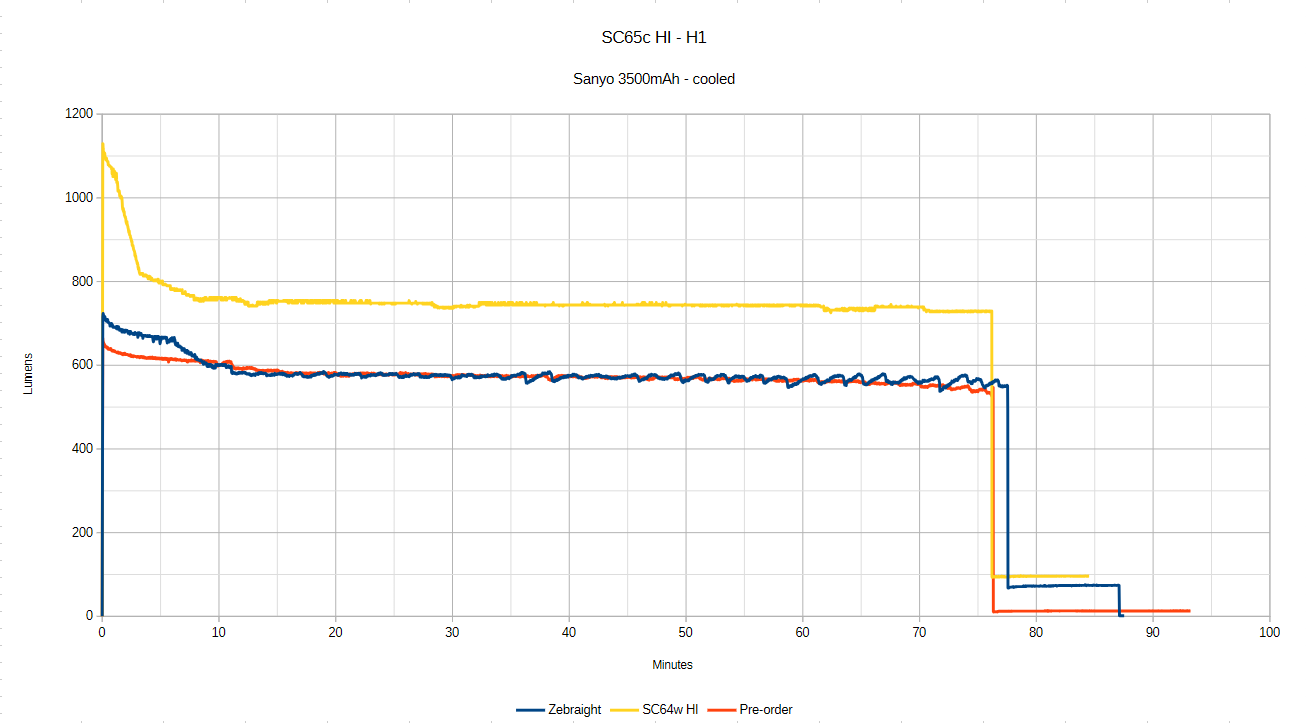
Note, I included a test of the SC54w HI but it was not done as recently. It did use the same battery but I did this test a year or two ago. I have tested my pre-order SC65 before but wanted to do it again so that its comparison to the new one had fewer variables. I don’t care to redo the SC64w HI test, but I think it’s reasonable to include. Back when I did test it, I also tested my pre-order SC65 and that looks basically the same as the test I just did.

So, I have no idea. Maybe my preorder wasn’t affected, maybe they never fixed it (though I’ve seen posts from McBob saying it was fixed), maybe it doesn’t actually cause much of an issue. Maybe there’s so much room for error in my tests that by random chance they ended up looking the same. Maybe that 10 minutes of 75 lumens at the end is the benefit from the update. Who knows.

It also really doesn’t seem like it’s an efficiency improvement over the SC64. But obviously the low CRI XHP35 has higher efficacy, so maybe the driver is pushing less power for the same time as the SC65, and if a 719a were swapped into the SC64 it would be a lower amount of lumens over the same time as the SC65 is managing. Who knows.

Finally, while the tailcap does have the spring bent at the end, it still marks the battery and sounds like there is gravel in the threads (which goes away when the battery is removed, so it’s probably not the threads). However, it looks more like it is polishing a ring in what is a somewhat stonewashed finish on the battery, rather than cutting a groove. When I used the battery from my old SC65 for the runtime test, it was a lot smoother to put the tailcap on than with the brand-new battery that the new light shipped with. So maybe once the ring is polished the tailcap might feel a lot better.
4 Thanks

Thank you for sharing these results. I recently bought a couple of SC65Cs and my experience with the “improved” tailspring is the same as yours. It’s still scoring the battery but not very deeply.

I find it odd because this isn’t a problem that any of my other flashlights have. ZL is so detail-oriented about everything functional, I am surprised they would have “fixed” this problem without fully resolving it. It really wouldn’t matter if they had onboard charging but since they don’t this is still somewhat annoying. Maybe over time the edges of the spring will smooth out and the problem will go away.

With the upcoming release of the SC70 (which could be any day, week or month now) it will be interesting to see what advancements they’ve made.

1 Thank

You could pull off the tailcap and try chamfering the edge at the end of the spring with a small hand file or sandpaper. Even a really tiny chamfer is probably enough to stop it scoring your batteries.

2 Thanks

That’s not the opinion I’ve formed. The driver being improperly assembled seems a lot more significant than the tail spring.

1 Thank

Based on your results, and those of other tests, it seems like the driver is quite efficient and high quality.

Assuming the teething issues you noted about the earliest drivers has been resolved of course.

sorry to hear that

you could buy some 3 prong pliers:

and bend the tip of the spring down slightly

the issue with the “defective drivers” was that there were missing components on the board..

mcbob figured it out and added them to the lights he modded.. I dont know how to find the link to his post showing the missing parts and I dont know what they affected

2 Thanks

The link I included in the original post shows the missing parts, or at least how TheFreeman fixed it. He also shows the H1 driver efficiency ranged from ~75-85%. Once he added the missing components (though we don’t know if he used the exact same ones Zebralight later used) it went up to over 90% at H1. I don’t understand how a difference that large doesn’t manifest in the runtime testing I did.

1 Thank

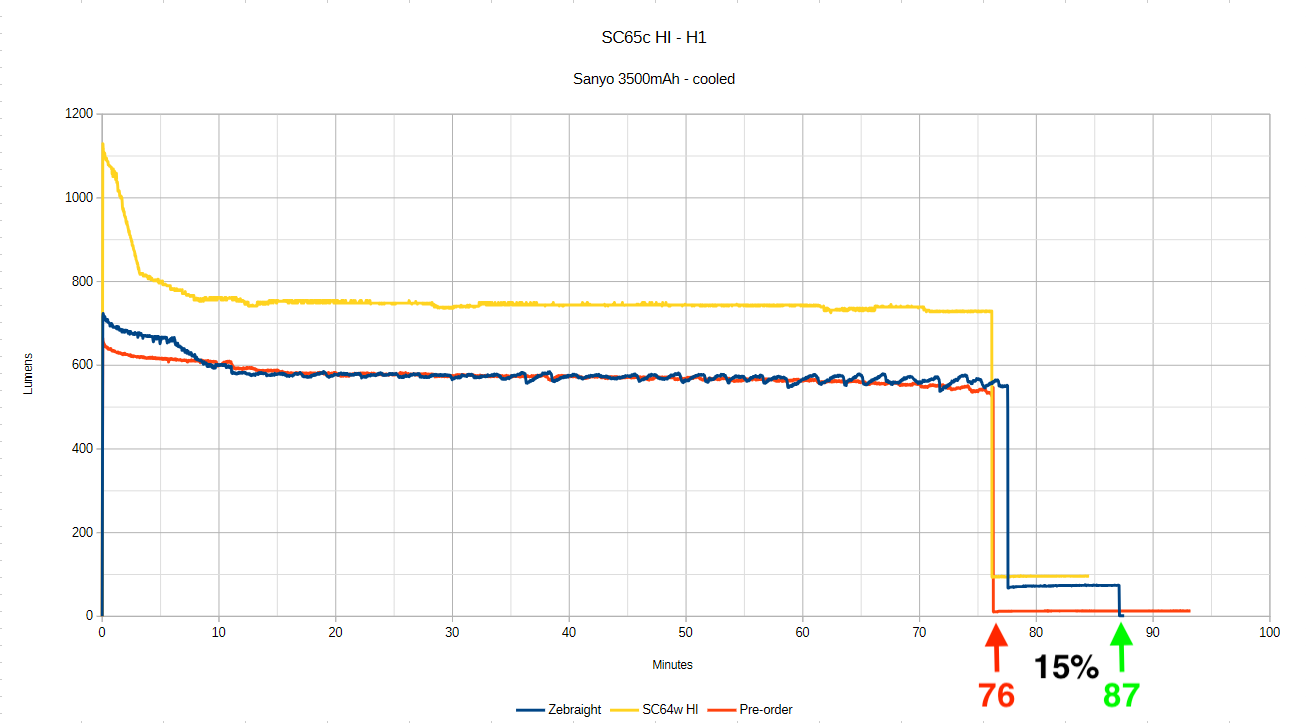
you might be right.. its a 15% change from the red arrow to the green arrow that I added to your chart:

thanks

I don’t think that extra period of 75 lumens indicates an add’l 15% efficiency. Based on the Zeroair review, 75 lumens works out to maybe 0.4 amps, and 600 lumens is 2+ amps. So we’re comparing 2 amps for 76 minutes (2.53 amp hours) to 2 amps for 77 minutes plus 0.4 amps for 11 min (2.63 amp hours), which is around 4% more. Even if my details aren’t perfect, I don’t think the delta is anywhere close to 15%+.

2 Thanks

Does it? I guess that’s what I’m having trouble with. Maybe both lights have a “good” driver. Maybe Zebralight found a bunch of the bad ones in a corner and is assembling them into lights now, and both have the “bad” one. Who knows. I don’t expect ZL to be forthcoming, all their crap behavior (this driver, low CRI SC64 LE’s, etc) was discovered by users like thefreeman and bobmcbob and maybe others. I was hoping this test would show some conclusive difference between them and I could feel confident at least one of them was properly built.

The 719a also isn’t overly popular so it’s hard to compare like to like with other flashlights. I tested the Lume X1 KR1 w/ NTG50 high CRI emitter, and it makes almost 800 lumens for almost 90 minutes. However, since I did that test to compare vs some 21700 lights, I used a 4000mAh battery. The math would scale that down to about 77 minutes, or about the same as the SC65 HI. Except much brighter. Of course the emitter efficacies aren’t the same so again, who knows…

1 Thank

Lume X1 is a great driver too! I don’t see how the comparison makes ZL seem inefficient.

I’m not defending ZL for any mistakes they’ve made, but I’m not seeing evidence that the 65c has a bad driver.

1 Thank

The KR1 makes 33% more lumens for the same time (assuming you accept my 3500mAh/4000mAh scaling of the runtime) from an emitter that is also high CRI and that is also around 4000K CCT. It could be the NTG50 has 33% higher efficacy than the 719a at that power level. Or it could be that the drivers both pull about the same power from the battery but one delivers 33% less to the emitter due to inefficiency. Or it could be somewhere between those two. The SC64 driver is fairly middling in efficiency in tests by thefreeman, and the XHP35 HI has pretty high efficacy (and is middling CRI ~80) yet the KR1 (slightly) outperforms it too. So it seems to me the driver must play some part or else the NTG50 is one hell of an emitter.

This is just my interpretation of things though, there isn’t any conclusive evidence other than thefreeman’s discovery that the driver was at some point improperly assembled, and bobmcbob’s discovery that for some period of time (maybe in perpetuity or maybe just when he bought a bunch) it was fixed.

I’m not going to buy another example, but I will try another test on a lower level, maybe a difference will surface there or maybe not. And maybe someone else will do a runtime test under similar conditions from which more conclusions can be drawn. Or maybe their test will have a very similar result and I’ll keep being confused. I feel like there should be two different performance profiles that runtime tests would fall into if there are two different drivers, one of which has clear efficiency shortcomings.

2 Thanks

The Lume X1 in the KR1 is a fantastic driver but I doubt it’s 33% more efficient than the SC65C. We do know that the 719A is a relatively inefficient emitter (even less than the 519A) and Noctigon says the NTG50 puts out significantly more lumens than a 519A in the KR1, so it’s likely not an apples to apples comparison. A pretty common complaint about the SC65c was that the move to 719A greatly reduced the output.

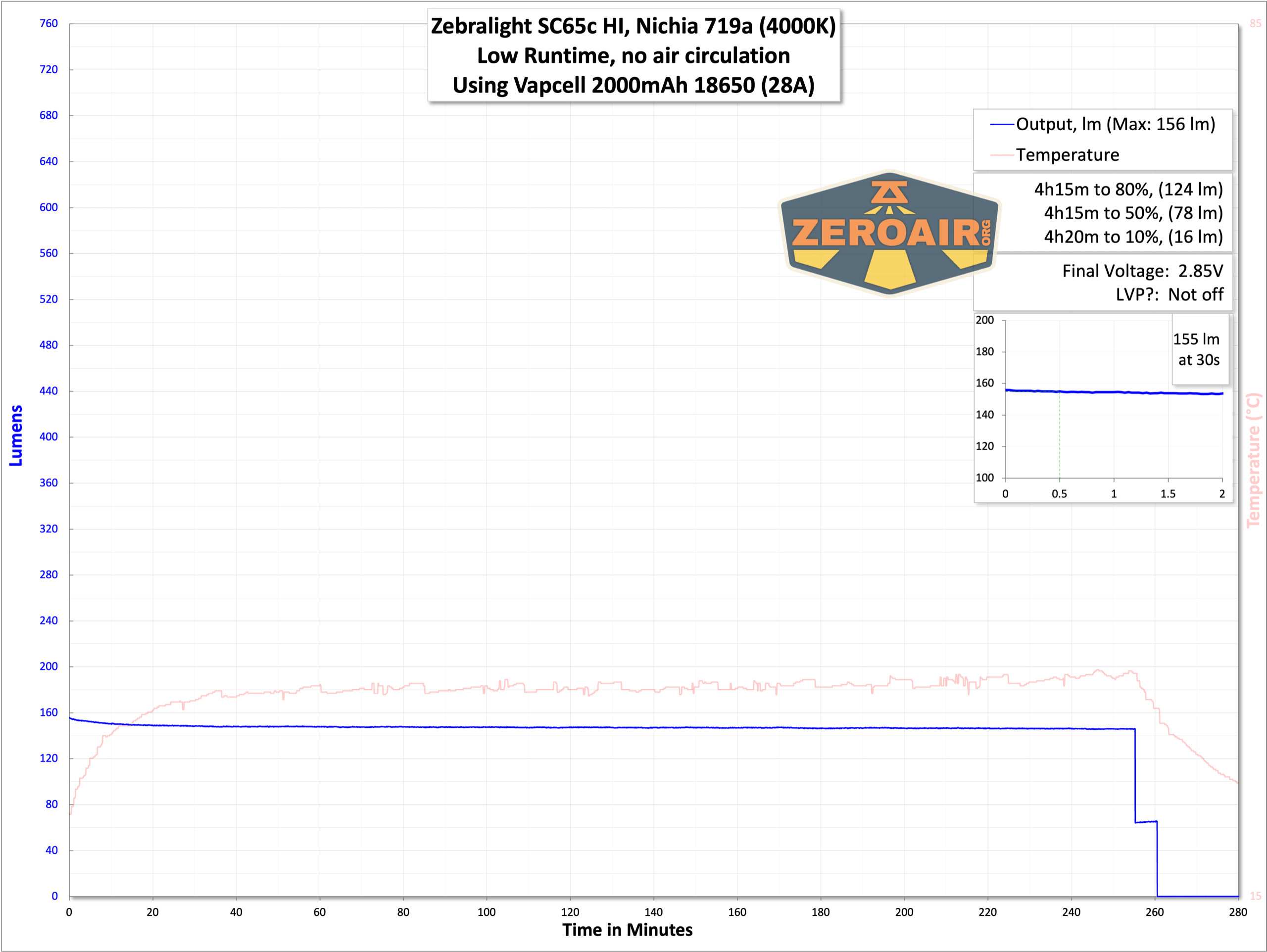
I’m also curious if you would be willing to do a test of one of the non-PID modes. Zeroair has the only SC65C runtime test I can find so that’s something we can use as a comparison point. Annoyingly, he used a 2000mah cell instead of a more standard one, but you could compare to his test of the top non-PID mode (244 lumens) and see how it matches up to ZL’s promise (3.5 hours) and Zeroair’s test (2.5 hours on 2000mah).

I don’t have the capabilities to do runtime testing and have never used my sc65c for an extended duration.

Maybe worth messaging ZL to point out this thread?

2 Thanks

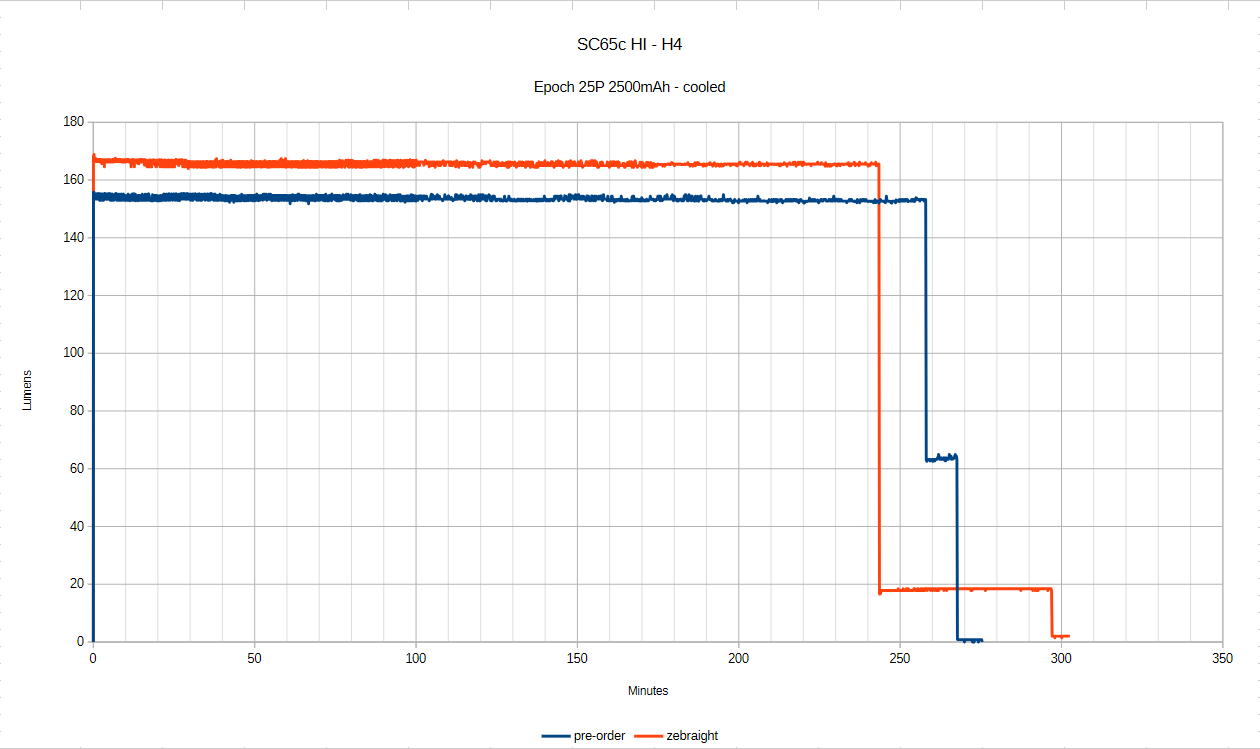
Here’s a test on a lower level. I’m calling it H4 because Zebralight doesn’t really name them, but it’s the lowest level you can program for H2 when in the G5 mode group. Or the fourth brightest level. I used a different battery than the previous test, because I didn’t want the runtime to take an eternity. But I used the same exact battery in both lights:

I don’t feel like this clears anything up… :person_shrugging:

Thanks for doing the test. I agree it doesn’t clear anything up. I also didn’t expect the difference in stepdowns because it didn’t sound like ZL made that change (from my recollection of what they said they changed after the first batch).

Even more surprising/confusing, Zeroair’s version of this run time looks like your pre-order not your new version. He used a 2000mah battery, so presumably yours would have run for 25% longer but it’s almost identical (just a few min off). Maybe your battery isn’t really 2500mah any more?

I just tested it at 2194mAh at .5A with a Vapcell S4+. It could be the Vapcell 2000mAh has a little over the stated capacity and that’s why they look so similar.

1 Thank