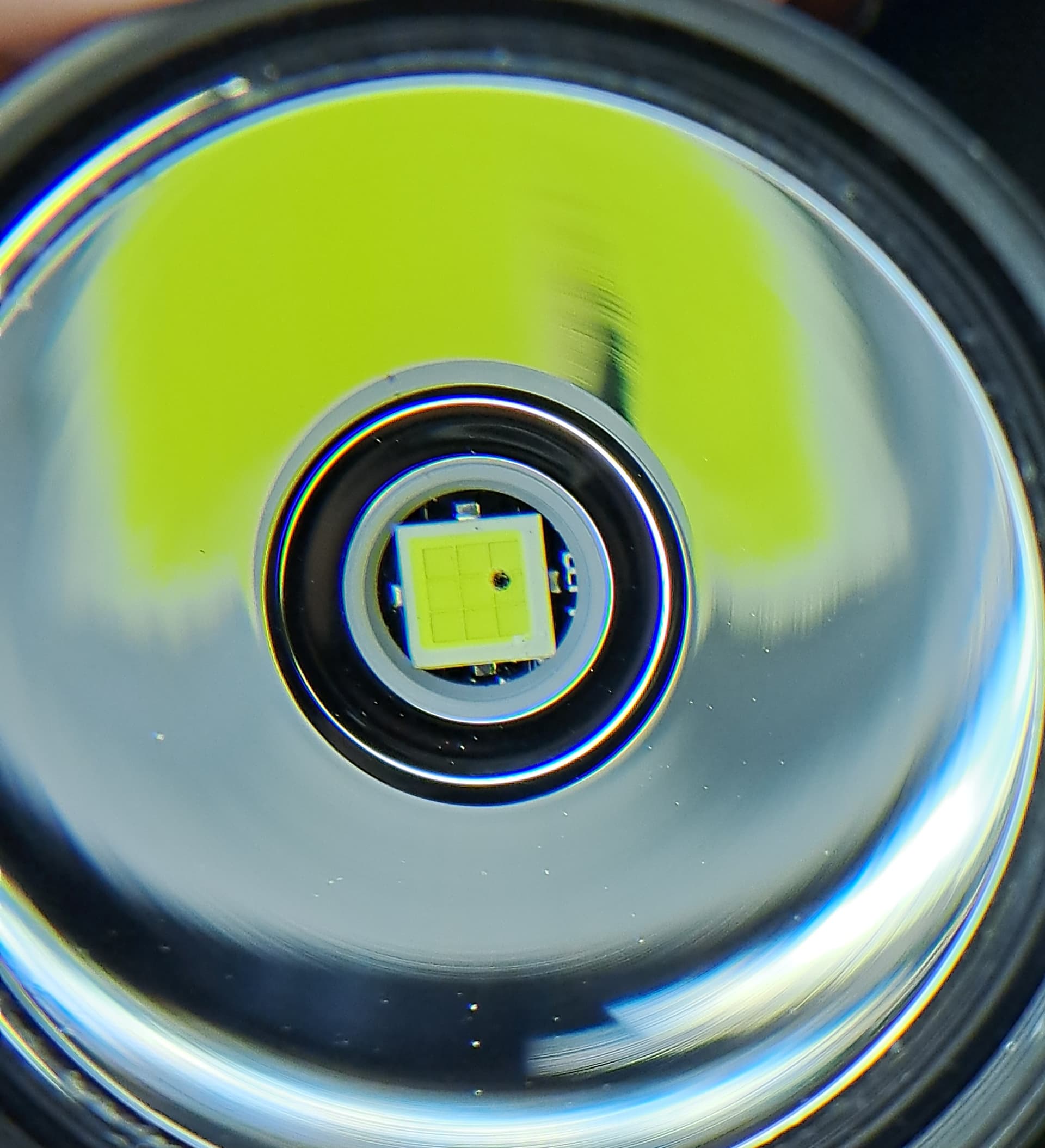
I was looking on Kaidomain’s AliExpress store and I stumbled upon the SFQ60 LED. According to the data in the opening post (and in various other places), the SFQ60 is listed as a 5050 LED, but KD has it listed as a 7070 LED and also with a considerable higher output/‘power handling’ than what is typically found for the SFQ60.
Does somebody has more information (or maybe experience?) about a possible 7070 SFQ60?!?
I thought that they maybe listed it wrong and it’s actually a SFN60, but from the few pictures that I could find of the SFN60, the LES seems to be quite a bit bigger than it shows on the picture of KD, so I’m not completely sure if it’s just an error in the listing.
I just ordered it anyway, so we will see what I end up with!
Planning to use it in a Convoy M21B and combining it with the Convoy 22mm 12A FET driver, including spring bypasses, etc. and see how far I can push it!
It’s possible that they manufacture the same array in different footprints.
I know that the 40mil and 43mil families are usually offered as one size down from the 55mil counterparts (SFN43 is 5050, SFN55 is 7070).
Maybe they do the same in the opposite direction, to try and get a bit more intensity (and heat dissipation) from the same die setup (like the Cree XP-L and XM-L2 sharing the same die).
A quick test of SFH43P (9090) from KD.
Clamp meter for current, DMM at LED pads for voltage. 4.5" Lumen tube w/ Mokka light cal.
DD with 4.18V Molicel P45B:
~7000 lumens cold start, ~30A, 3.45V. Quickly dives towards mid 6k range.
Relevant to the above figure: wires used were 18AWG, like 9" length per wire, two wires total, with each wire soldered to only one pad of the MCPCB.
Soldering wires to every pad of the MCPCB is probably beneficial at high amps. Need to test this theory…
At lowest PSU current setting:
.02A, 2.50V, 3 lumens.
Comments:
The SFH43P has a much smaller LES than the SFH55 according to the charts in the OP, (14.9 mm^2 vs 25.8 mm^2) so it has higher surface luminosity and is better suited for use in smaller reflectors and optics. The LED array of the SFH55 is slightly larger than the MCPCB thermal pad, which is another difference between it and the SFH43P.
I will be acquiring a hobby lipo charger that has a power supply mode and should allow me to test LEDs up to ~45A.
I am not surprised. All chips are in parallel, so voltage is the same for all chips, the current is divided into all chips. The Vf is low for almost all LEDs with parallel connected multi-die chips. The SFH43 has 16 single chips, so at 10 Amp every chip has a current of 625 mA.
2,95 V is very high for a current of only 625 mA. At this voltage newer emitters reaching about 1 to 1.5 Amps. Tbf, smaller LED chips have higher Vf in general, mostly due to thin or small contacts or bond wires.
LEDs with such high operating currents are not really practical anymore. It is obvious why almost all LED manufacturers use higher Vf (6/12 V) for these big emitters with extremely high power: better handling of current (wire thickness) and power supply.
I still not tested these ultra-high-current LEDs yet (without datasheets and official information also more difficult to do), but I planned to buy a more beefy power supply (over 60 Amps) for testing even those LEDs.
I prefer emitters like XHP70.3 HI which have higher voltage, but less current which makes the handling easier. They have lower light flux tho. These Sanan emitters are unique in the way of putting maximum power out of relative small size.
This is a trend with some Chinese lights using the really high power multi die LEDs with buck drivers, or buck+a FET for direct drive turbo. It’s sort of a compromise to a 6 or 12 Vf LED because high power (20+ amp) boost drivers are pretty rare. TaskLED made a high power boost driver (not sure if they still do), but i remember it was very expensive. I do know San’an makes 12 and 6 volt version of the quad die 5050 and 7070 leds. Nightwatch uses the 5050 size.
High current 3V LEDs are more practical now than they have been at any other time, and the same can be said for 6V and 12V LEDs.
We’ve got better liion cells now, better FETs, more advanced firmware, BeCu springs, and so on. When the Molicel P50B comes out they’ll be even more practical.
Cree will be offering a 3V XHP70.3 soon. Clearly the trend has moved towards high current multi-die 3V LEDs rather than away from them.
Having a choice of 3V LEDs in addition to 6V and 12V options allows for more design freedom.
For example, with an array of 5 LEDs or any array which is a prime number, the only wiring options are all LEDs in parallel, or all in series. 3V LEDs allow for series wiring with a lower resulting string voltage. If your design parameters were limited to an LED string voltage of 60V, this would be 20x 3V LEDs in series, or 20x 6V or 12V LEDs in series/parallel, but the end result is the amperage requirement is the same.
When you put it that way it makes a lot more sense lol
I hadn’t thought about this until now. Does that mean that the 12V XHP’s have less resistive losses and are more efficient than the 6V XHP’s? If we ignore driver efficiency
They’d have a marginally better efficiency because resistive losses are directly correlated to the current. You could get away with an MCPCB using thinner traces, and thinner gauge wires, as well as the slightly decreased resistance/heating from the internal parts of the LED.
I’m pretty sure that is why Acebeam runs the X75 in a 24v configuration, and the Noctigon M44 24v for each channel.
Also because paralleling LEDs is seriously bad practice and lowers lifespan unless they are thermally coupled very well.
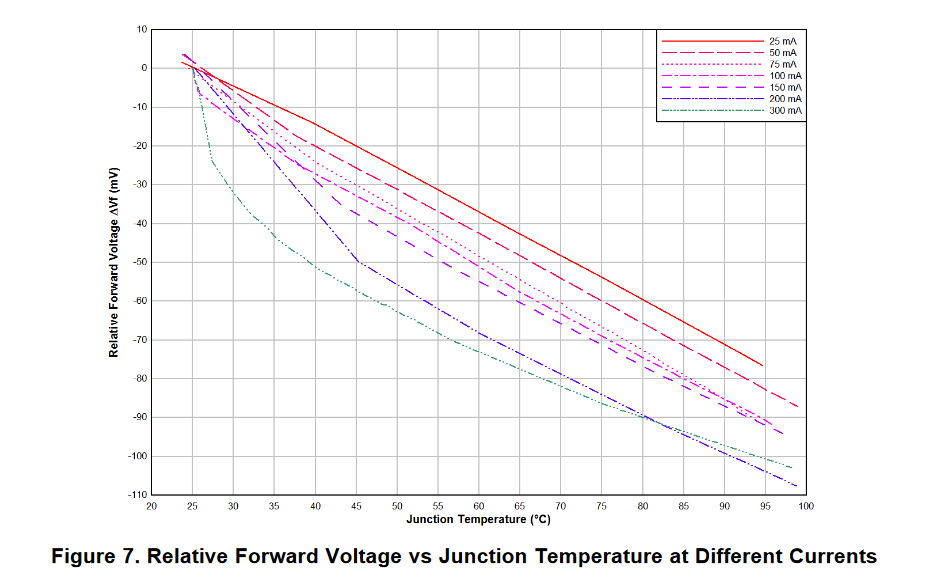
LEDs have negative temperature coefficients - a hotter DIE means lower V_f. Lower V_f means that particular LED will get more current than the others that still have a higher V_f. Therefore it will get even hotter, and get even more current, until that LED pops. Now the same current is applied to (n-1) LEDs, and the next pops until there is none left.
This is why LEDs should never be paralleled unless run very far from their limits, or with individual current limiting resistors (resistors have a positive temperature coefficient and cancel the effect out), or by coupling the LEDs so well that they must all have the same temperatures and one can not “run away”.
If you have a comparatively small head (let’s say 30mm) and 4 LEDs on the same PCB and brass pill, they are coupled enough and such a runaway case can not happen. But once you have 10 or so LEDs in a large head, they are not coupled well anymore, and single LEDs can exhibit such a phenomenon and die from overcurrent despite driver current divided by number of LEDs being within safe margins.
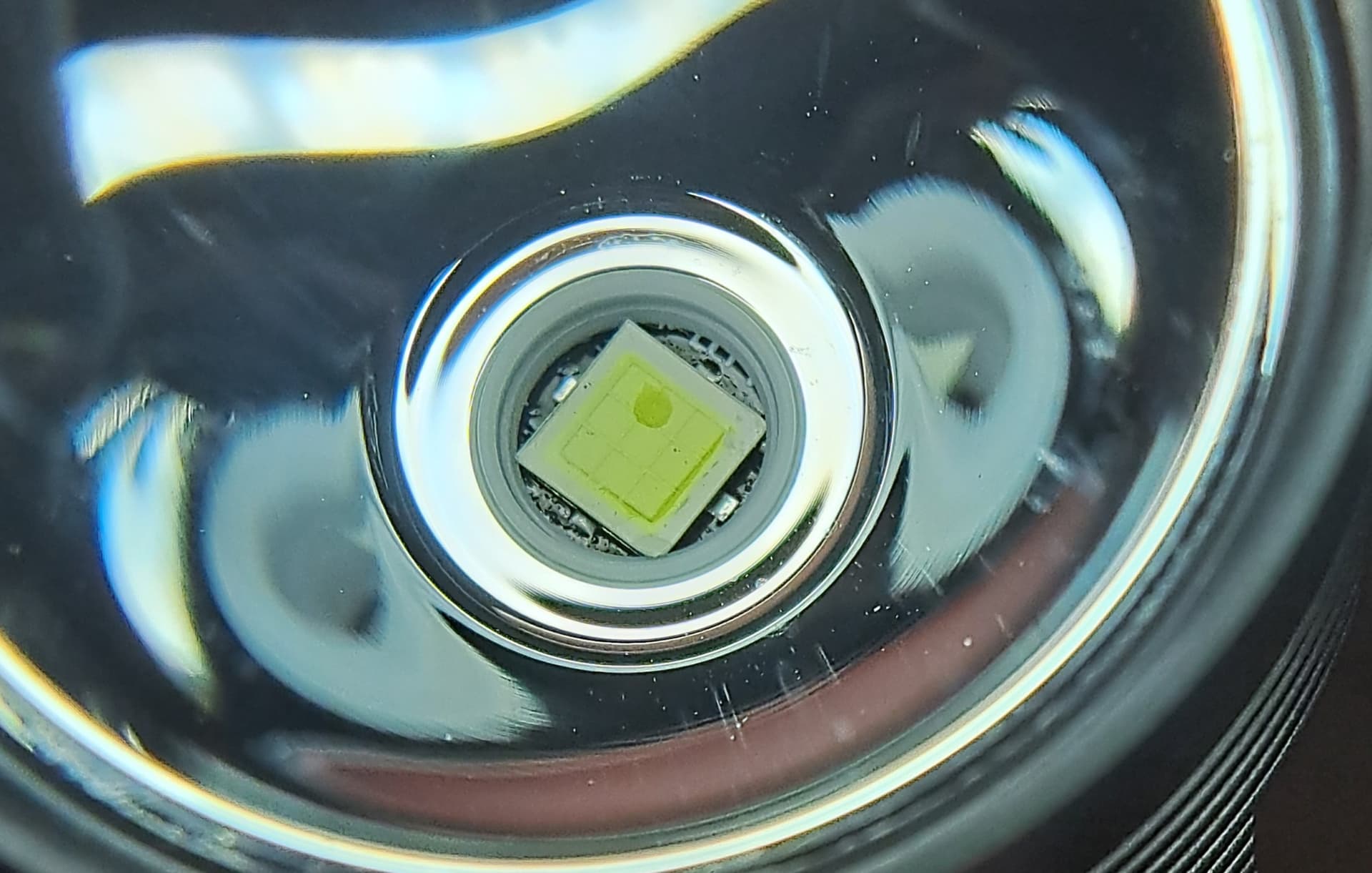
Just to illustrate resilence, I had the misfortune of some debris landing on the SFN40 but despite the coating appearing to be damaged, the LED works fine.