Shload of old 18650s. Best approach to charge?

Hi,

I just acquired a new scooter for use in scuba diving. It has 144 18650 batteries in it. They are all Sanyo NCR18650GC unprotected cells.

They were shipped from the manufacturer charged to 30%, and then sat, installed in the scooter, for 3 years. The battery pack has a Bluetooth BMS. The manufacturer says the BT drain is small, but in that much time has probably killed the batteries.

I’ve also been told that, if I want to try to save/use them, I can test each individual battery and, if it has some voltage, then I would be safe to charge it. Then only replace the individual cells that have no voltage.

I have an Opus BT-C3400 that I have had for several years.

The question is, what is the best approach for the batteries that do have some voltage (if there even are any)?

If a cell has any voltage (is there a minimum, where I should still junk it if the cell is lower?), should I just put it in the charger and do a normal charge? Or should I run it through a Discharge-Refresh cycle?

Initially, I figured I would just do a Refresh on all of them (that have voltage).

But, thinking about that and the history of the batteries, I’m not sure if a Refresh offers any advantage over just doing a normal Charge.

And, with 144 of them to go through and currently only having 1 Opus, doing a Refresh on them all will take weeks!

I am thinking of buying another Opus, or maybe even 2 or 3 more, to cut down the overall time this will take.

Meanwhile, any thoughts on whether a Refresh is worthwhile versus just doing a Charge?

And, for that matter, do I need to test their voltage? Or can I just put them in the Opus and let it decide whether to charge it or not? If the Opus doesn’t start charging it, then I junk it?

Thanks!

Yes.

If it’s under 2.5V, it’s probably not safe to use any more. If it’s between 2.7V and 4.2V, it’s probably fine and can be put in a charger for normal use.

Don’t charge them all to 100% and store them that way though. Li-ion cells age fastest when they’re totally full or totally empty, and they should be stored somewhere in the middle instead. Charge them to like 3.7V or 3.8V before storing them, and don’t fill one up until you’re about ready to use it.

For the longest life span in years, try to charge to only ~80% or so, and use it until it’s at ~20% before charging. That’ll maximize the number of charge cycles it gets, and also maximize the total energy it can produce in its lifetime. It doesn’t have to be exact… just use it until it’s “low-ish” and then charge to “high-ish” when convenient. But if you have 144 of them, maybe cell life span isn’t a big concern.

2 Thanks

Thank you.

But, that still doesn’t answer my main question.

Let’s say they test at 2.7V. Given their history (one really slow discharge from 30% in their whole life), is there any advantage to doing a Discharge-Refresh? Or is it just as good to do a simple charge in this case? The difference is many hours of time. A Refresh takes almost 24 hours. With 144 cells and a 4-bay charger, that is a LONG time before I’m done and can actually use my scooter.

I will replace any that are bad and charge them all to full. Then reinstall them all in the scooter and connect the scooter’s charger, to let it make sure they are all charged the same and the scooter’s charge/battery maintenance circuitry is happy.

Then I will take the scooter diving and run those batteries down having fun! And, yes, I will store it between dives with the batteries at less than 80%, but more than 30% or so.

2.5V is the rated cutoff of most cells. The voltage at which the cell becomes unsafe to recharge is much lower than this.

Reading cell datasheets can teach us a lot about lithium ion cells. If possible, refer to the datasheet for your cells.

Samsung 35E datasheet is one of the more comprehensive ones and has a lot of useful information.

The Samsung pack design guide shown in the 35E datasheet says 1.0V is the do not recharge voltage, and it is speaking generally about liion packs, not specifically about the 35E cell:

Normal discharge cutoff: 2.5V-3.0V (cell chemistry and application dependent)
Over voltage protection: 2.0V-2.5V (cell chemistry and application dependent)
BMS shut down voltage: 2.0V
“Do not recharge” voltage: 1.0V.

It even lists the continuous “float charge” voltage as 4.05V which is not something you see in most datasheets.

The “Lithium Ion Rechargeable Batteries Technical Handbook” from Sony says: “Under no circumstances should overdischarge (to 1.0 V/cell or less) be allowed to occur.”

These are two technical resources provided by the cell manufacturers which indicate that 1.0V can be used generally as the absolute minimum “do not recharge” voltage for liion cells.

A paper titled “Overdischarge and Aging Analytics of Li-Ion Cells” (link to pdf) shows some cycle life tests of LCO lipo cells discharged to 2.7V, 1.5V, 0V, and -.5V. The 0V and -.5V discharged cells fail rather quickly, with the -.5V internally shorting out after 14 cycles. The cell discharged to 1.5V performs similarly to the 2.7V cell: “The cell that was cycled under the recommended voltage window lost 20% capacity of its nominal capacity after 287 cycles, Fig. 2c. After 165 cycles, the coulombic efficiency exhibits an unsteady trend due to the degradation taking place within the cell. Similarly, for the 1.5 V case, the total number of cycles reduced to 220, Fig. 2d, and the unsteady coulombic efficiency occurs at the 145th cycle. In both cases, the main degradation mechanism is the SEI thickening.”

The above study demonstrates that a liion cell doesn’t simply become dangerous trash when significantly over-disharged, hence the 1.0V “do not recharge” voltage provided in the Sony and Panasonic literature.

Cells below <3.0V should be “pre-charged” which means initially charged at a reduced rate. For a cell which has been sitting for a very long time and is at a low voltage, a pre-charge rate of .1C may be a good place to start. After a while when the cell is >3.0V the charge rate can be increased.

3 Thanks

A simple recharge should be fine. I’ve never seen a datasheet which recommends some kind of “refresh” protocol.

1 Thank

Thank you for that info.

I misspoke earlier. The batteries are NCR18650GA, not GC.

I found a Panasonic datasheet.

Sanyo NCR 18650GA Button Top Data Sheet (batteryjunction.com)

It does not give a minimum “do not recharge” voltage that I can see specified.

Does that mean I should treat them as 2.0V is the cutoff. Do not recharge if less than 2.0? If 2.0 or above, then okay to attempt to charge?

Does that mean that the “Discharge-Refresh” mode of the Opus BT-C3400 charger is just snake oil?

Also, does anyone know what battery voltage is the minimum for the charger to detect the battery and start to charge it?

For example, if the charger won’t start unless it detects at least 2.0V, then do I need to test the cel voltage before putting it in the charger? Or just let the charger test the voltage for me? If the charger doesn’t detect and start charging, then I know to junk the battery?

Yes, it has no use with LiIon batteries. Essentially you are just wasting another charge cycle.

Anyway, when you proceed with charging these cells have a plan what to do if something goes wrong.
Charging them e.g. in the garage on a concrete floor with nothing flammable around and above for 2 meters and having a bucket with sand ready are good ideas (+ have a smoke alarm in the charging room).

1 Thank

If you’re putting them back in the scooter to use as a pack, that might make things more complicated. I doubt it uses 144 cells in parallel, because the amperage would be insane. But it’s probably not all in series either, because it’d have way too much voltage. So, probably something between, like 12S12P.

If it was entirely parallel, that would make things easier. Just check the shared voltage of the entire pack, make sure it’s acceptable, then plug it in and use it’s built-in charger. Parallel cells are easy to care for. But it’s almost guaranteed to have a bunch of series sets in parallel instead.

Batteries are more complicated when the cells are in series… because if there’s a strong cell in series with a weak cell, the imbalance can be very dangerous. It’ll over-discharge the weak cell during use, then over-charge the strong cell while charging, and end up destroying both and maybe starting fires. So they need to be carefully matched – the same model of cell, and the same voltage, and the same usage history. It’s not safe to just take out a couple old cells and put new ones into the middle of a series.

So you may need to identify the series / parallel sets within the 144-cell battery, and make sure each cell in each series set is healthy. If not, the entire series set may need to be replaced. Or depending on the details, maybe good cells from two sets can be combined to make one set.

Then once each series set is good, charge each set to the same voltage before connecting them in parallel. Once connected, they’ll equalize rapidly, so they need to be very close to the same voltage beforehand to avoid too many amps during the equalizing process.

2 Thanks

That would be the safer way to go, yes.

HKJ’s guide on this subject is also a useful reference:
“2) Do not charge batteries measuring below 2 volt, except if you have data saying it is safe.”

If you were to go by the “pack design guideline” chart shown in the Samsung 35E, which seems to be a general reference applicable beyond only the 35E, you might revive a cell all the way down to near 1.0V. I wouldn’t do this personally, but it suggests that if you’ve got a cell at 1.9V, you can make a call as to whether or not you want to toss it.

Being a 144 cell pack, it is probably 12s12p. The cells are likely arranged in banks of 12p, which are then wired in series. Arranged this way, the individual cell health / impedence matters less than if it were series sets (12s) wired in parallel.

12s12p_43.2v_battery_pack_with_sanyo_ga_18650_battery_cu_top

2 Thanks

Right. I’m aware of that issue.

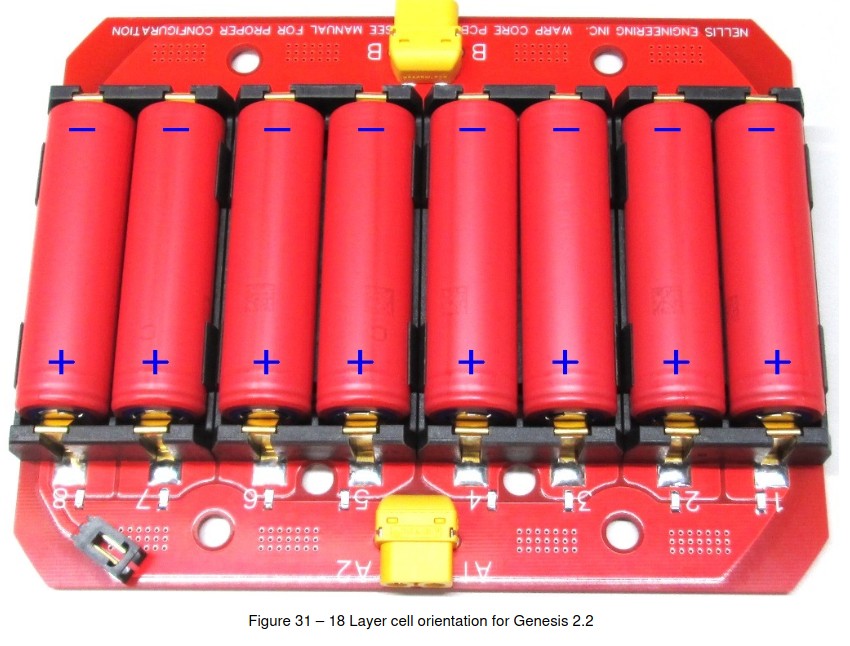
The cells are in 18 layers (circuit boards). 8 cells per layer. Layers are paired. I presume that means each pair of layers is 16 cells in series and then the 9 pairs are in parallel. So, 16S9P?

If any cell in a pair of layers needs to be replaced, then I will replace it with a good cell from one of the other pairs of layers (as all cells are currently from the same production run, with the same history). Presumably I will find at least one bad cell along the way, so that will eventually leave me with one or more layers that have 1 or more empty slots.

Once I’ve gotten rid of all the bad cells, I will toss all the cells from whatever partially filled pair of layers I have. Then, I will fill all my empty pairs of layers with all new cells from the same production run.

If I start testing and the first couple of layers are all bad (which is entirely possible), then I’m not going to waste my time. I will just order 144 new cells.

18650battery store and IMRbatteries are both around $4.75 each for these, if I order 144 of them. That’s $680. I’m hoping I can get this thing going for much less money than that.

Thanks, @Valynor. I should have known that.

I will stick to using the Refresh cycle for my NiMH batteries, and not for Li-ions.

Assuming 8 cells on a layer are all in series, do I need to ensure all 8 cells are at the same charge level when I install them, prior to connecting the scooter’s charger?

Or can they be a different charge levels and then when the scooter’s charger is connected and charging them all it will bring them all up to the same level (~4.2V)?

From what @ToyKeeper said, it sounds like that might be bad. Having a 2.9V cell and a 4.1V cell in the same pack connected in serial would result in one of them getting overheated during charging?

If that is the case, it sounds like I need to charge them all individually to “full” before installing them. I have no way to charge them all to the same level, that is (for example) 80%. So, if they all (in the same layer) need to be the same, then they all need to be full.

Sounds like there’s a lot of assuming and presuming going on.

Look for yourself and determine how your pack is wired. Are the cells arranged in parallel banks which are then wired in series, or the other way around? This matters.

The first questions don’t make sense to me but the follow up questions help to clarify what it is you are asking.

Yes, charge your cells individually to full, or otherwise charge them in parallel.

You can discard (or at least not use in the scooter pack) the cells that are clearly at a different starting voltage than the others.

Mixing brand new cells with old cells requires some consideration. You wouldn’t want new and old cells in the same series string.

Liion wholesale has some cells for <$3 each: Search Results – Liion Wholesale Batteries
DMEGC INR18650-29E are $2.29 each which would make for a $330 rebuild.

Hoop’s theory makes a lot more sense than the arrangement I was picturing. Taking a bunch of parallel sets and putting them in series seems a lot safer than taking series sets and connecting them in parallel. So that’s likely how the pack is built.

But

Check the actual battery pack to find out. And check the cells. Then you’ll have the info you need to decide what to do. Depending on what you find, it may be as simple as just plugging the pack in to charge it normally.

Thank you all for the all the help. I’m sorry I’m not a bit more savvy on the Parallel/Series thing and so coming across as an ignoramus (which I am - at least on this). :smiley:

If you are curious, the manual for this scooter’s battery pack is here:

Microsoft Word - Warp Core Manual R1.0.doc (logicdivegear.com)

The model of the scooter is a Genesis 2.1 or a 2.2. I have a 2.2. The difference is that the 2.1 has only 9 layers of batteries and half the run time. The 2.2 has 18 layers of batteries. If you look at the manual, you will see those references.

I have consulted with the manufacturer, but, of course, they don’t want to take on liability by helping me “bring back” the existing batteries, with the risk of fire, etc, if done wrong. And, I’m sure they would like me to just buy a new set of batteries directly from them ($750).

Thus why I’m here asking questions.

What I HAVE been told is that, in the 18 layer configuration, if I replace a single battery with a brand new battery, I need to replace all the cells in both layers. From what you have told me, that seems to indicate that all 16 cells in the pair of layers are in series.

But, I don’t know, and I don’t know how I could look at the circuit board and tell that.

Regardless, I think I know enough now, from a practical standpoint to do what I need to do.

I will check every cell and toss any that are less than 2.0V.

I will put the rest on an individual cell charger and then refill as many pairs of layers as I can.

Any pairs of layers that are not completely filled, I will then fill with new cells that are all from the same production run.

The risk of my scooter catching on fire inside, during a dive, is not something I want to tempt fate with, so I want to go with a conservative approach to this.

The manufacturer is very specific about what cells to use. This is a high drain application, and they say that the electronics are very sensitive to variances in cell voltage. So, rather than go with any cheaper cells, I will get the exact same cells. But, maybe from a cheaper source than the scooter manufacturer.

Since we’re already into the start of the rabbit hole… I did a quick check on a scuba forum.

What I see is that the 9 layer G2.1 uses 9 layers that are each 2s4p, resulting in an overall pack that is 18s4p.

The 18 layer G2.2 uses layers that are 1s8p to make 18s8p - double the capacity at the same voltage.

I also noted in the manual that 9 of the layers are interchangeable between the 2.1 and 2.2. The other 9 layers are specific to the 2.2.

And, when installing cells in the common boards, the orientation of the cells is different. For the 9 layer config, on each layer 4 of the cells are installed with polarity one way and the other 4 installed the opposite way.

For the 18 layer, the layers that are interchangeable between the 2.1 and 2.2, all the cells are installed with the polarity in the same direction.

That pack construction is super cool because it makes for a user rebuildable / serviceable pack, since there are no welded tabs.
I have not seen this construction method used before in an actual product but it has occurred to me to build packs using this method. It’s nice to see the concept validated in this way.
The alternative best route to take for custom pack building is to make welded packs using a “K-welder.”

The downsides to the non welded construction method are some voltage loss at each connection and reduced amperage handling vs welded connections.

The instruction manual looks good and appears to tell you what you need to know in order to rebuild the pack.

The cells in the Genesis 2.2 are arranged in parallel banks, which are then wired in series. The voltage of all cells in a given parallel bank should be the same.
It’s not totally obvious from figure 31, but figure 34 shows the negative tabs sharing the same connection, which means they are in parallel.
Each layer in the stack is flipped 180 degrees.

Let us know what voltage you find the banks to be resting at.

2 Thanks

If you do 4 a day after work its 35 days. Its really not that long consider you let your scooter sit for three years. Doesnt the scooter have a charging system, why would you charge them individually.