I don’t think it make sense in any case. If I decided to take the risk I shall be the only person responsible. I’m disappointed that some think otherwise.
in 98-99% of the cases you receive the driver and save the 3$ for tracking and insurance,
which makes sense on a single driver
still it sucks if you are unlucky and the driver is lost,
but blaming me for it and insist for paypal refund and the open a Paypal case is not nice
If there are problems with the drivers I help get em fixed, if lost I offered him a replacement for bare material costs and shipping
for orders close to 50$ I highly recommend tracking which also coveres 25€
for orders close to 100$ I insist for tracking and full insurance, as a loss would be too risky
I agree on the “logic”, but in law it’s always the seller that’s responsible for shipping, and you should up your prices a bit to cover your losses.
(in this case between individuals, not a business, and having the 3$ option, I kinda agree it’s not your fault at all, but I would go 50/50 on it and forget about it).
It seems he fulfilled all his responsibilities, didn’t he?
I mean he packaged it well, got the name and address correct, even offered insurance and/or tracking. What more can the seller do?
If the buyer did not want insurance and the package gets lost by the shipping company, he or she needs to grow up and accept the small loss of money due to their poor decision.
Just because PayPal gives buyers the ability to steal their money back from an honest seller doesn’t mean they should.
It’s like some people can’t accept that they made a mistake and instead want to put the blame on anyone else, but themselves. I’ve been around people like that and I can’t stand them.
I guess it depends on country. In mine, after handling the package out to the shipping company, seller is not responsible for the delivery.
If package is lost, buyer is entitled to lay a claim to the shipping company (though seller is allowed to do it in the buyer’s name and many do so). The shipping company refunds the package (up to some limits), refund goes to the buyer.
I am surprised that 2 EU countries have this kind of a difference in their laws.
I appreciate that I’m a bit late to this, but is it still possible to put in an order for one of the 20mm boards?
If so, I’d like:
(1) 20mm 1S NarsilM, 50°C, SD=2.8V, PO=(2B), short spring (unsoldered)
Lexel,
Please add me for one Q8 47.5mm driver, if available.
Thank you!
OK
I am pretty sure that the order of springs from Kaidomain is lost, as some LEDs I ordered 2 weeks later arrived here today
I ordered springs 2 days ago, so it will probably take 2 weeks to arrive
I ordered 3 more 20mm board from oshpark today
There are parts for plenty more drivers, just some board sizes I need to order
17, 22, 30, 38.5 and 46mm drivers are in stock
I ordered 3 more Q8 driver boards today, but I got one Q8 driver here in my stock
The question is if tocirahl takes this one or it is availiable for you, I wait till tomorrow if tocirahl answers my PM
Q8 driver arrived in the post today, thank you.
Whoops, not interested in the Q8 driver for now; thanks Lexel. Didn’t see any PM from you though.
If it’s still possible, I’d actually like to request 4 inches of wire soldered to my 22mm driver though. Let me know how much extra that would be. Any news on those springs?
2x4” or 2x2”
2x4” is 1$ extra
I ordered new springs, no tracking on the old ones they are lost or heavily delayed
LEDs I ordered from Kaidomain 2 weeks later than the springs arrived today
The spring situation is unfortunate =/. 2 x 4”, please! $1 coming your way.
That’s great, could you please also add 3” (i.e. 2 x 3”) of cable, unsoldered. I’ve just realised that I don’t have much left.
Just let me know when/where/how much to pay. (I think it’s $14 + 0.30 + 0.75 + 2 = $17.05, but I may have missed something)
Where is the eswitch soldered on the ones that don’t have the “switch” print, on the OTC cap pads?
switch gets soldered to the OTC
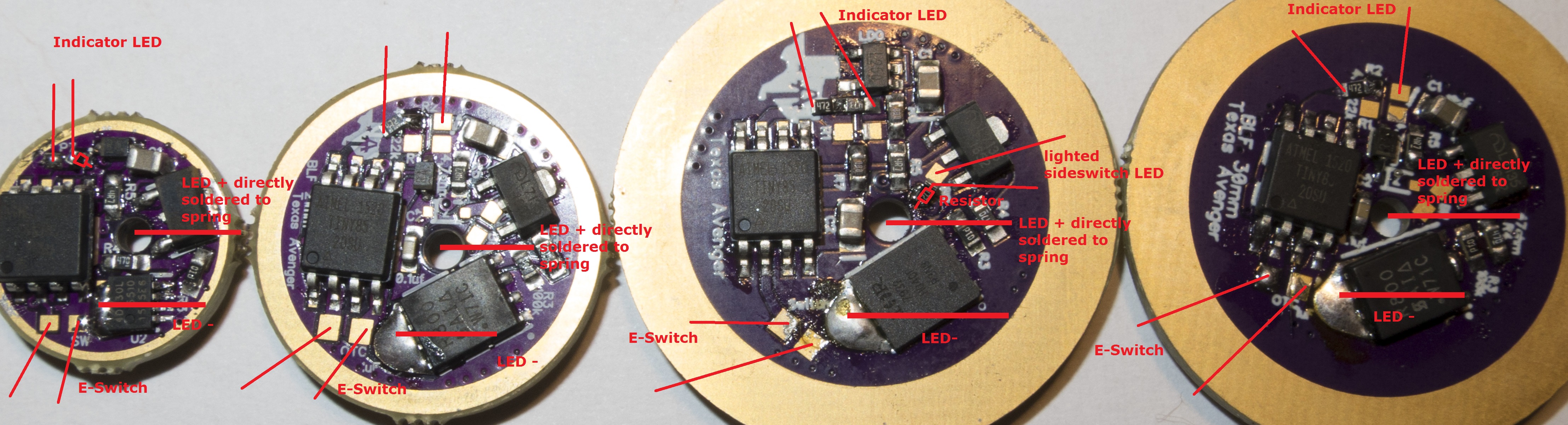
Hey Lexel, just double checking, you’ll be soldering the wire directly to the end of the spring closest to the battery, right? If not, just include the wires without soldering them for me.
the positive wire gets soldered at the tip of the spring

Thanks for the info on the eswitch connections.
If I wanted to connect an indicator LED (in this case, on an Astrolux S42 switch board), am I correct in thinking that an extra resistor needs to be added to the driver, at the outer R1 pad? Does this have to be matched to the indicator LED, or does it just need a standard value?
The outer pad of R2 and the inner pad of OTC are both marked with “-”, are they both direct to ground? The traces on TA’s unpopulated board image would suggest that, but I don’t know enough to be sure!
The reason I ask is that the S42 switch board has a single ground wire for the switch and indicator LED.
If you look at the picture Lexel has provided above, you’ll see that the pad for the indicator LED already has a 4700 Ohm resistor in place. This would be the positive lead for the LED. I think you have to ask him to add that resistor.
Keep in mind that these tiny resistors which are only soldered on one end are very easy to break. A slight tug on the LED wire can snap it in two. When I add my LEDs I use a through hole type resistor in the middle of the wire. This creates a more robust connection.
Of the two switch pads, the pad closest to that LED negative joint is the one that is negative. So if your switch pad shares a common negative make sure you wire your switch up to the correct pads. I don’t know if that’s clear, but if you look at the two build threads in my signature I show how I wired up my switch and LEDs.
I’ll let someone else answer the rest, as I’m not 100% sure.
you can solder on both pads of R2 one is ground the one with the smd resistor positive
I can add a 0805 resitor of any value you like
So paypal finally solved the case with the lost driver
the buyer got refunded the whole amount, but as I also could proove I sent the item paypal did not charge me at all