Weekly reminder that li ion batteries has to be respected

For some people including me who wondering what are real worlds examples of li ion battery burned/exploded in a flashlight body this week provided 2 new examples:
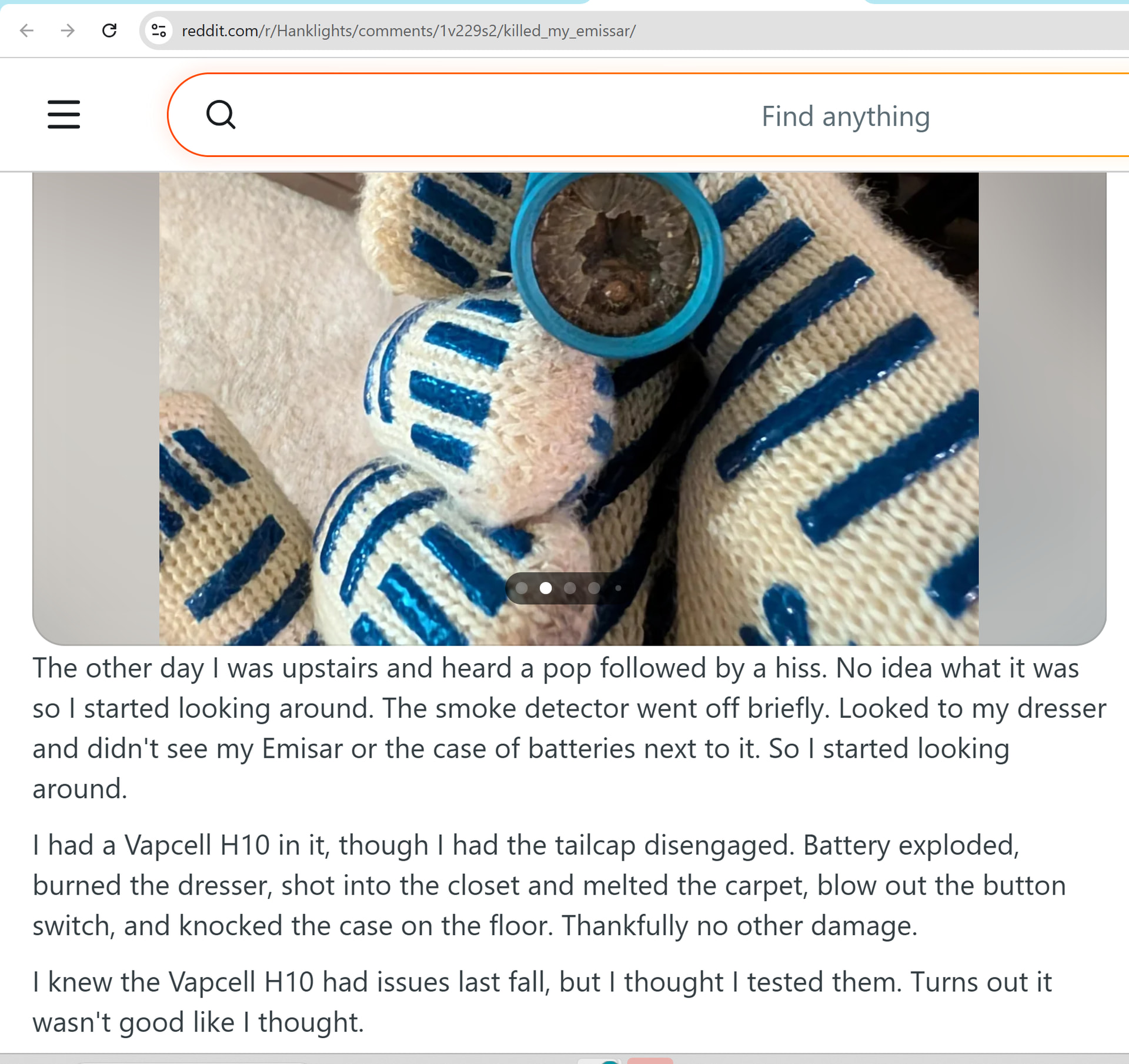

First one is more expected, 5 days ago user reported on reddit that his D3AA exploded with Vapcell H10 in it. This is probably not a surprise to most people here since we heard about problems with that line like a year ago and that why currently that line is discontinued. People recommending switch to K10 which I am not aware of having similar incident so far. I have personally one of K10 so you can call it I have skin in the game :grin:
But generally I would recommend to stick to protected 14500 with 3A CDR and disable turbo for D3AA and use group 8 for 5A driver for convoy T6 or T8.
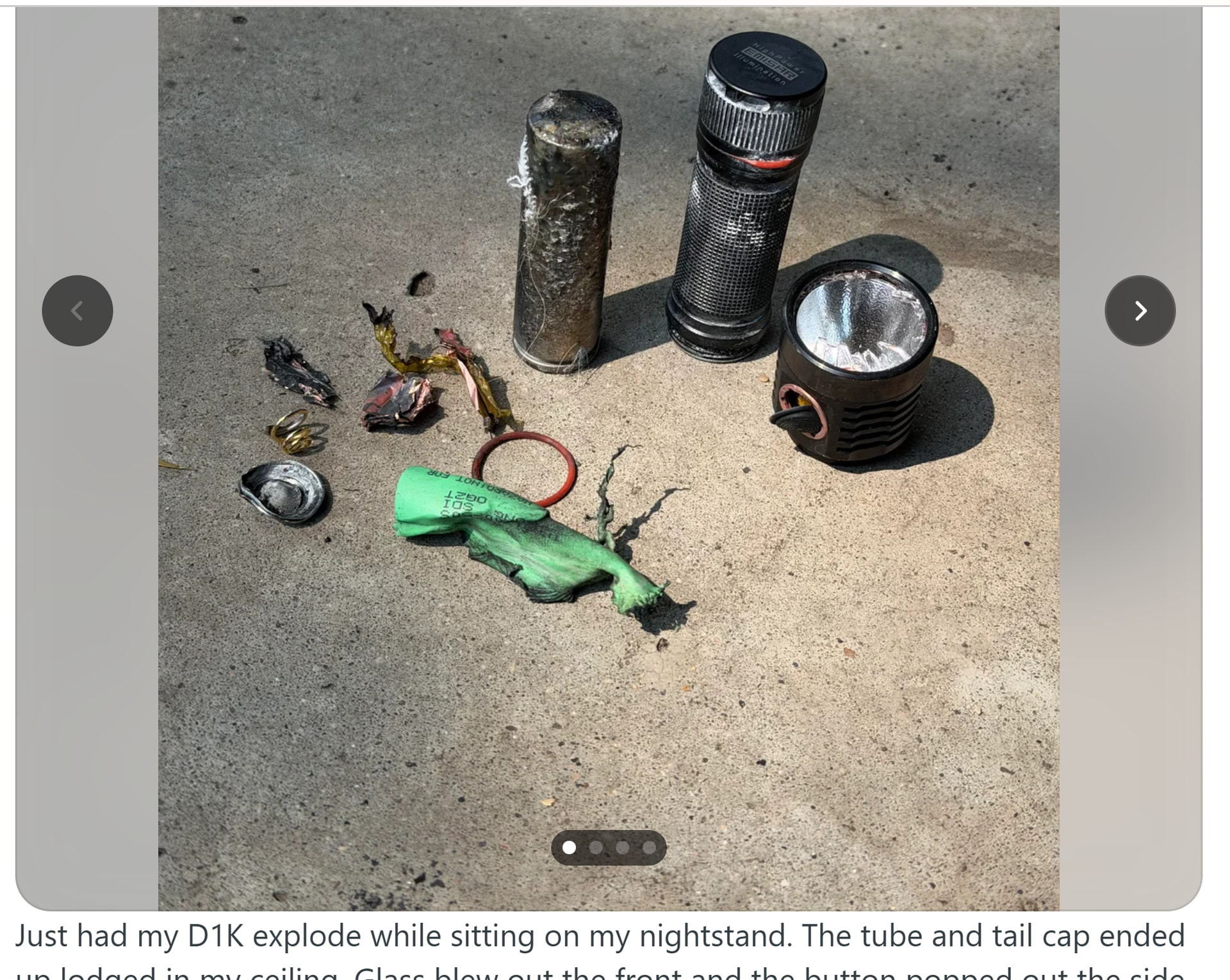
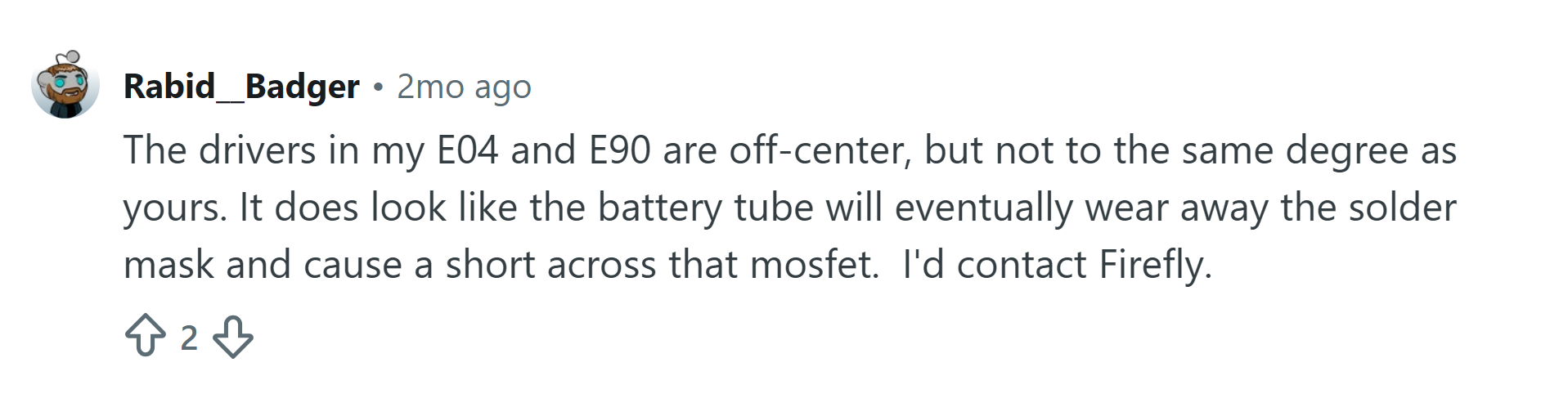
Second incident is more dramatic and worrying since there no clear understanding on what went wrong and therefore no oblivious steps on how we can mitigate that risk. Yesterday user reported on reddit that his D1K exploded by simply sitting on a nightstand.

From image user posted and he later confirmed it - that a lume X1 driver:
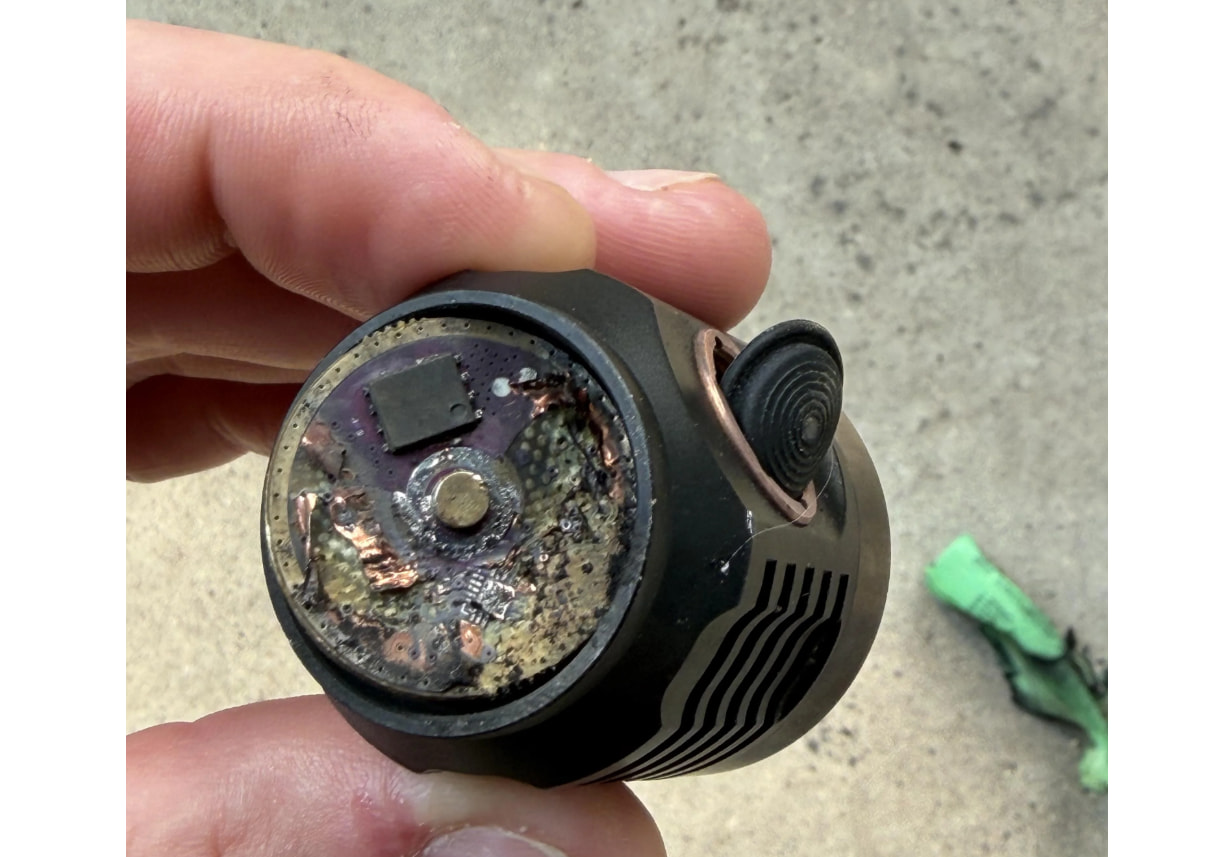
Here I saw that opinions split into following groups:

  • Some think that internal battery problem not related to light
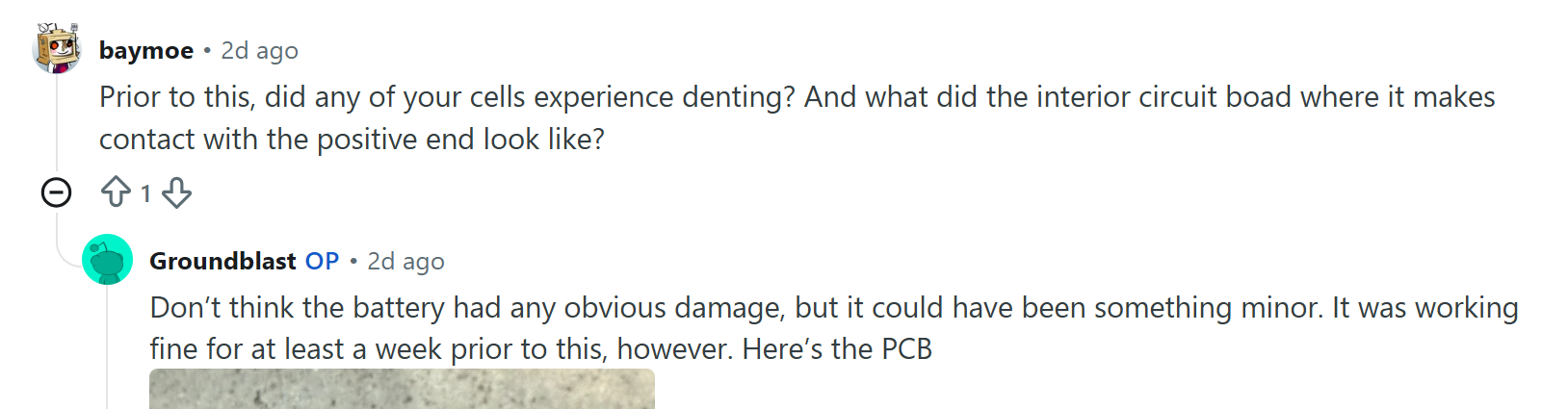
    For that hypothesis I would review if excessive pressure of springs in flashlights can cause internal short. We know a number of cases that Emisar and Noctigon flashlights dent positive terminal of battery - example
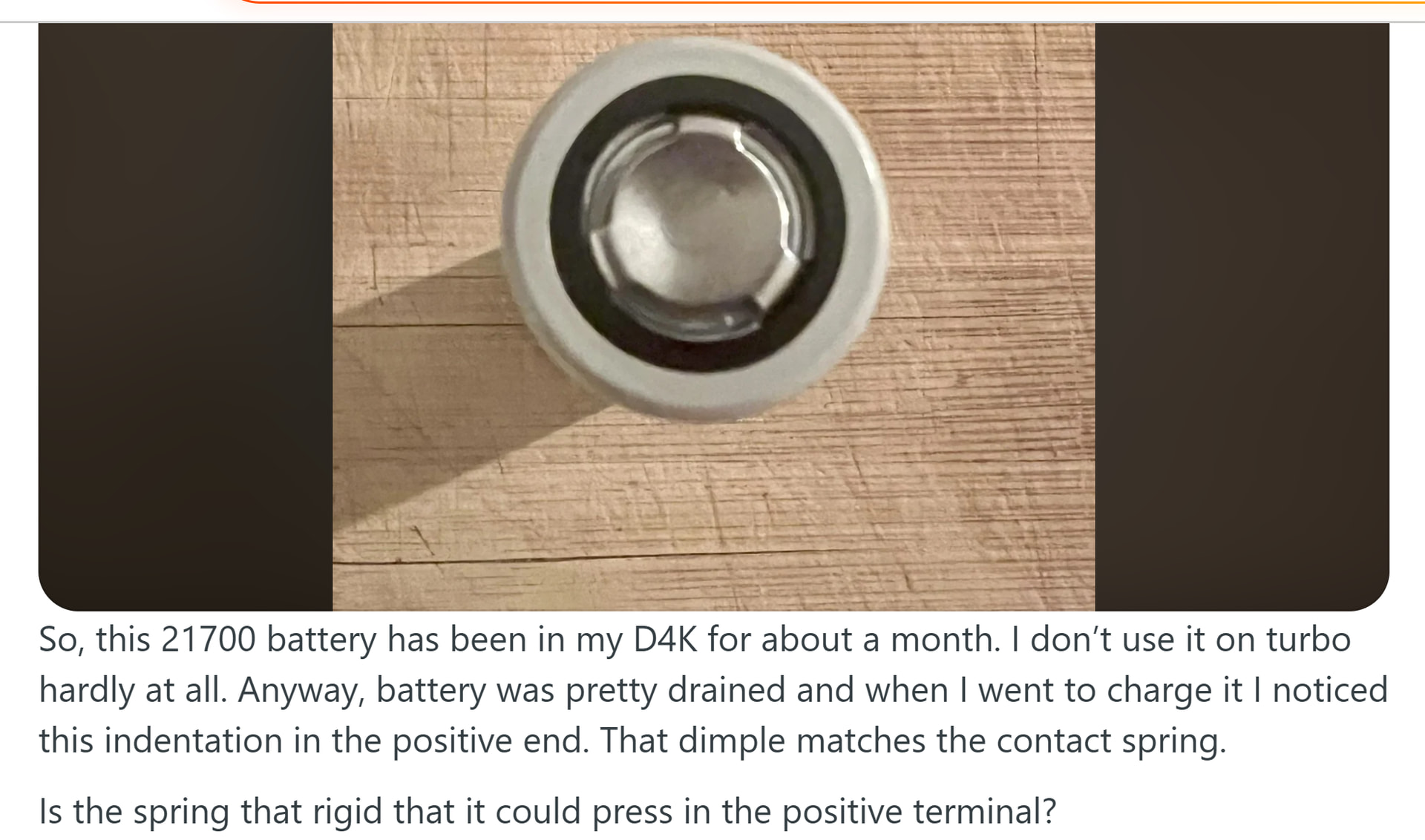
I had a similar case myself after dropping mine D4V2 with lume x1. To me that concerning design. I would rather vote for longer design and have more robust spring which allows improve drop resistance.

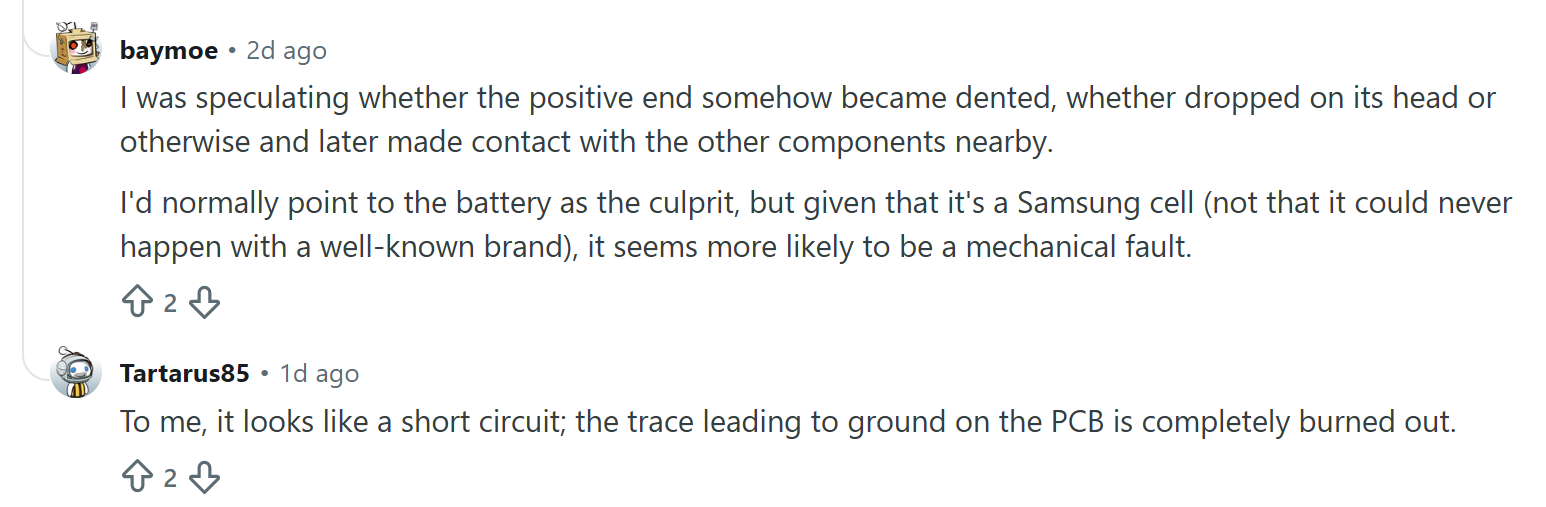
On other side people responded that per evidence we do not see melted main driver spring which usually the case when shorted:
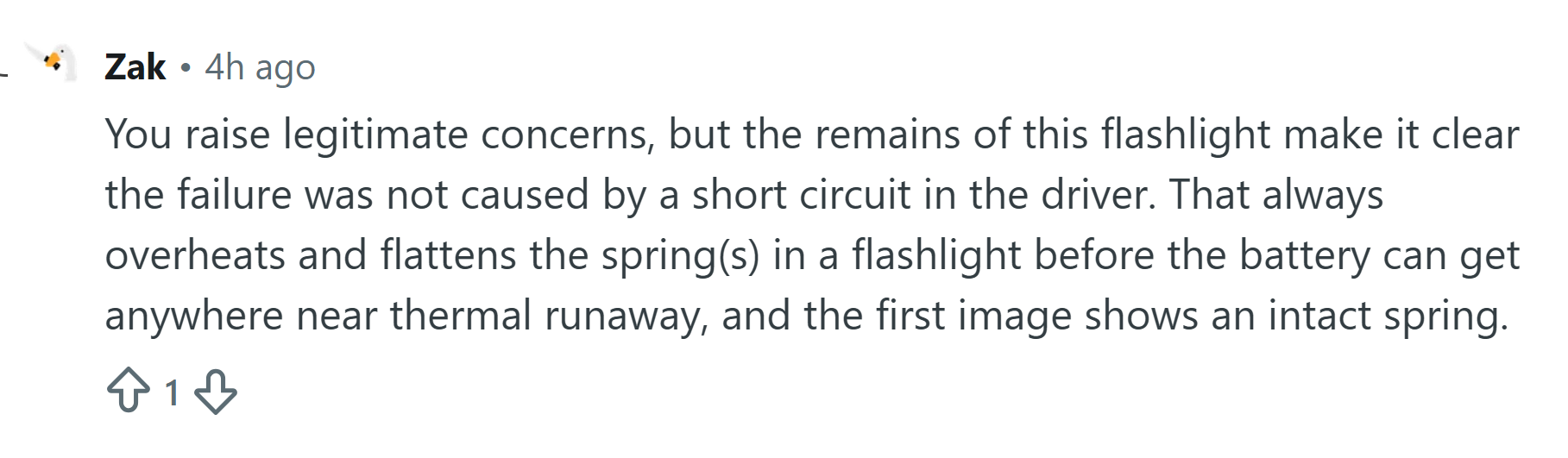
Hopefully we can get to the root cause. Meanwhile it looks I have to use tailcup lock more often to eliminate risk of driver short when unattended.

Main takeways in both incidents to me:

  • it better keep lights away from something easily flammable.
  • think twice to have 18650 or higher capacity flashlight near your bed.
  • quick reaction is a key
7 Thanks

thanks for the links

I dont think that would have prevented the two blown batteries you posted.. because I dont think the cause was the driver..

imo the cause is use of Turbo causing excess heat in the battery, and damaging it over time…

it turns out some Lume drivers have a very high thermal ceiling on Turbo:

“newer Loneoceans driver lights can reach that kind of surface temperature [80C] from a couple turbo activations. His custom Anduril build has a feature that ignores thermal management under 71°C in turbo.”

the only guess I have as to why the second light blew up, would be that the battery was damaged by getting it hot from using Turbo

but it is very worrysome not to actually have a good idea what went wrong, especially since the Boom was a delayed reaction, while the light was just sitting unused

7 Thanks

My money is on it was a driver malefaction first and then the battery vented.

Interesting discussion. Do you think this is an argument against using higher power cells and/or the new higher power FET turbo lume lights? The lume x1 turbos at 10a, but the lume 10 hits 30+ amps. The Lume N1 can get up to 32a as well. I read the Lume 1 is capped below 30a. Obviously, it wasn’t super high turbo current at play in the D1K explosion, but to the extent we’re talking about high current and/or heat related damage, things only get worse about 10a.

It certainly seems to be an argument against increasing thermal limit for anduril lights, provided that the Lume drivers actually implement thermal management properly!

This does seem like an incident worth looking more into. I don’t know if there is someone in the community who could investigate more to try to forensically determine what really happened but it could help improve flashlight safety.

2 Thanks

I’m not a member on Reddit but I just read all of the posts in that thread as of this time.

A few things that were pointed out in that thread that I think are relevant:

We don’t know the age of the battery.
That battery was introduced with a very high CDR compared to most everything else that was available at that time. Leading edge stuff.

My thoughts:
The flashlight taking off like a rocket was probably related to being stored on its head.
The end result could have been worse if it had been laying down because fire and flames could have gone elsewhere and set something on fire. I just don’t believe it would have punctured the ceiling or a sheetrock wall.
I have a habit of always shutting off flashlights in the lowest mode. I am not saying that would have changed things in this case but it doesn’t sound like this guy has that habit.
I would also question depth of discharge habits and charging habits.
Was the positive post dented a little a lot or not.
Has the battery ever been dropped.
Was the rapper fully intact.
I’m not trying to blame anybody.
I do not have that light or that battery.

3 Thanks

I had an AgO button cell go pop out of nowhere.

Calipers, button always stored separately in the clear plastic shell the whole beastie came in. Noticed that it started to swell that I couldn’t slide the cover onto the calipers, but it still had juice, so why not?

One night heard a loud pop like a firecracker, and a coupla seconds later, something hitting the floor. Tf?? Odd. Looked around, nothing.

Eventually found the spent shell on the ground, checked the calipers, and saw the slidey piece of cardboard was popped clean off its track. Finally put 2+2 together, and was quite surprised that a “safe” button cell can go boom.

Also, primary '123s in my MH10 started overheating and melted the wrap, even though the light was off.

Lucky I felt it getting quite warm and popped em out in time.

Damnedest thing…

The protection circuit can only protect you from external factors, but not if the battery fails internally.

4 Thanks

If that true I would be concerned a lot on how it is easy to degrade cells to a state when they are unsafe.

User reported the battery in question is - Samsung INR21700-50S
I found there link to its datasheet on convoy site - here

Per Samsung pdf provide I see it rated 25A for continuous discharge (and it expected that cell wont be heating to above 80℃ per its own internal resistance) and it can handle 45A if you ensure to do cut off when it reach 80℃.

For operational temperature it rated from 0 to 80℃.

Thank you for flagging it out. I remember it was discussed in Artemis thread:

78C on outside can easily mean it 90C on inside which is outside of battery SAFE range.

But if above hypothesis is true then it is a driver issue to me where driver design make it probable to degrade battery to a state when it can explode. Lume x1 driver only consumes up to 10A which is nothing for this battery but heat from leds/driver could be the cause. Otherwise product page should warn that only li ion batteries with operation range up to 100C should be used. But from quick search there no mainstream 21700 that can handle up to 100C. Molicel P60B states 90C as temp cut off but even it recommends up to 60C as normal operational condition.

1 Thank

If you ask me the problem here is temperature management and not the current per se. The cell in question is rated up to 45A in its spec if you ensure it do not exceed 80C temperature. So yes if these drivers inherit same firmware and @jon_slider hypothesis is correct then it will be even more prevalent/high probability issue since internal temperature due to lag could be even higher.

But generally I think you right with such high power battery and driver you AT MERCY of firmware to work correctly and as we know with software it can glitch. But at least with flashlight you have hands as temperature sensor :grin: and tailcup as emergency cut off.

That is true. But as @Oli pointed out above for “Samsung INR21700-50S” battery:

my idea was that rewrapped 3A CDR (14450??) cells are more mainstream and because of it being mass produced you have higher chance of getting good QC and design which proven with time. I am not expert but it is just common sense. So protection circuit here just additional perk. If you using something that rare and on the edge you usually taking more risks.

That what interest me as well.

Edit: found this → so no report of oblivious dent to battery

After reading that post, I took some lights I have for inspection. I was wondering that the Convoys with charging port are maybe a safe design in this case, because thebcharging port is communicating vessel with the battery case, so in a venting event the rubber cap will pop out and release the gases. The M3-c, specifically, has a big hole close to the charging port. What do you think guys?

Pointing out that this driver has a turbo temperature flaw is all well and good. However there is no reason to suspect or assume that this guy was running the light way past the point where he could hold on to it. Yes, he said he liked turbo. Some people don’t like turbo.

Again I’d really like to know the timeline. How long has he had this light and battery. Charging habits. Voltage when received, if checked at all, anything abnormal, if checked at all.

There are multiple things that people can do that are not good for overall battery health.
And that includes some things that I do with some of my batteries.
Again I’m not blaming anybody but not everybody should be playing with this leading edge stuff.

3 Thanks

One such thing I’ve read about people doing is “reviving” or harvesting dead or questionable cells just to save a few bucks…

Except, a Lume Driver on Turbo. And the light whose Samsung INR21700-50S blew up had a Lume driver and the owner commented that he likes to “blast Turbo”. Although he claims he does not use Turbo excessively, in combination with the Lume driver.. it was apparently excessive

Agree!

My present hypothesis to explain why the Samsung INR21700-50S blew up, is that:

The Lume driver allowed excess heat on Turbo, which compromised the Samsung INR21700-50S battery by exceeding 80C.

if that is true:
The solution is: Do Not use Turbo with Lume drivers.

Or, simply do not use lights in ways that exceed the Thermally Sustainable Output.. Which is why I disable Turbo on All my Anduril lights, and lower the Ceiling to 100/150.

1 Thank

I’m pretty skeptical that you could get a battery to 80 in a D1K or any lume light. Even if there is a flaw in thermal management (which I am still having trouble understanding because every single one of my lume lights steps down from turbo due to heat), how hot would it have to get before the battery gets to 80? The driver in question is capped at 10 amps, so it’s not like it was pulling 40a from the Samsung.

I don’t have an answer, but I don’t think it’s because this guy was blasting turbo enough to have heated the battery beyond 80c.

1 Thank

Maybe dont just speculate without evidence. If possible, please do your own tests w an IR thermometer, and share your actual data of the results.

and consider the info from these two highly knowledgeable posters:

bob_mcbob said:

“newer Loneoceans driver lights can reach that kind of surface temperature [80C] from a couple turbo activations. His custom Anduril build has a feature that ignores thermal management under 71°C in turbo.”

and Toykeeper said:

As you can see Toykeeper mentions an actual test of a Fireflies Z1 Artemis (with a Lume driver), that reports the Outside of the light got up to 78C!!!

iow, Turbo got the light 28C HOTTER than the thermal ceiling was set to.

1 Thank

jon you seem to be misinterpreting what mcbob and toykeeper said or referenced.
The battery is not going to get anywhere near as hot as the head of a flashlight.

And you are speculating without evidence that the guy was repeatedly hitting turbo.

In the example where mcbob shows a flashlight head at 71c, ( edit. 78.5c) I would estimate the battery temperature was 15c less and possibly closer to 20c less.
It depends on how long you are going to hold the flashlight up at that high temperature but the reality is the guy can’t even hold on to it at that temperature.

So I find it very unlikely that the guy in question had the head of the flashlight up that hot.

2 Thanks

exactly my point - I haven’t seen any indication of batteries getting to 80. I have numerous lume lights, have turbo’d them plenty and have not experienced third degree burns from holding the tubes. It is self-evident that my batteries have not gotten to 80c.

If the outside of the flashlight was 78 C, the inside (the LEDs in particular, but also the regulator chips) would likely be quite a bit hotter, like 100+ at the LEDs. The 78 C measurement was after heat has already spread out and reduced quite a bit.

In the thermal image, even the body tube was like 65 or 70 C, which suggests that the battery inside was probably at least 70. And the battery’s rating isn’t a hard limit… it’s an arbitrary point along its curve for an average cell. Getting close to the rated limit is going to be unhealthy for it… just not as bad as exceeding the limit.

High-power turbo is hard on torches. It significantly reduces the life span of the LEDs, the battery, and often other components too. LEDs are typically rated at 50,000 hours of life at a particular power, temperature, and humidity… but the life span varies greatl depending on conditions. Like, a hot-rod turbo light may have LEDs burn out after just 50 hours, while a light driven at only a tiny fraction of its rated power could last for a million hours.

… and similar story for batteries. Fast-charging or fast-discharging it reduces the life span quite a bit, and heat makes this effect stronger. Also, fully charging or fully discharging it reduces the life span. It’ll stay healthier when kept closer to the middle, like 20% to 80% full.

Anyway, the unfortunate thermal regulation behavior doesn’t affect all Lume lights. It only affects the ones with loneoceans firmware with the “turbo temp extra” flag enabled. That’s the bit which makes it ignore overheat conditions until it is already well past the user’s configured temperature limit. It was added to make turbo stay at full power longer… but as a side effect, it also makes the light greatly overshoot its thermal target, and increases the risk of damage to the torch or its battery.

I haven’t merged that patch into my repository, and don’t plan to. My firmware releases aren’t affected.

To tell if your light is using loneoceans firmware, use the Version Check function (15+ clicks from off). A loneoceans build blinks out a model number, then a “buzz”, then blinks out a seemingly random series of numbers and "buzz"es. The version check format is:

  • My builds: MMMM-YYYY-MM-DD (model number, then date)
  • Loneoceans: MMMM-REVIDNO (model number, then git revision ID, hex number where A-F are shown as a “buzz”)

Or to be safe, on any high-powered light, take care of your batteries and try not to use turbo much. To help with this, Anduril can be configured to disable turbo. It’s usually fairly safe to set the ceiling to 130/150 or maybe 120 or even 100, and also disable turbo so a double-click goes only to the ceiling. On an affected light though, even just lowering it to 149/150 (with turbo disabled) would be enough to avoid the “turbo temp extra” behavior, because that only activates at full power.

6 Thanks