Sorry for the avalanche of questions - just one more: what could be the current draw for, say, SFT40 spot at Turbo and then at constant High? Would a about 5-6A and around 2A respectively be far off from the expectations?
I just got the light  One solution to this dilemma is breaking the circuit by turning the battery cap a quarter turn momentarily, which deletes all 4 memories and resets them all to default (Low).
p.s. I just wanted to add that the default ‘Low’ settings for all modes are already pretty practically usable brightness-wise without a need for adjustments.
1 Thank
Based on @koef3 runtime plot on Turbo, the HS21 with the standard Sofirn (nominally 3 Ah) battery has the ‘luminous efficiency’ (it’s got to be a better name for it) of around 1100 lm·h in Spot, and around 1000 lm·h in both Flood and Flood+Spot. It’s possible that these numbers could be up to 50% higher at lower discharge rates.
I wonder: does the HS21 have a thermal sensor, or is stepping down in high modes based on a timer?
Since the HS21 shouldn’t be submerged I cannot tell. I think there is some sort of temperature sensor but in the runtime charts the stepdowns are timing controlled.
1 Thank
Not sure if I’m reading it right, but for the tested Turbo the Sofirn’s runtimes seem to match what you’ve reported closely enough?
How heavy is it on the head? On paper it is 87g without a battery (vs 50g Skilhunt H04), but how does it feel? Is it too heavy for running or long hikes?
The light w/battery weighs about 135 g. The strap + top strap + bracket is another 35 g.
I’m used to the Nitecore NU25(2017) which, with a shock cord, is 45 g total - so yes this one is a tad heavier :-), but…
Despite reports, I find the head strap to be supple, comfortable, yet firm enough and removed the top strap which annoyed me. But I’m not running.
One more comment that may help is that the clip-in bracket supplied is solid and the angle adjustment ratchet(?) is super solid to a point that turning the lamp requires two hands - one to hold the bracket and the other to adjust the light position - so I don’t see the light turning around by itself.
1 Thank
Here is @Weerapat_K running with it:
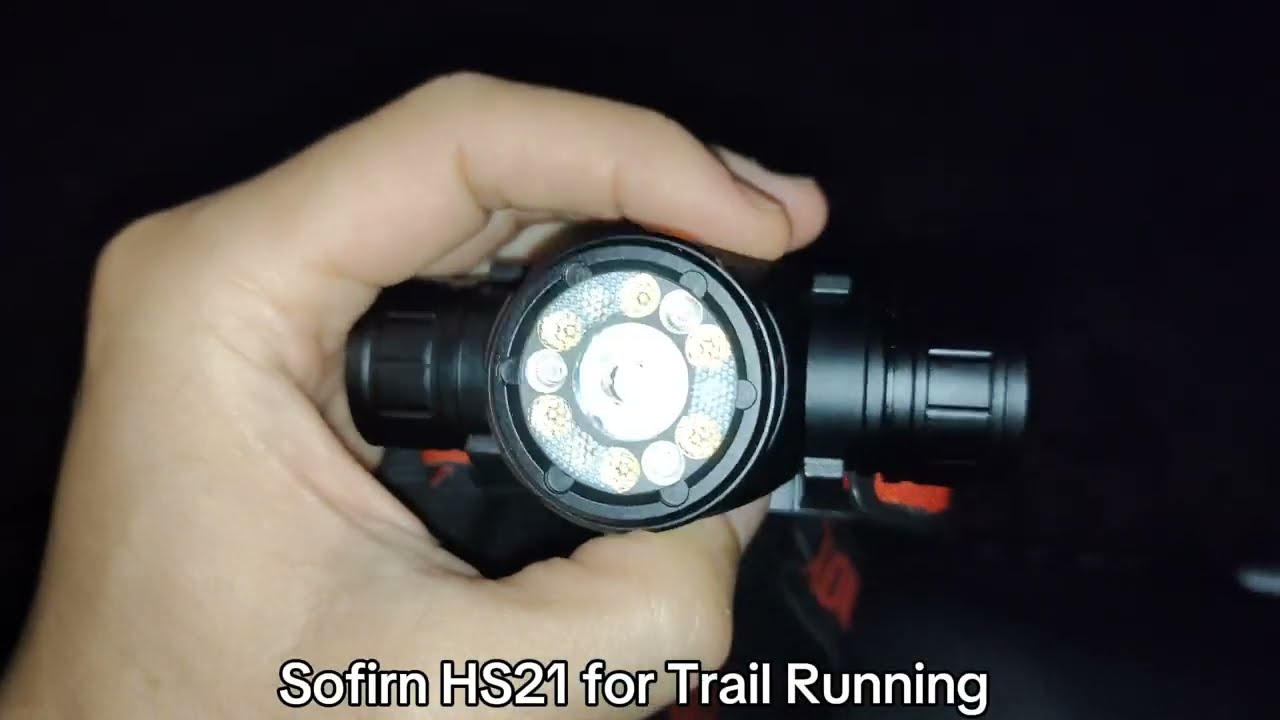
p.s. He mentioned somewhere that he uses Skillhunt headband with it instead of the original one.
2 Thanks
If you want 3in1 headlight , better check HS42…
If it only had an 18350 short tube available, it could be great for running I imagine…
1 Thank
Thanks to all the initial reviewers. I was planning to buy one, but it looks like Sofirn really missed the point of having an IR controller - to be able to reliably turn the light off AND on. I have an old headlamp that can do this - and it works well.
A little more engineering could have gone into the IR design to eliminate ambient light interference. And it baffles me why one would design it so that it cannot be turned back on via IR. Adding a simple timer to power down the circuit if the light has not been turned back on via IR within a preset time period would prevent battery drain.
1 Thank
In defence of HS21: it seems to be an excellent light even without the IR, and I, as others may have, received and immediately tested the light on a sunny afternoon - the IR, and indeed the light, tend to work better at night :-).
It may be tricky to implement turning the light on again with proximity sensors even if done on a timer, I think, because once the light is off I would expect it to stay off even if I put it back in a pocket or a bag which the IR may misunderstand.
My dream UI would be getting rid of both IR and the top button and replacing them both with a second turn dial on the side controling on/off and intensities. Two dials only - no more double, triple, hold clicking, memory per channel dilemmas and the like. Fast, simple, usable, intuitive, and satisfying. Oh, dreams…
2 Thanks
Did you have a chance to do a runtime on High? The reason I’m asking is that, just like you said, I would expect the High to behave just like Turbo sans 2 initial minutes of Turbo, but the manual suggests some strange timings for more stepdowns on High.
1 Thank
I have used the HS21 for a few days now. There are already better reviews of this light than I can provide by @Weerapat_K here, bicycling here, and running with it here. @koef3 has contributed the first runtime test on Turbo for it here and contributed all kinds of useful comments earlier in this thread. @macomako posted several observations here. @zeroair published a review here and so did @darrenyeo here. @PiercingTheDarkness became yet another fan of this light here. @TimMc review here. @1Lumen review here.
I’d like to add a few comments on the light, some not new, but never summarised. In random order:
General
- The front rotary dial for modes is brilliant and intuitive. Adding a second dial on the side to replace the IR and the on/off button manoeuvres would be a blessing (IMHO)
- The Sofirn strap is nicer than its reputation would indicate - I removed the top part and it still holds well and is comfortable despite the reality of the 18650 headlamp heft.
- It is true that there is no glass lens in front of TIR and that the o-ring under the battery cap is rather slender. I don’t thing it matters much.
- Undocumented in the manual is double-clicking from on in any white mode which brings (rememberable) Turbo. Double clicking in the Red mode turns on ~0.5 Hz blinking on High instead (that’s documented).
- Green or Red will illuminate the switch for 5 seconds when turning on the light, to indicate the battery capacity left - Red indicating less than 60%. When the voltage gets very low, the Blinking-Red flashes constantly when the light is on to indicate imminent need for recharging.
- The clip-in hard plastic bracket works well, but it’s stiff enough to generate high tensile stress on the base of the bracket when clipping and unclipping the light from it. My bracket cracked fairly quickly. Those brackets are standard and can be bought on line easily, but it would be nice if they were made of some tougher compound or designed slightly differently to toughen them where needed.
IR proximity sensor
- It works well enough at night. Yes, in the daytime it may be activated by a stray sunlight from e.g. a window, but does that really matter? It can be kept off anyway.
- Despite the ‘accusations’ I don’t find light from other flashlights being capable of activating the HS21 IR sensor at night, possibly because, unlike the sunlight, the LEDs don’t emit much in the IR renge.
- Waving back and forth in front of the IR sensor works fine, but momentarily tapping/covering it by hand (for less than a second, but no longer than 3 which turns the light off - more than 1 second and less than 3 does nothing) works as well.
- The IR waving, just like button-holding, changes the intensities in a circular fashion - i.e. always up, and then ‘around’ down from Turbo to Low, then stepping up again, or L-M-H-T-L-M-H-T-L-… Having 4 levels to cycle through is a little awkward (e.g. if I want to decrease the brightness from Med to Low, I still have to wave through High and Turbo first - it may be easier with creative button techniques: click to off, long-click to Moon, let go, and long-click again to Low). I found that it requires a lot of waving to get what I want, especially when you overshoot the desired level, which is not that hard to do. The second intensity dial, if implemented, would be more direct and intentional, I think.
- In tight spaces like house doorways or a maze of a basement under an apartment block the IR sensor may sometimes be activated by passing close to other solid objects - just don’t turn it on.
- Be careful when the IR is active (and, again, it doesn’t have to be, the light works just fine without it) when using the right hand to turn the front mode dial, as you can inadvertently cover the IR sensor as well and make it react.
- If you don’t plan on using the IR sensor, covering it with strong, opaque tape should prevent accidental activation and may have the added benefit of lowering parasitic battery drain.
The front rotary dial and memories
- The dial is brilliant and unique. It allows for quickly and intuitively switching between the 4 LED combinations and thus beam patterns. Each of the 4 modes has an independent intensity memory (including moonlight and turbo), which I like, and @koef3 does not.
- I like it because I can set each of the 4 dial positions to the light level I want (I normally set Spot to Turbo for spotting, Flood to Low for say camping/cooking, Flood/Spot to Medium for comfortable walking/biking with peripheral illumination, and the Red to low or medium (in addition to being better than white for preserving night vision at higher intensity, it’s calming and less disturbing to others, I think). This way it’s only the front dial that needs to be adjusted for different light needs - no need to fiddle with the button clicking or IR gestures.
- Another setting (say at night camping, trying to avoid annoying others around you and preserve dark adaptation): I set all the 4 modes to moonlight (at 2 lm for white modes and 0.5 lm for red) - pick a mode, long click from off, then regular click to turn it off, change mode, repeat - takes 10 s. Overall, the independent memories are satisfying and flexible, I think.
- Whether you like the independent memories or not there is a neat trick - turn the battery cap a quarter turn momentarily to brake the circuit, and all the 4 memories go back to the default Low modes, which are useful in their own right without any further adjustments at reportedly 2, 30, 50, and 100 lm at a flick of a single dial. A win-win situation.
The beam
- The Spot is unusually concentrated for a headlamp at some 10 cd/lm (translating to intensity of around 15,000 cd in the centre on Turbo). This soft centre spot with some spill is great for mid distance spotting and not too narrow for a headlamp either. And the wider diffused Flood (some 1 cd/lm) can be combined with Spot or each used alone - so lots of options.
- The Flood is really nice high CRI neutral, dispersed light. Nothing to change.
- Despite concerns, the combined Spot+Flood (spot being 6500k and flood 5000K) don’t look that mismatched - the Spot mostly wins and the Flood just add a little warmness, colour, and peripheral vision, which is great. That being said, I wonder if using the SFT40 5000K for the Spot emitter wouldn’t work even better.
- The Red has unusually large range of brightness, ranging from some 0.5 lm to 100 lm (and a bright ~50 lm/~0.5 Hz blinky). The red LEDs are probably the ‘regular’ ~620 nm peak red (as opposed to deep longer-wave red, peaking at some 660 nm), which is, according to this paper, just fine as it seems that the particular dominating wavelength in the 600-700 nm range makes little difference in terms of the dark adaptation time after exposure to red light, as long as it’s not too bright.
Room for improvement
- There may be little things here and there, but I think the major usability improvement (and unique at that) would be adding the second on/off+intensity dial on the side, as I probably mentioned before. Such light wouldn’t even need a manual - the front dial changes the light sources - the side dial turns it on and off and regulates the intensity. Another win-win and probably resulting in more robust and waterproof light as well.
6 Thanks
Thank you for the excellent details, very helpful.
Im looking forward to receiving my HS21, the rotating front selections really appeal to my rotary UI interest.
Great Idea!
otoh, Im curious to experience the motion activated switching… has some advange when hands are dirty, for example working under a car, to be able to change output without getting grease on the headlamp controls… Remains to be Seen… 
Would you approve this idea:
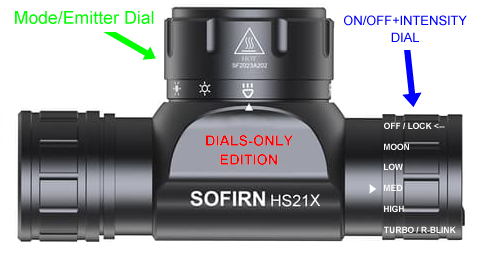
The side dial could have and indent at the OFF position to push it in and lock the light. You would pull it out to unlock and turn normally to adjust the intensities. I’ve seen such locking dials before. If this is too difficult to implement, a normal indexed dial would work just fine, and the battery cap quarter turn could lock the light anyway.
7 Thanks
It may not end well - too many obstructions on which the IR sensor can lock.
Would one of you fine folks be willing to put a piece of electrical tape or similar sealing cover over the IR sensor, activate the IR mode, and see if it disables/blocks it from doing things?
So far I like the form factor, the modes, generally the UI, love the idea of the dial.
And verry thankfully for me the mode memory is indeed per channel. Everything really looks good except the dumb IR.
For me;
rotary switch Headlamp, great!
IR switched Anything, especially Headlamp; STUPID.
And while I’m verry encouraged that IR can be turned off( really Sofirn, you never mentioned that from the start, it took a release and reading the manual download to know it can be deactivated-- its not even mentioned anywhere on the product page for buying thd light!)
While that is great, I’d really like to know if the sensor could be covered and completely avoid it ever taking input.
That accidentally activating and changing the light mode, or on/off could get me seriously hurt or killed. Especially having read here how sensitive it can be to the environment, I’d need a way to circumvent it.
That looks Great to me, Except, I’d want to add a 3rd control; a separate on/off switch. Big button up top would be great. Or stick it on the left end cap.
I’d want to be able to select channel without turning the light on, but also select output without turning it on! Mode memory basically.
Could rotate front dial for flood/throw, side knob to needed output, and then turn on when needed.
Yes, I know I’m picky.