I have print-out of an old Anduril manual, a really old one with font that looks like it’s from the dot-matrix era . It’s possibly written by @ToyKeeper? Under "Ramp Config Menu’ there’s a note about default ceiling and floor level:
Smooth ramping: Floor=1/150, Ceiling=120/150, Ramp speed=1 (fastest)
Stepped ramping: Floor=20/150, Ceiling=120/150, Number of steps=7
But also: “Default values are different for each model of flashlight. The numbers above are only examples…”
Also another note that’s related to our discussion of Simple mode’s max level:
“Simple UI has all the basic functions needed to work as a flashlight, but the minimum and maximum brightness are limited by default to make it safer…”
I didn’t pay attention to this before because I’ve never set any light in simple mode. But now that I think about it, this might be automatic & universal in Anduril lights, including our Wurkkos TS10. Still learning all these interesting “hidden” details in Anduril after all this time.
That was true in the past… but the ramp shape has been refined and recalculated, the latest firmware uses ceiling 130.
I verify ceiling by looking up the firmware specifications, when possible
more reliable, for me, is I actually measure the ceiling output on my meter, and then manually set the ceiling to 130 (or 120), and reverify the output on my meter.
btw, to set ceiling to 130,
First I clic 1 time: 1C,
then do two separate press and hold: 1H, 1H (each 1H = 10 clics)
Likewise Jon. You’re always a GREAT source of information, especially when it comes to Nichia.
From a few casual measurements of Turbo output from the 2 different batteries: the no name battery drops all the way 50-60% of output of Vapcell H10 (1100 lm). So I guess this is one way to protect our Wurkkos TS10: use no name battery?
I took the TS10 for a walk this evening. The beam looks really, REALLY good throughout, surprisingly not green at all even at low level. The TS10 is teaching me the usefulness of 100 lm. I like it.
this could be because of the batteries having different CDR (Continuous Discharge Rate)
the stock battery has a 3A CDR
the H10 has a 10A CDR
Ive had similar thoughts…
I disable Turbo, and lower the ceiling to a max output of about 350 lumens. So for my use pattern, a 3A CDR battery works fine, and I dont have to risk burning LEDs by using Turbo with an H10. I dont use my TS10 at outdoor distances, its not good at that… It works great for me indoors.
BTW, theres a new TS10 that is much better outdoors. Its called the TS10SG. I highly recommed you treat yourself to one.
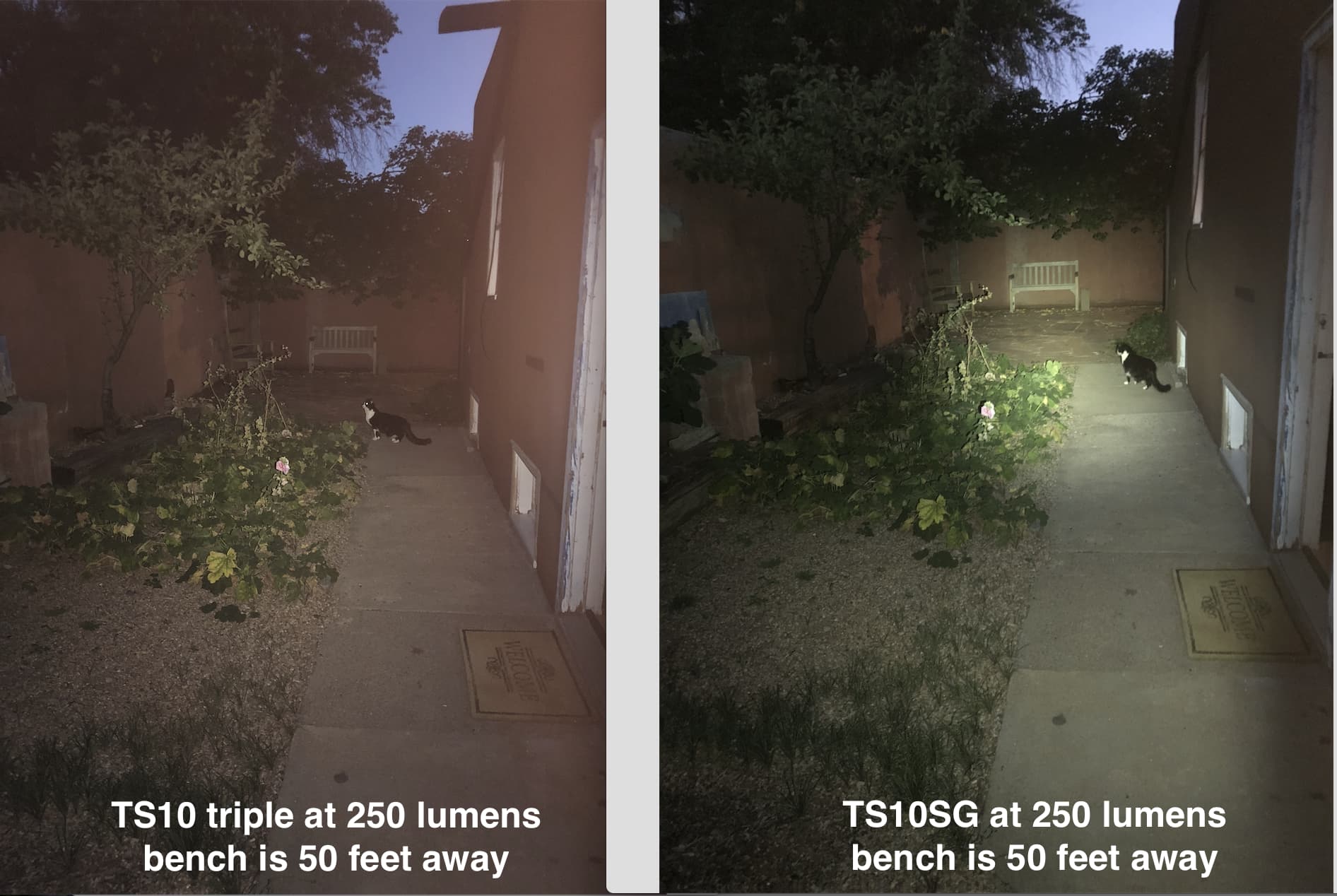
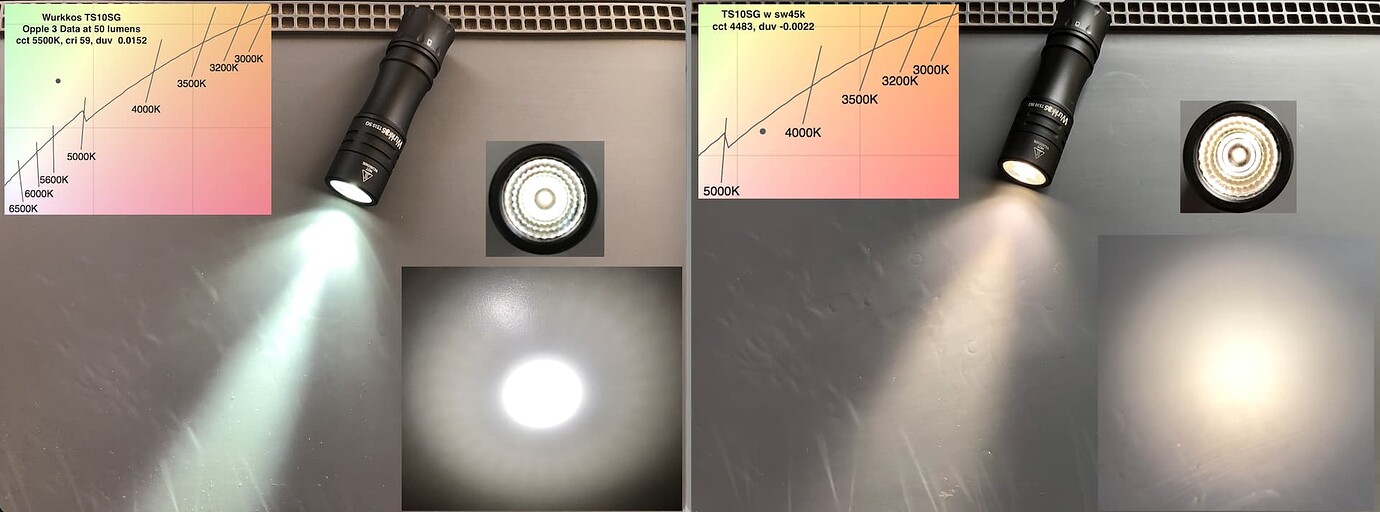
TS10 compared to TS10SG, trying to illuminate a bench 50 feet away, with 250 lumens:
The TS10SG beam is much more focused and works much better to reach past 30 feet. This is one of the few times you will catch me recommending a light with a Low CRI LED
Thanks Jon but wow that TS10SG is greener than green. Is that SFT25? I can’t take that. I think every discussion of a light with SFT25 needs to start with how green it is.
I don’t even know where my blue no-name battery came from. Probably some junk stuff I bought. If you opt for battery, what does TS10 come with? A Wurkkos label 14500?
A couple questions pls:
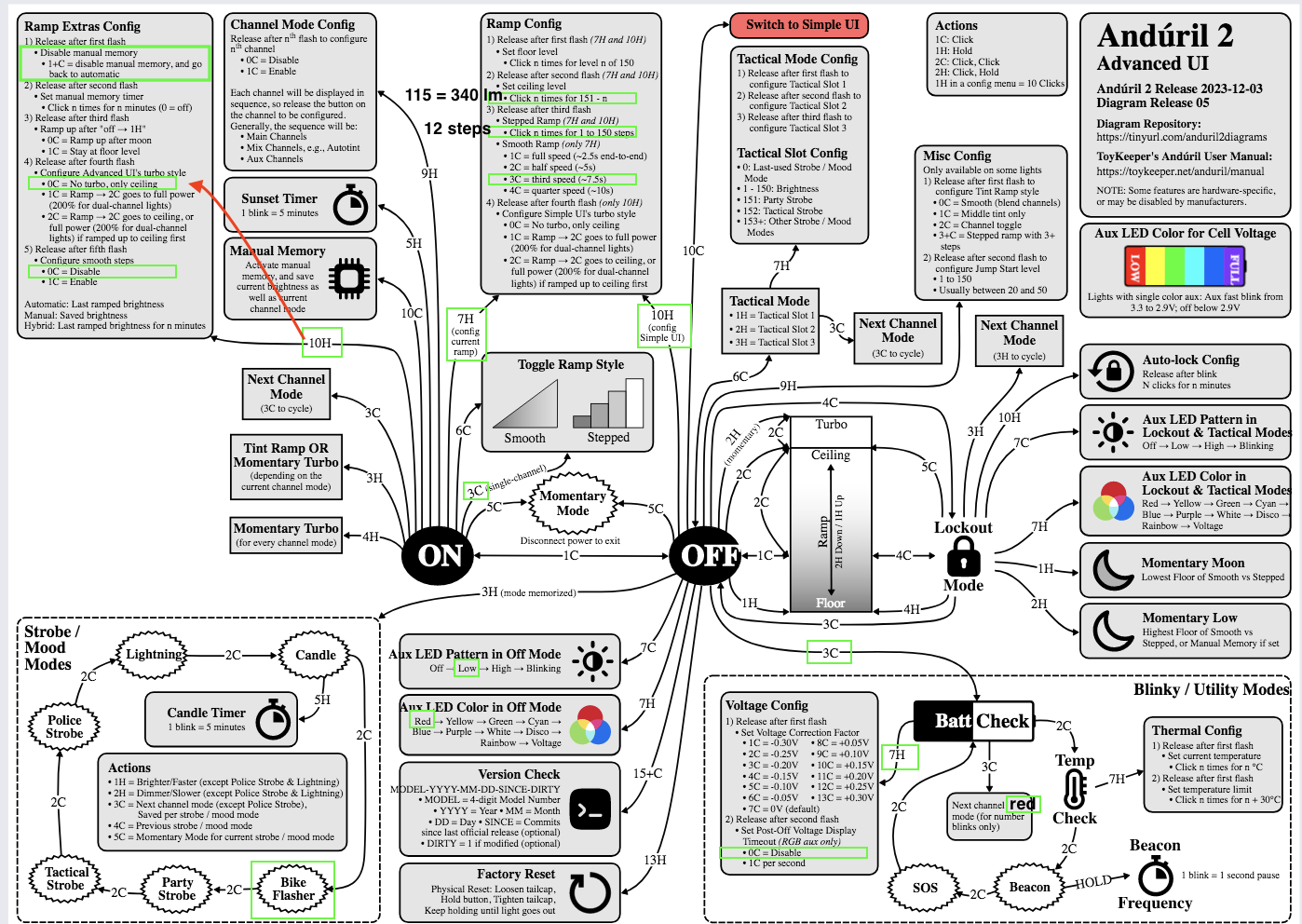
How to kill Turbo? Is that 7H from on, then release after 4 flash?
This new Anduril diagram that I got I think from your post somewhere (?), is showing 10H to go from Advanced to Simple UI. Shouldn’t that be 10C? 10H is the other way, Simple to Advanced, no?
yes, the green tint is what keeps me from using it, though outdoors at night the green tint is not very noticeable. Im planning to try swapping in a different LED.
yes
the light must be in advanced, then
from ON do 10H
release at 4th flash
do nothing else, just let the light finish flickering
here is a chart that shows the Turbo options, top left, (red arrow) in the Ramp Extras Config menu
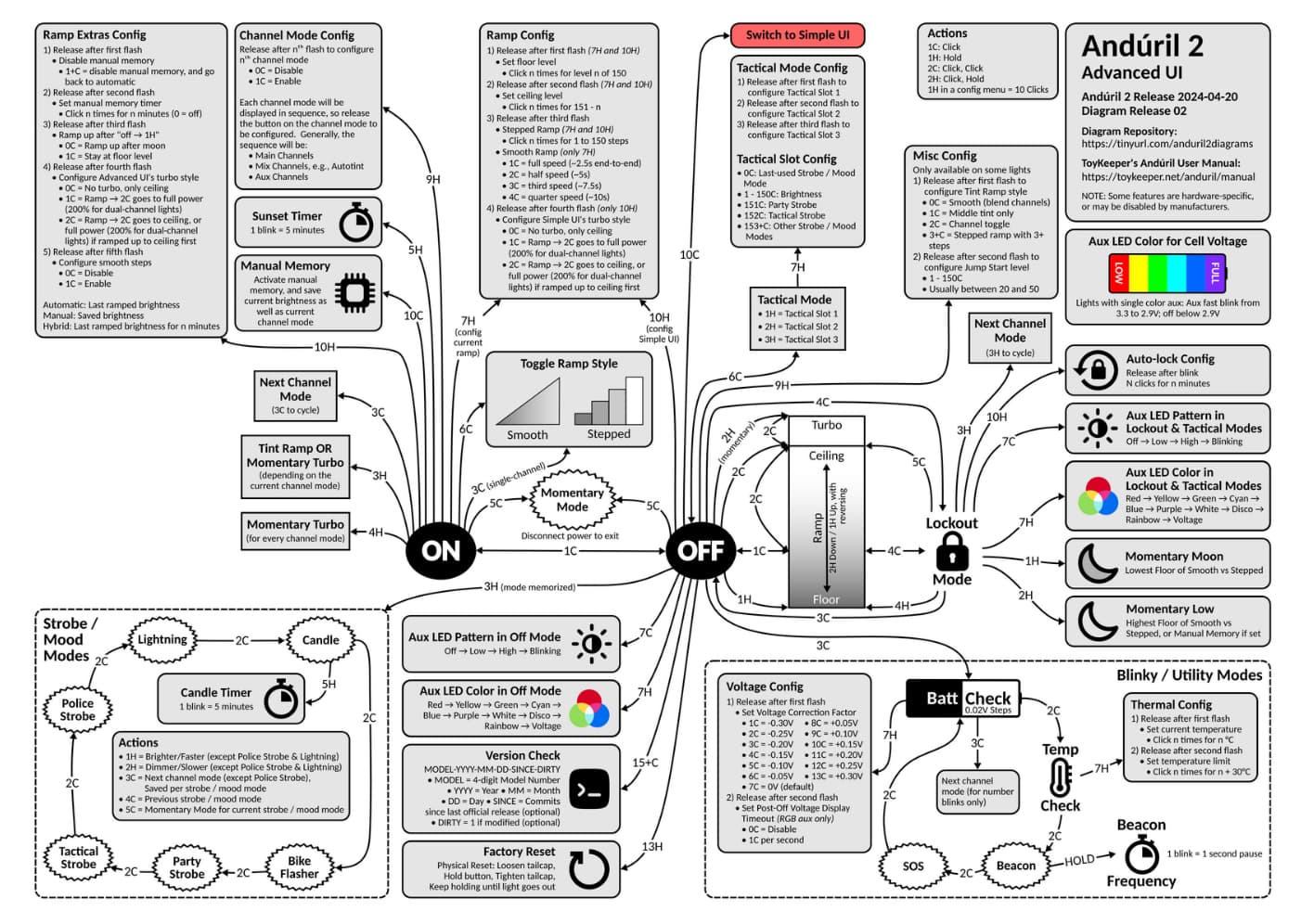
Thank you for sharing your cheat sheet! Just for your quick visual information (you may already be aware of this): Your cheat sheet is displaying a different font from containerfan’s original diagram, and this different font does not really fit the diagram layout.
My guess is that you went with the SVG file format, but you do not have the Carlito font installed on your system. This is actually why the first point in the Credits section of containerfan’s Readme states: “It is necessary to have this font installed for the source SVG files to be displayed properly; however, this is not necessary for the exported PNG and PDF files.”
Thank you, appreciated! I have been sharing a link to my flowchart on a couple of occasions I saw fit here on BLF, and of course, for those interested there is always the good old diagram thread started back in the day by Lux-Perpetua.
Looking good! When it comes to file formats, I tend to work with PDF a lot, because it is infinitely scalable and never looks blurry. So printing on paper always looks crisp, no matter which size, and on-screen you can zoom in and then take a screenshot of a detail, and it will also not look blurry, as PNG would at some point.
Interesting that the tint is so green on that sample. I have several lights with the SFT25 including, most recently, TS10 SG, NLIGHTD E1, Acebeam TAC 2AA, and Fireflylite X4 Stellar. Only the Acebeam has a very slight green corona around the hotspot and that is not noticeable in outdoor use. The rest produce pure white light, in my estimation, even on the lower levels.
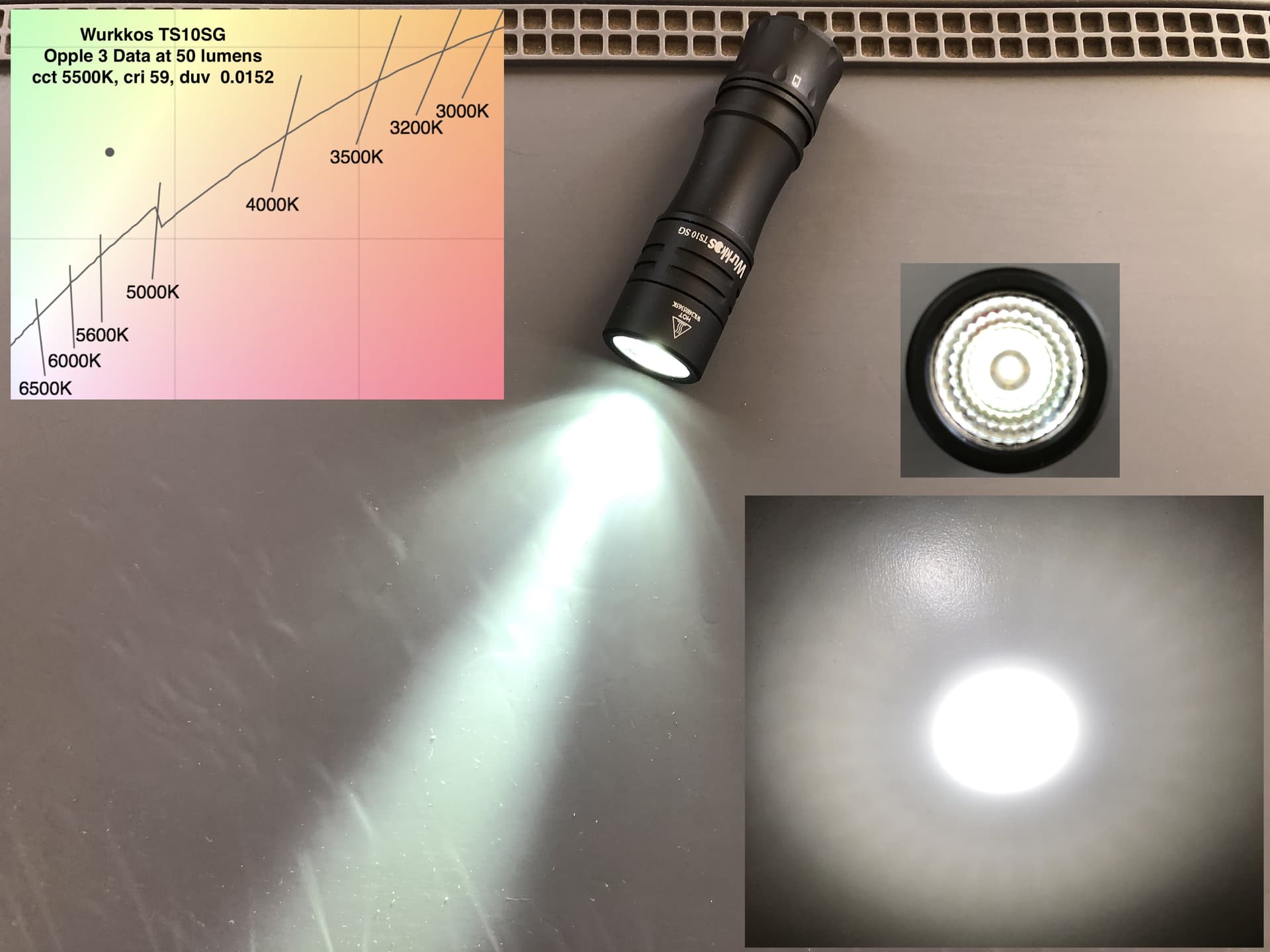
green tint is normal for Low CRI LEDs. When used outdoors they just make foliage more vibrantly green… LOL… here is the Opple 3 result on my sample… others will vary (and I dont consider my result “scientifically accurate”):
Sure yes you wouldn’t hear an argument from me. Both of my Wurkkos SBT90.2 lights have Duv 0.0050 and “act” accordingly. I tell myself 1 km throw, 4800 lm, just shut up and enjoy the “show.”
Advanced UI SMOOTH ramping ceiling = 800 lm (average of 4 measurments), looks to be the same as Turbo-1 (1 level below Turbo - sorry if my unconventional naming confuses) of STEPPED ramping.
Correct and highest is Turbo, which seems to be highest when you double click from level 1, as opposed to double clicking say from Level 6. The battery probably takes a hit from level 6, so Turbo to follow is not as high. Just a theory.
This is a very finicky light to measure outputs because it steps down so quickly. The hot and tiny space, lack of mass, and the small battery contribute.
A lot of “seem” and some “uncertainty” because now that I know what’s going on I don’t want to repeat Turbo test too often. In a light that is so finicky wrt output to begin with. Glad I posted here; I learned a lot about this light from the discussion.
This might also be of interest for owners. The “steady state” level of TS10 appears to be Level 4 of Advanced UI, ie around 95 lm. In other words, during my walk, were I to start at any higher level say 800 lm, TS10 would step down to a certain level and stay there, and at the end of my walk when I’m home and measure that output level that TS10 likes to step down to, it is around 100 lm.
thanks for sharing your observation of how deep the output drop is.
that is the highest Regulated output and corresponds to level 90/150. It uses the Linear 7135 chip. Outputs below that are also Regulated by the Linear chip
Above that level the FET comes online, and output is unregulated and will decline as battery voltage drops, even when heat is not the issue, and the thermal stepdown is not in play.
I think if you were to use a lower starting output, instead of 800 lumens, (so the light does ot become heat soaked so thoroughly), the sustainable output could be higher.
For example with a 200 lumens starting output, you may find the TS10 can sustain closer to that 200 Lumens for the duration of your walk. Instead of declining from 800 to 100 lumens.

 . It’s possibly written by @ToyKeeper? Under "Ramp Config Menu’ there’s a note about default ceiling and floor level: